Mail Compliance Management for Property Managers
Discover effective mail compliance management strategies for property managers. Ensure security, meet regulations, and protect resident data.
Published

Mail compliance management is the process by which property managers and facility operators ensure all mail and package handling meets regulatory standards, security requirements, and operational best practices to protect sensitive resident data and fulfill legal obligations. For multifamily housing operators, this means more than sorting packages correctly. It means building a documented, auditable system that covers every step from data ingestion to final delivery. Frameworks like the GLBA Safeguards Rule and NIST CSF 2.0 now set the bar for compliance in mail systems, and regulators expect evidence of control effectiveness, not just written policies. A qualified individual must oversee the program, and that oversight must be continuous, not a one-time setup.
What are the key regulatory requirements for mail compliance management?
Property managers operating in multifamily and student housing environments face a layered set of compliance obligations. These requirements govern how resident data is handled, stored, and transmitted throughout the mail and package workflow.
The most relevant frameworks include:
- GLBA Safeguards Rule: Requires a documented risk assessment covering all stages of mail production, from data ingestion through final mailing. The rule mandates a designated qualified individual to supervise the security program. GLBA risk assessments must address confidentiality, processing integrity, and access controls at every step.
- NIST CSF 2.0: The FFIEC’s Cybersecurity Assessment Tool was sunset in 2025. NIST CSF 2.0 is now the preferred framework for third-party cybersecurity and ongoing risk management. Property managers must align their mail compliance programs with its continuous risk management requirements.
- SOC 2 Type II reports: Regulators require independent audit reports covering a 12-month period to prove that security controls are effective, not just documented. SOC 2 Type II reports confirm confidentiality and processing integrity in mail operations.
- HIPAA and Business Associate Agreements (BAAs): Healthcare-related mail requires executed BAAs specifying encryption standards, access controls, and breach notification timelines. There is no federal HIPAA certification. Compliance is demonstrated through executed BAAs and SOC 2 reports, not a certificate on the wall.
- State privacy laws: Several states have enacted their own data privacy statutes that affect how resident personally identifiable information is handled in mail workflows. Property managers must review applicable state requirements alongside federal frameworks.
Compliance in mail systems is not a single checkbox. Each framework adds a layer of accountability that requires documented evidence and ongoing management.
How can property managers operationalize mail compliance effectively?
Turning regulatory requirements into daily practice is where most property managers struggle. The following steps build a functional compliance structure that holds up under audit.
-
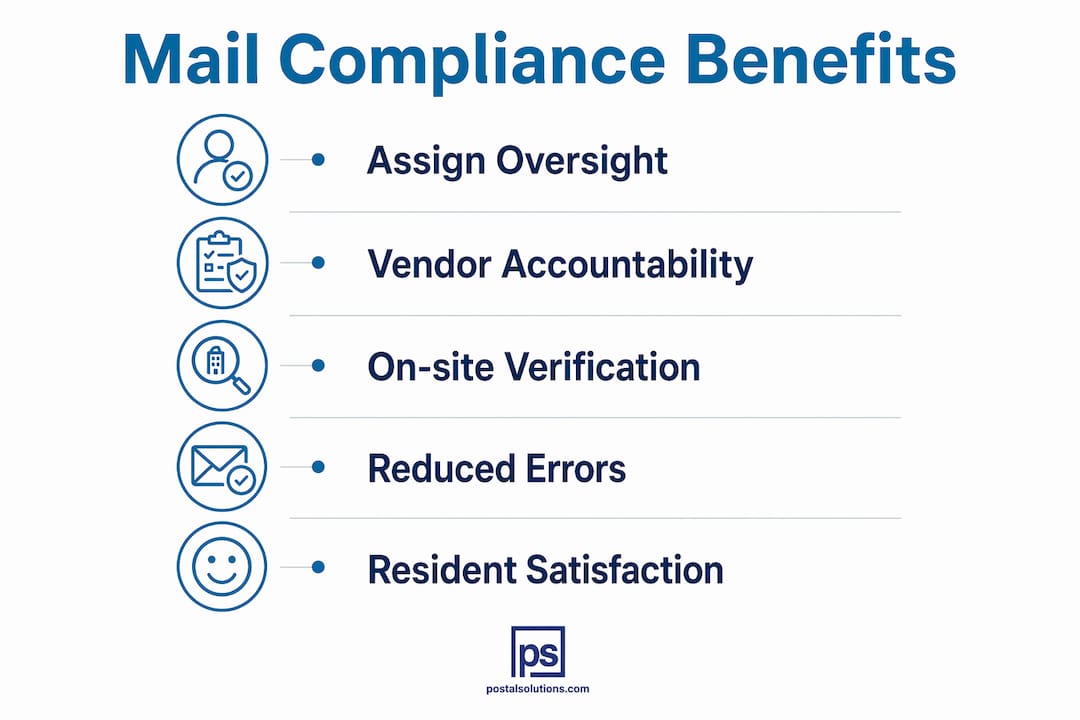
Establish a single chain of custody. Use vendors who handle the entire mail production process in-house. Subcontracted production introduces uncontrolled handoffs that regulators flag as compliance gaps. A single chain of custody eliminates those risks.
-
Require on-site USPS verification. Before mail enters the postal stream, a USPS inspection should catch barcode errors, postage discrepancies, and sortation mistakes. On-site USPS verification is a critical control that many operators overlook until a delivery failure triggers a resident complaint.
-
Document risk assessments across every production stage. Risk assessments must cover data ingestion, printing, insertion, and mailing. Each stage carries its own exposure points, and regulators expect written evidence that you have identified and addressed them.
-
Implement role-based access controls and encryption. Encryption and access controls protect personally identifiable information at every stage of the mail workflow. Only authorized personnel should access resident data, and that access should be logged.
-
Maintain audit logging and quality control workflows. Audit logs create the paper trail regulators demand. Quality control checkpoints at each production stage catch errors before they become compliance failures.
-
Coordinate production timelines with regulatory deadlines. Notices like lease renewals, rent increases, and legal disclosures carry legal delivery deadlines. Build production schedules that account for USPS transit times and verification steps.
Pro Tip: Appoint a qualified individual specifically responsible for overseeing your mail compliance program. This person should conduct regular reviews, not just respond to incidents. Regulators treat the absence of a designated compliance lead as a structural deficiency.
What are the common challenges in managing vendor compliance for mail services?

Vendor relationships are the most common source of compliance failures in multifamily mail operations. Property managers often assume that hiring a vendor transfers compliance responsibility. It does not.
Key risks and how to address them:
- Subcontracting without disclosure: Some mail vendors outsource production to third parties without notifying clients. This breaks the chain of custody and creates audit gaps. Require written confirmation that all production occurs in-house.
- Insufficient audit documentation: Policy documents are not proof of compliance. Regulators like the OCC demand independent audits proving that controls actually work over time, not just that they exist on paper.
- Lack of regulatory knowledge: A vendor who cannot explain GLBA, NIST CSF 2.0, or SOC 2 requirements is not equipped to support your compliance program. Evaluate vendors on their regulatory fluency, not just their pricing.
- Missing BAAs in healthcare contexts: If your property handles any healthcare-related mail, every vendor touching that data must have an executed BAA in place. Missing BAAs expose you to HIPAA liability regardless of the vendor’s internal practices.
- No ongoing risk assessment process: Vendor compliance is not static. Build contract terms that require annual risk assessments and updated SOC 2 Type II reports. A vendor who passed an audit two years ago may not meet current standards.
Pro Tip: Request a vendor’s most recent SOC 2 Type II report before signing any contract. If they cannot produce one, treat that as a disqualifying factor, not a negotiating point.
Managing mail regulations through vendor relationships requires the same rigor you apply to your own internal controls. The compliance obligation stays with your property regardless of who handles the physical mail.
How does mail compliance management improve efficiency and resident satisfaction?
Compliance is not just a legal obligation. When managed well, it directly reduces operational costs and improves the resident experience.
| Compliance Practice | Operational Benefit | Resident Impact |
|---|---|---|
| On-site USPS verification | Fewer delivery errors and returns | Faster, more accurate package receipt |
| Audit logging | Reduced time investigating complaints | Faster resolution of missing mail issues |
| Role-based access controls | Lower risk of internal data breaches | Greater trust in property management |
| Single chain of custody | Fewer production delays and handoff errors | Consistent, predictable mail delivery |
| Structured package room audits | Eliminated backlog and clutter | Easier, faster package pickup |
Property managers who treat mailroom management as an operational risk category rather than a facilities afterthought avoid the most expensive mistakes. The double-pay trap is the clearest example. When a package room runs without structured oversight, property staff spend hours troubleshooting resident complaints and manually sorting deliveries. That labor cost compounds on top of whatever the property already pays for package handling. The result is paying twice for a problem that a structured compliance approach would prevent.
Residents notice when mail operations work well. Packages appear in the right place, notices arrive on time, and complaints drop. That reliability builds the kind of resident trust that reduces turnover, which is the metric that ultimately matters most to property owners.
Key Takeaways
Effective mail compliance management requires documented controls, qualified oversight, and vendor accountability at every stage of the mail and package workflow.
| Point | Details |
|---|---|
| Regulatory frameworks are mandatory | GLBA, NIST CSF 2.0, and SOC 2 Type II set the compliance baseline for mail operations. |
| Qualified oversight is required | A designated individual must supervise the compliance program continuously, not just at setup. |
| Vendor accountability is non-negotiable | Require SOC 2 Type II reports and in-house production from every mail vendor you use. |
| On-site USPS verification prevents failures | Catching barcode and postage errors before mailing reduces delays and regulatory risk. |
| Compliance reduces operational costs | Structured mail management eliminates the double-pay trap and cuts staff time spent on troubleshooting. |
What property managers get wrong about mail compliance
After working with multifamily operators across the country, the most consistent mistake is treating compliance as a one-time project. A property manager sets up a process, files the documentation, and assumes the work is done. Regulators do not see it that way, and neither should you.
The second mistake is underestimating vendor risk. Most operators focus their compliance energy inward, on their own staff and systems, while giving vendors a pass. That gap is where audits find problems. A vendor without a current SOC 2 Type II report is a liability, not a partner.
The third mistake is skipping the qualified individual requirement. Compliance programs without a named, accountable person in charge drift. Policies go unreviewed, risk assessments go stale, and the first audit reveals years of accumulated gaps. Appointing someone to own the program, with authority to enforce it, is the single highest-return compliance investment a property manager can make.
The operators who get this right treat compliance as an ongoing operational discipline. They schedule annual vendor reviews, update risk assessments when workflows change, and build package room management into their standard operating procedures. That approach does not just satisfy regulators. It builds a property that residents trust and staff can actually manage without burning out.
— Postal Solutions
How Postal Solutions supports compliant mail and package management
Postal Solutions manages mail and package operations for multifamily housing communities across the country, including conventional apartments, student housing, and senior living properties. The company offers daily package room management outsourcing, where a package manager visits the property to organize the package room, mark unit numbers on deliveries, and complete weekly audits using the community’s existing software or a Luxer One system installed by Postal Solutions. As the largest Luxer One sales agency in the United States, with over 1,200 installations across more than 40% of U.S. states, Postal Solutions brings both the hardware and the management structure that compliance-conscious operators need. Property managers looking to reduce staff burden and improve resident satisfaction can learn more about package management services or contact Postal Solutions directly at postalsolutions.com.
FAQ
What is mail compliance management?
Mail compliance management is the process of ensuring all mail and package handling meets applicable regulatory standards, security protocols, and operational controls to protect resident data and meet legal obligations.
Which regulations apply to mail compliance in multifamily housing?
The GLBA Safeguards Rule, NIST CSF 2.0, and SOC 2 Type II audit requirements are the primary frameworks. Healthcare-related mail also requires HIPAA-compliant Business Associate Agreements with every vendor handling resident data.
What is a SOC 2 Type II report and why does it matter?
A SOC 2 Type II report is an independent audit covering a 12-month period that proves a vendor’s security controls are effective in practice. Regulators require this evidence rather than policy documentation alone.
How does on-site USPS verification improve compliance?
On-site USPS verification catches barcode, postage, and sortation errors before mail enters the postal stream, reducing delivery failures and protecting properties from regulatory risk tied to missed notice deadlines.
How can Postal Solutions help with mail compliance management?
Postal Solutions manages daily package room operations for apartment communities, including weekly audits and unit-level organization, and sells and installs Luxer One locker systems to support structured, accountable mail and package management across multifamily properties.