Cost Per Package Delivered: Apartment Manager's 2026 Guide
Discover what is cost per package delivered apartments in our 2026 guide. Learn to manage delivery expenses and avoid surprise costs!
Published

Cost per package delivered in apartments is defined as the total expense a property incurs to receive, organize, secure, and make parcels available to residents, including staff labor, technology, theft losses, and indirect operational costs. For most multifamily properties, this number is far higher than what shows up on any single vendor invoice. Understanding the full picture is what separates properties that budget accurately from those that absorb surprise costs every quarter. This guide breaks down every component, compares manual and automated approaches with 2026 benchmarks, and gives you a practical framework for evaluating your own delivery expenses.
What is cost per package delivered in apartments?
Cost per package delivered is the industry’s informal term for what operators and consultants more formally call total cost of package management, measured on a per-parcel basis. The number is calculated by dividing all package-related expenses over a given period by the total number of packages received during that same period.
The components that feed into this figure fall into three categories: direct labor, technology, and loss-related costs.
- Staff labor is typically the largest line item. Manual package handling consumes 8–12 staff hours weekly, costing $14,560–$21,840 annually in labor alone for a 200-unit community. That figure assumes a $35 per hour blended rate and does not account for time lost to resident complaints or package searches.
- Technology costs cover hardware and software. Managed vendor services typically cost $2–$4 per unit per month, resulting in $7,200–$14,400 annually for a 300-unit property. Hardware investments for smart locker systems run $12,000–$36,000 for a 200-unit community, with software fees adding $2,000–$4,000 per year.
- Theft and loss costs are the most underestimated category. Package theft incidents average $500 per event, and properties typically experience 15–30 incidents annually, producing $7,500–$15,000 in direct losses.
Pro Tip: Track every package-related staff hour for 30 days before requesting vendor quotes. Most properties discover their true labor cost is 40% higher than their initial estimate.
There is also a significant indirect cost that rarely appears in budget spreadsheets. Poor package management contributes to lease non-renewals, which cost an average of $4,000 per unit in lost rent and turnover expenses. One frustrated resident who cannot locate a package is a manageable problem. Twenty frustrated residents in a 300-unit building represent a retention risk that compounds every renewal cycle.
Manual vs. automated package management: cost and efficiency
The comparison between manual handling and automated smart locker systems is not simply a technology preference. It is a financial decision with measurable payback timelines.
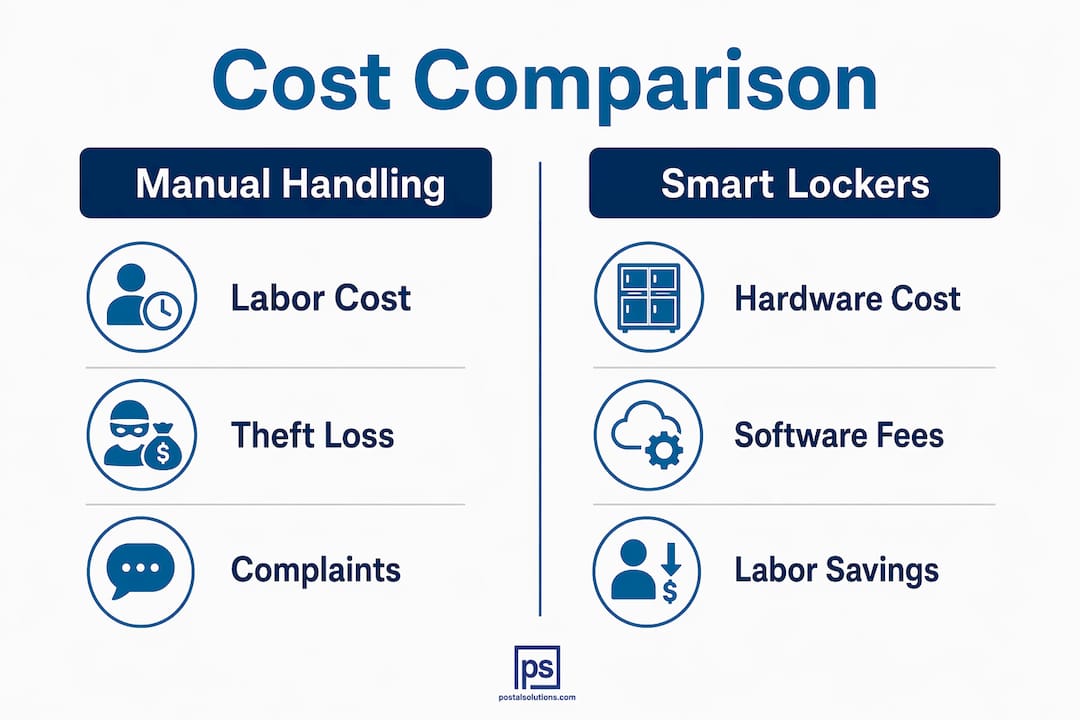
| Factor | Manual Handling | Smart Locker System |
|---|---|---|
| Annual labor cost (200 units) | $14,560–$21,840 | Near zero post-installation |
| Hardware investment | None | $12,000–$36,000 |
| Annual software fees | None | $2,000–$4,000 |
| Annual theft losses | $7,500–$15,000 | Significantly reduced |
| Total annual cost (est.) | $22,000–$37,000 | $4,000–$6,000 (post-payback) |
| Payback period | N/A | 12–18 months |
Without automation, properties can incur $22,000–$37,000 in annual costs from labor, theft, complaints, and reputation damage. That figure makes the hardware investment look straightforward, but the real calculation is more nuanced.
Smart locker systems carry a 12–18 month payback period from combined labor and theft savings, with net savings reaching $20,000 or more annually after that threshold. The upfront capital requirement is the primary barrier for smaller properties or those with constrained capital budgets.
Manual management also carries a scalability ceiling. As package volume grows, labor hours grow proportionally. Automation does not scale that way. A locker bank that handles 50 packages per day handles 150 packages per day with no additional staffing cost.
Pro Tip: When evaluating smart locker proposals, ask vendors for a cost-per-package calculation based on your actual annual volume. A 100-unit property receiving 8 packages per unit per month processes roughly 9,600 parcels per year. Dividing total annual system cost by that number gives you a direct comparison metric.
One important nuance: locker-only systems have physical limits. Oversized packages, cold storage deliveries, and irregular parcels often cannot fit in standard locker bays. High-volume communities report better scalability and reduced staff involvement with managed package rooms over locker-only approaches, especially for oversized or irregular packages. A hybrid model combining a managed package room for large parcels with a locker bank for standard deliveries often produces the best operational outcome.
What drives package delivery costs in multifamily properties?
No two properties carry the same delivery cost per package. Several variables determine where your number lands within the industry range.
-
Unit count and package volume. Larger communities generate more packages but also benefit from economies of scale in technology investments. A 500-unit property spreading a $30,000 locker installation across 6,000 annual packages per month achieves a much lower cost per parcel than a 100-unit property with the same hardware.
-
Physical space and layout. Properties without a dedicated package room face higher labor costs because staff must manage deliveries in lobbies, leasing offices, or hallways. Retrofitting a package room into an existing building adds construction costs that must be factored into the total cost of ownership.
-
Package management model. The choice between a staffed package room, a locker-only system, or a hybrid model directly affects both capital and operating expenses. Hybrid models combining large managed package rooms for oversized deliveries with smaller smart locker banks maximize operational efficiency and resident convenience.
-
Regional labor costs. A $35 per hour blended staff rate applies in many markets, but properties in Boston, New York, or San Francisco face significantly higher wage floors. Regional labor costs can push annual manual handling expenses well above the national benchmark range.
-
Seasonal volume surges. Holiday periods from november through january can double or triple daily package volume. Properties without scalable systems absorb that surge through overtime labor or accept degraded service quality, both of which carry real costs.
The lack of a standardized cost-per-unit benchmark in the multifamily industry means property managers must tailor package solutions to specific asset characteristics rather than rely on generic numbers. That reality makes internal data collection more valuable than any industry average.
How can property managers assess package delivery cost-effectiveness?
Evaluating your current delivery expenses requires a structured approach. Generic vendor comparisons rarely surface the full picture. Here is a practical framework for getting to an accurate number.
-
Calculate your true labor cost. Log every staff interaction with packages for four weeks: receiving, sorting, notifying residents, handling complaints, and conducting audits. Multiply total hours by your blended hourly rate. Most properties find this number is 20%–40% higher than their estimate.
-
Quantify theft and complaint incidents. Pull maintenance and complaint logs for the past 12 months. Assign a $500 cost to each confirmed or suspected theft incident. Add staff time spent on complaint resolution at your hourly rate.
-
Assess resident satisfaction impact. Survey residents about package experience during lease renewal conversations. If package management appears in non-renewal feedback, assign a portion of your $4,000 per-unit turnover cost to the package management line.
-
Evaluate total cost of ownership over 3–5 years. Operators advise evaluating total cost of ownership over 3–5 years, including labor reduction potential and ongoing maintenance, rather than hardware quotes alone. A system that costs $30,000 to install but saves $20,000 per year in labor and theft pays for itself in 18 months and generates positive returns for years after.
-
Track KPIs after implementation. Key performance metrics include theft incidents per month, staff hours allocated to package management, resident complaint volume, and package pickup time. These numbers tell you whether your solution is performing as projected.
Prioritizing resident access and minimizing staff intervention are the two metrics most predictive of long-term system success. Properties that optimize for both consistently report lower per-package costs and higher resident satisfaction scores.
Key takeaways
The true cost per package delivered in apartments includes labor, technology, theft losses, and resident turnover risk, making total cost of ownership the only reliable metric for vendor comparison.
| Point | Details |
|---|---|
| Labor is the largest cost driver | Manual handling costs $14,560–$21,840 annually for a 200-unit property at standard wage rates. |
| Theft losses compound quickly | At $500 per incident and 15–30 incidents per year, theft alone costs $7,500–$15,000 annually. |
| Automation pays back in 12–18 months | Smart locker systems generate $20,000+ in annual savings after the payback period. |
| Hybrid models outperform single solutions | Combining managed package rooms with locker banks handles oversized parcels and reduces staff touchpoints. |
| Evaluate over 3–5 years | Short-term hardware quotes miss soft costs; total cost of ownership reveals the real financial picture. |
The costs most property managers never see coming
After working with multifamily communities across the country since 2016, the pattern we see most often is not that property managers choose the wrong solution. It is that they calculate costs too narrowly before making any decision at all.
The $500 theft incident cost is real, but the downstream effect is what compounds. A resident who loses a package and does not get a satisfying resolution tells neighbors, posts a review, and factors the experience into their renewal decision. That chain of events can turn a $500 incident into a $4,000 turnover cost before anyone realizes what happened.
We also see properties underestimate ongoing soft costs after installation. Software updates, hardware maintenance, and the labor required to handle package exceptions that fall outside the automated workflow add up. Property managers frequently underestimate these ongoing costs, leading to poor vendor and solution selection. Asking vendors for a five-year total cost projection, not just a hardware quote, is the single most useful thing you can do before signing a contract.
Portfolio-level strategy also matters more than most operators realize. A property management company running 15 communities can negotiate meaningfully better terms on Luxer One installations and managed service agreements than a single-site operator. If you manage multiple assets, treat package management as a portfolio decision, not a property-by-property one.
— Postal Solutions
How postal solutions manages apartment package delivery costs
Postal Solutions specializes in apartment package management for multifamily communities, student housing, and senior housing across the United States. As the largest Luxer One sales agency in the country with over 1,200 installations in more than 40% of U.S. states, Postal Solutions sells and installs Luxer One package room and locker systems sized for any community. For properties that want ongoing operational support, Postal Solutions offers daily package room management outsourcing, with a package manager visiting the property to organize the room, label packages with unit numbers, and complete weekly audits. This service eliminates the double cost of paying staff wages while also absorbing the productivity loss that comes with unmanaged package rooms. Contact Postal Solutions to assess the right solution for your community’s volume, layout, and budget.
FAQ
What is the average cost per package delivered in an apartment?
There is no single industry-standard number, but total annual package management costs for a 200-unit property typically range from $22,000–$37,000 under manual systems and drop significantly with automation. Dividing those figures by annual package volume gives a per-parcel cost specific to your community.
How much do smart locker systems cost for apartments?
Smart locker hardware for a 200-unit community costs $12,000–$36,000, with annual software fees of $2,000–$4,000. Most properties reach payback within 12–18 months through labor and theft savings.
What are the hidden costs of manual package management?
Beyond direct labor costs of $14,560–$21,840 annually, manual management generates theft losses of $7,500–$15,000 per year and contributes to lease non-renewals that cost approximately $4,000 per unit in turnover expenses.
When does a hybrid package management model make sense?
A hybrid model combining a managed package room with a smart locker bank makes sense for high-volume communities where oversized or irregular packages exceed locker capacity. This approach reduces staff touchpoints while maintaining coverage for all parcel types.
How should property managers compare package management vendors?
Evaluate total cost of ownership over 3–5 years, not hardware quotes alone. Include labor reduction potential, software fees, maintenance costs, and theft incident reduction when comparing proposals from vendors like Luxer One or managed service providers.