Luxury Apartment Package Service for Property Managers
Luxury Apartment Package Service for Property Managers For luxury apartment communities, the most effective package management approach combines Luxer One hardware with Postal Solutions’ managed package-room operations. This pairing deliver
Published

For luxury apartment communities, the most effective package management approach combines Luxer One hardware with Postal Solutions’ managed package-room operations. This pairing delivers concierge-level resident experience, documented loss prevention, and measurable staffing savings that no single-technology solution achieves on its own.
TL;DR
- U.S. parcel volumes are increasing, putting every luxury property under sustained delivery pressure.
- About 85% of renters say package convenience influences their leasing decisions, and around 20% of renewals can turn on how well a property handles deliveries.
- Luxer One hardware paired with Postal Solutions’ daily managed service addresses resident experience, security, capacity, and ROI in a single, coordinated program.
- A properly managed package room reduces the double cost most properties pay: payroll for staff pulled away from their primary duties, plus the productivity loss that follows.
Table of Contents
- What types of package solutions work best for luxury apartments?
- How does the package intake-to-pickup workflow actually run?
- How do security features and capacity compare: lockers vs. smart package rooms?
- How can software integrations turn package data into an operational asset?
- What does a package system rollout actually look like?
- How do you calculate ROI for a luxury package solution?
- How do you evaluate and choose the right package management vendor?
- Why Postal Solutions: experience, proof points, and real outcomes
- What privacy and data security regulations apply to package management systems?
- How does package management integrate with your property management systems?
- Key Takeaways
- The case for managed operations in luxury communities
- Postal Solutions brings turnkey package management to luxury communities
- Useful sources
- FAQ
What types of package solutions work best for luxury apartments?
Not every solution fits every property. Matching the model to your building profile is what separates a well-run luxury apartment package service from an expensive disappointment.
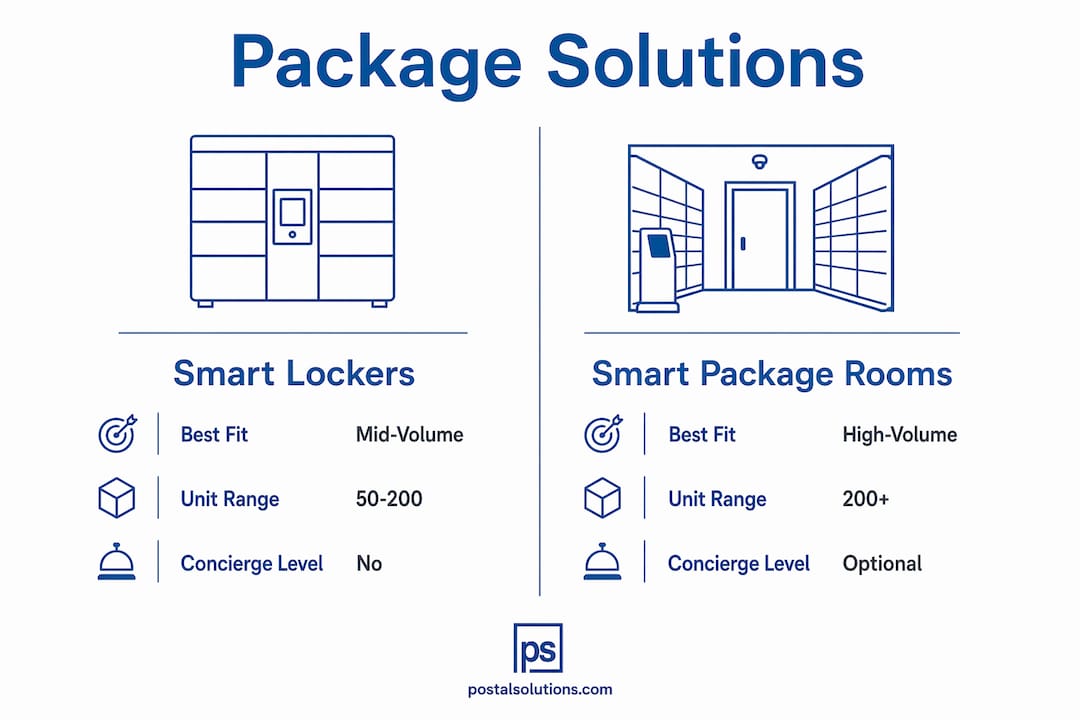
| Solution Type | Best Fit | Unit Range | Concierge-Level by Default? |
|---|---|---|---|
| Smart lockers | Suburban mid-rise, moderate volume | 300 units | With managed service added |
| Open-shelf smart package room | Urban high-rise, high volume | 200–600+ units | With managed service added |
| Hybrid staffed center | High-rise with repurposed amenity space | 300+ units | Yes, with part-time attendant |
| Refrigerated lockers | Any property with grocery/meal-kit demand | Any size | Yes |
| Doorstep/off-site concierge | Ultra-luxury, low-density | — | Yes |
Smart lockers use fixed compartments with electronic access. They work well for moderate-volume properties but hit a ceiling fast when oversized parcels or holiday surges arrive. Open-shelf smart package rooms use computer vision and kiosk guidance to handle mixed parcel types, giving residents QR/PIN self-service pickup around the clock. They also deliver 2x–3x higher storage capacity per linear foot compared with fixed-compartment lockers.
Refrigerated lockers are no longer optional at properties where residents receive grocery and meal-kit deliveries regularly. The 2018 NMHC/Kingsley survey found that a significant share of communities with refrigerated lockers reported daily use, signaling genuine resident demand rather than a niche feature.
Hybrid staffed centers repurpose underused amenity space with a part-time attendant, offsetting costs while providing flexible service levels. For luxury communities, this model can double as an evening clubroom attendant role.
None of these models delivers a concierge-level experience by default without an operational layer. Technology handles intake and storage; a managed service handles the resident-facing exceptions, audits, and organization that technology cannot.
How does the package intake-to-pickup workflow actually run?
Understanding the full sequence helps leasing teams set accurate expectations with residents and carriers alike.
Core sequence:
- Carrier arrival: The carrier accesses the package room or locker bank via a carrier kiosk, QR drop-in code, or controlled-access door. Carrier noncompliance (drivers leaving packages in lobbies or at doors) is the most common failure point and requires active enforcement.
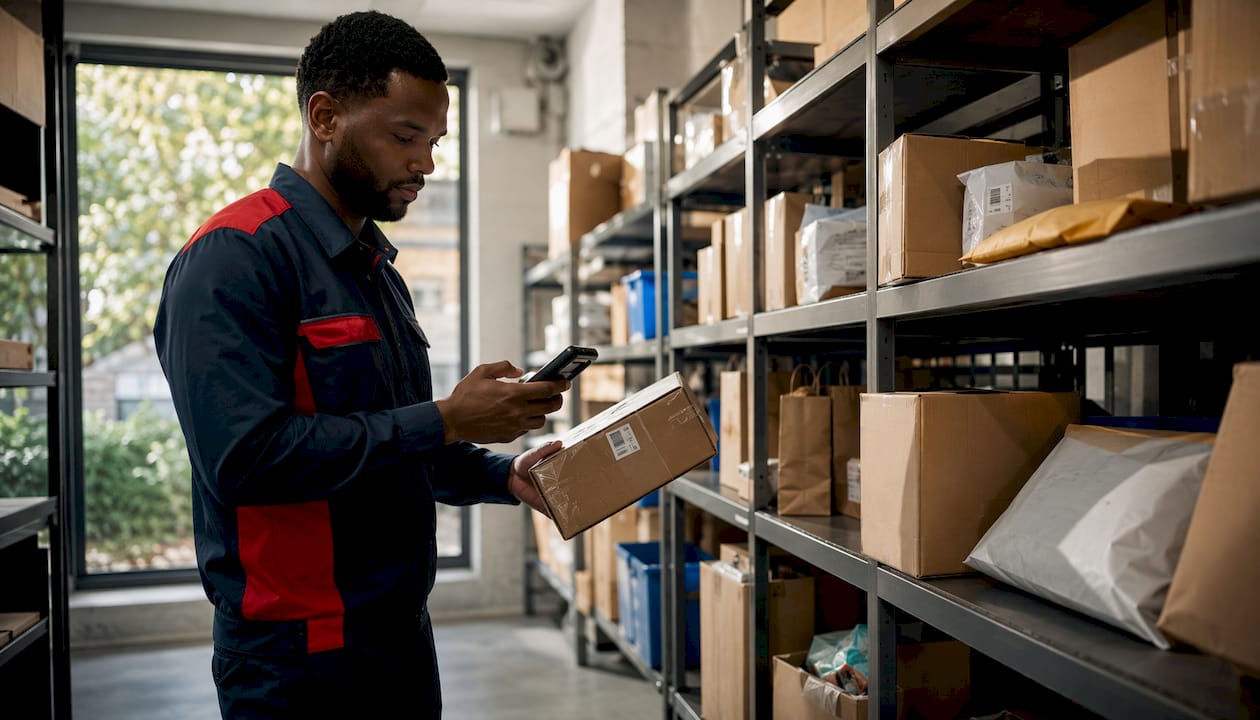
- Intake: Packages are scanned into the system automatically or logged manually. In a managed-service model, a package manager also marks the unit number directly on each box, reducing resident confusion at pickup.
- Secure storage: Items are placed in the appropriate compartment or shelf zone. Oversized items go to a designated overflow area; cold items route to refrigerated lockers.
- Resident notification: The system sends an SMS or email alert with a QR code or PIN for pickup. Notifications are triggered immediately upon intake, not on a batch schedule.
- Resident pickup: The resident authenticates via QR code, PIN, or app and retrieves the package. In a managed-service model, a package manager is on-site during peak hours to assist with exceptions.
- Exception handling: Failed pickups after a set window trigger escalation alerts. Oversized items that cannot fit in standard storage are flagged for doorstep delivery or held in a supervised overflow area.
The flow looks simple on paper. In practice, the gap between step 1 and step 2 is where most properties lose control. Carriers who bypass the designated intake point create a chain-of-custody break that no software can retroactively fix. A managed service with daily audits catches these breaks before residents notice.
How do security features and capacity compare: lockers vs. smart package rooms?
Security and capacity are not the same problem, but they interact. A system with excellent access control and no overflow capacity will still generate resident complaints during peak periods.
Security controls to evaluate
- Access control: Electronic locks with carrier-specific credentials vs. resident PIN/QR authentication
- Camera integration: Interior room monitoring and full locker-area coverage
- Audit logs: Time-stamped chain-of-custody records for every intake and pickup event
- Carrier authentication: Carrier-specific kiosk codes that expire and rotate
- Courier training and enforcement: Documented onboarding for delivery drivers, with compliance tracking
Capacity trade-offs
| Dimension | Fixed-Compartment Lockers | Open-Shelf Smart Package Room |
|---|---|---|
| Storage per linear foot | Baseline | 2x–3x higher |
| Oversized parcel handling | Limited | Flexible |
| Cold-storage integration | Add-on module | Dedicated refrigerated zone |
| Surge absorption | Low | High |
Open-shelf smart rooms handle mixed parcel types and reduce overflow because shelving adapts to parcel size rather than forcing every box into a fixed compartment. The capacity advantage is most pronounced during holiday surges and Amazon Prime events, when locker systems routinely fill to capacity and begin turning packages away.
Pro Tip: Plan your package room capacity for your peak week, not your average week. If your property receives 400 packages on a normal Tuesday, assume 600–800 during peak holiday periods and size your storage footprint accordingly.
Physical security controls and software audit trails work together. A camera that records every intake event and an audit log that timestamps every pickup create a defensible chain of custody. Properties that can produce that record resolve theft claims quickly and reduce the liability exposure that comes with untracked package handling.
How can software integrations turn package data into an operational asset?
Package intake data is now a measurable operational resource, not just a log of deliveries. Properties that treat it as such gain real advantages in staffing, carrier relationships, and resident service metrics.
Common integration targets:
- Property management systems (PMS) such as Yardi, RealPage, and Entrata
- Resident portals and leasing CRMs for notification and communication
- Access control platforms for carrier credential management
- CCTV systems for synchronized event recording
- Carrier routing systems for compliance tracking and preferred-access agreements
Intake-system data is increasingly used for staffing optimization, carrier compliance tracking, resident-service KPIs, and ESG transport-emission reporting. A property that can show a carrier its compliance rate and average intake time has leverage in negotiating preferred routing and access protocols.
One documented outcome: a community receiving over 9,000 packages per month at Crossing D.C. used managed package operations to handle 470+ resident emails, saving staff five hours per week, while achieving 95% of packages picked up within 48 hours. That kind of performance data becomes a leasing talking point.
Privacy and data security considerations are straightforward in practice: require vendors to document data ownership, retention periods, and access controls in their service-level agreements. Resident authentication data (PINs, QR codes, contact information) should be covered by the vendor’s privacy policy and never shared with third parties without consent.
What does a package system rollout actually look like?
A well-planned installation avoids the two most common surprises: electrical work that delays go-live, and carrier onboarding that takes longer than expected.
High-level timeline:
- Site survey and scope definition (1–2 weeks)
- Hardware procurement and delivery (2–6 weeks depending on configuration)
- Installation and network/electrical setup (1–3 days on-site)
- Carrier onboarding and credential distribution (1–2 weeks)
- Staff training and resident communications (1 week)
- Live operations with managed-service oversight
Site survey checklist:
- Door access: confirm carrier-accessible entry point with appropriate clearance
- Electrical: dedicated circuit and UPS backup for locker kiosks or room sensors
- Network: stable Wi-Fi or hardwired connection for real-time notifications
- Footprint: square footage, shelving layout, and ADA-compliant aisle clearance
- Fire egress: confirm package room placement does not obstruct required exit paths
- Permits: check with building management and local authority for any required approvals
For high-volume properties, the staffing impact during rollout is temporary but real. Plan for two to three days of reduced front-desk capacity while installation is underway. After go-live, a managed-service model shifts the daily package-room burden away from leasing staff entirely. At Stuyvesant Town, an automated package system reduced dedicated staff from 12 to two while cutting resident wait times from 30 minutes to seconds.
How do you calculate ROI for a luxury package solution?
Budget conversations go better when you can show the math. The ROI case for a luxury apartment package service rests on four cost categories and three savings drivers.
Primary cost drivers:
- Hardware: entry-level locker systems range from $6,900 to $20,000 for hardware alone; smart package rooms vary by footprint and sensor configuration
- Software and subscriptions: monthly platform fees for notification, audit, and reporting tools
- Installation: electrical, network, and labor costs beyond hardware
- Managed service: ongoing daily or weekly visits for package-room organization and audits
- Maintenance: component replacement cycles, typically annual for high-traffic systems
Simple ROI formula:
Annual savings (staff hours redirected + lease renewals retained + theft claims avoided) minus annual total cost (hardware amortized + software + managed service) = net annual ROI
Example: A 300-unit property paying a leasing associate 10 hours per week to manage packages at $22/hour spends roughly $11,440 per year on that task alone. Redirecting those hours to leasing activity while a managed service handles package operations produces a direct labor savings that often covers the managed-service fee within the first year.
Hidden costs to budget for: carrier noncompliance remediation (driver retraining, access credential resets), holiday surge handling (temporary overflow storage), and hardware replacement cycles. Properties that skip these line items routinely underestimate total cost of ownership by 15–25%.
For luxury, high-touch properties, a subscription or managed-service bundle typically fits better than a one-time capex purchase. It converts an unpredictable maintenance liability into a predictable monthly operating expense and keeps the vendor accountable for performance through SLA terms. Professional property management services consistently show that outsourced operational functions protect cash flow and reduce the hidden costs of in-house management.
How do you evaluate and choose the right package management vendor?
A vendor evaluation that skips the hard questions produces a system that looks good in a demo and underperforms in daily operations.
Prioritized evaluation criteria:
- Security: audit logs, camera integration, carrier authentication protocols
- Carrier integrations: confirmed acceptance rates with UPS, FedEx, USPS, Amazon, and regional carriers
- Capacity per square foot: tested performance at your projected peak volume, not average volume
- Exception handling: documented process for oversized items, failed pickups, and cold-storage parcels
- Resident UX: notification speed, authentication options, and pickup friction
- SLAs: defined response times, uptime guarantees, and penalty language
- Service-level reporting: weekly or monthly audit reports you can share with ownership
Questions to ask vendors during RFPs and demos:
- What is your carrier acceptance rate at comparable properties, and how do you enforce compliance?
- Walk me through your onboarding process for delivery drivers at a new property.
- How often are audits completed, and what does the audit report include?
- Who owns the resident data collected by your system, and what is your data retention policy?
- Can you provide API documentation for integration with our PMS?
- What is your process when a package is lost or a resident disputes a delivery?
Red flags:
- No audit logs or chain-of-custody records
- Vague answers about carrier training and compliance enforcement
- No documented process for oversized or cold-storage items
- References limited to properties significantly smaller than yours
- SLA language with no penalty provisions
Trust signals that indicate vendor maturity: certified carrier integrations with major national carriers, published installation counts across multiple property types, multi-property case studies with specific performance metrics, and SLA terms that include defined remedies for downtime or compliance failures.
Why Postal Solutions: experience, proof points, and real outcomes
Postal Solutions was founded in 2016 and has spent nearly a decade focused exclusively on package management for multifamily and student housing communities. The company is the largest Luxer One sales agency in the United States, with over 1,200 Luxer One installations completed and active deployments in more than 40% of U.S. states.
Core services:
- Daily package-room organization: a package manager visits the property to sort parcels, mark unit numbers directly on boxes, and keep the room current
- Weekly audits via the property’s existing package-room software or via a Luxer One system sold and installed by Postal Solutions
- Sales and installation of Luxer One locker systems, smart package rooms, refrigerated lockers, and combo configurations
- Six-day-per-week managed visits for properties that want full-service coverage
Postal Solutions has served on-campus universities, Public Private Partnership (P3) developments, conventional multifamily, student housing, senior housing, municipalities, and businesses of all sizes. The company represents Luxer One at national conferences and trade shows, which means the installation and operational knowledge runs deeper than a standard reseller relationship.
The combination of Luxer One hardware and Postal Solutions’ managed operations is what delivers a concierge-level experience at scale. Hardware handles intake, storage, and resident authentication. The managed service handles the daily organization, exception resolution, and audit cadence that keeps the system performing at the level luxury residents expect. Neither element alone is sufficient.
What privacy and data security regulations apply to package management systems?
Package management systems collect resident contact information, authentication credentials (PINs, QR codes), and delivery records. In the United States, the primary regulatory framework is not a single federal statute but a combination of state-level privacy laws, building-level data governance policies, and vendor contractual obligations.
California’s Consumer Privacy Act (CCPA) is the most relevant state law for properties operating in California, requiring disclosure of what resident data is collected, how it is used, and giving residents the right to request deletion. Other states including Virginia, Colorado, and Texas have enacted similar frameworks. For properties operating across multiple states, the safest approach is to apply the most protective standard uniformly.
In practice, compliance means three things: requiring vendors to sign a data processing agreement that defines ownership, retention, and access controls; confirming that resident authentication data is encrypted in transit and at rest; and maintaining audit logs that can be produced in response to a resident dispute or regulatory inquiry. Vendors who cannot produce clear answers to these questions during procurement represent a compliance risk, not just an operational one.
This article provides general operational information, not legal advice. Confirm current data privacy requirements with qualified legal counsel for your specific property and jurisdiction.
How does package management integrate with your property management systems?
A package management system that operates in isolation from your PMS, resident portal, and access control platform creates duplicate data entry and gaps in the resident experience. Integration is what converts a package room into a connected amenity.

The most common integration points are Yardi Voyager, RealPage, and Entrata for PMS connectivity, and platforms like Zego, Knock, or Funnel for leasing CRM and resident communication. On the access control side, systems like Brivo, Latch, and Salto can be configured to grant carrier-specific credentials that expire automatically, eliminating the need for manual key management.
Resident portal integration means that package notifications arrive through the same channel residents already use for maintenance requests and rent payments, rather than a separate app they have to download and remember. That consistency reduces pickup friction and improves the resident experience metrics that show up in lease renewal surveys.
For new construction, designing carrier access, package doors, and dedicated room sizing into the building plan from the start produces long-term operational advantages and preferential carrier routing. Retrofitting these elements into an existing building is possible but adds cost and timeline. Properties planning renovations should treat package infrastructure as a core amenity specification, not an afterthought.
Key Takeaways
A concierge-grade luxury apartment package service requires Luxer One hardware, a managed daily operations layer, and PMS integration working together — no single element delivers the full outcome alone.
| Point | Details |
|---|---|
| Match solution to property size | Smart package rooms fit 200+ unit urban properties; lockers work for moderate-volume suburban mid-rises. |
| Plan for peak, not average volume | Size storage capacity for holiday surges, when volume can run well above weekly averages. |
| Managed service eliminates double cost | Daily package-room management redirects staff hours to leasing, removing both payroll waste and productivity loss. |
| Hardware cost baseline | Entry-level locker hardware runs $6,900–$20,000 before software, installation, and ongoing service fees. |
| Postal Solutions as your partner | Postal Solutions sells and installs Luxer One systems and manages daily package-room operations across all apartment classes nationwide. |
The case for managed operations in luxury communities
The most common mistake luxury property managers make is treating package management as a technology problem. Buy the right locker system, the thinking goes, and the problem solves itself. It does not. Every automated system still requires planned oversight: scheduled audits, exception handling, and a staffed escalation path for the situations no kiosk can resolve.
What actually separates a high-performing luxury package program from a frustrating one is the operational layer behind the hardware. Residents at a luxury property expect the same reliability from their package room that they expect from their concierge desk. That standard requires daily attention, not a weekly glance at a dashboard.
Postal Solutions has seen this play out across hundreds of properties. The communities that get the best resident satisfaction scores are not necessarily the ones with the most expensive hardware. They are the ones where someone shows up every day, marks the boxes, clears the exceptions, and keeps the room current. That discipline is what the technology enables but cannot replace.
Postal Solutions brings turnkey package management to luxury communities
Property managers who want concierge-level package operations without adding headcount have a direct path: Postal Solutions bundles Luxer One hardware installation with daily managed package-room operations in a single service relationship. There is no need to coordinate a hardware vendor, a software platform, and a staffing agency separately.
Three concrete outcomes Postal Solutions delivers:
- Concierge-level resident experience: daily package-room organization, unit numbers marked on every box, and weekly audits keep the room current and reduce resident friction at pickup.
- Reduced staff hours: leasing and maintenance staff stop being pulled into package handling, freeing them for revenue-generating activity.
- Measurable reporting: weekly audit data gives ownership and management teams a clear record of package volume, pickup rates, and carrier compliance.
Postal Solutions manages apartment package operations for luxury, conventional, student, and senior housing communities across the United States. Contact Postal Solutions to request a site survey and implementation plan for your property.
Useful sources
Industry research and operational frameworks:
- Package Management Is Now a Top Amenity for Multifamily Properties — RealEstateRama
- Thinking Outside the Box to Solve Package Delivery Issues — Multifamily & Affordable Housing Business
- A Framework for Solving Multifamily’s Package Management Problem — Insights by Blueprint
- MDU Property Managers Shut Door on Lockers in Favor of Smart Package Rooms — Buildings
- 2018 NMHC/Kingsley Package Delivery Survey Results — NMHC
Postal Solutions resources:
- Apartment Package Lockers vs. Package Rooms
- Secure Package Storage for Multifamily Housing
- Package Management for Resident Retention
- Apartment Package Management Services
FAQ
What does a luxury apartment package service include?
A luxury apartment package service covers secure intake, organized storage, resident notification, and managed pickup for all parcel types, including oversized and refrigerated items. At the highest service level, it includes daily on-site package-room organization and weekly audits.
How does Luxer One work in an apartment community?
Luxer One provides electronic locker systems and smart package rooms where carriers deposit packages using a carrier-specific kiosk or QR code. Residents receive an automated SMS or email notification and retrieve their package using a PIN or QR code at any hour.
Can residents have packages delivered directly to their apartment?
Most luxury communities route deliveries to a centralized package room or locker system rather than individual doors, which reduces theft risk and carrier liability. Doorstep delivery is available as a managed add-on at select properties with dedicated concierge staffing.
What does package service mean in an apartment community?
Package service refers to the full program a property uses to receive, store, and distribute resident parcels, including the hardware (lockers or shelving), software (notifications and audit logs), and operational oversight (daily organization and carrier compliance management).
How do luxury apartments prevent package theft?
Effective theft prevention combines electronic access control, camera monitoring inside the package room and locker area, time-stamped chain-of-custody audit logs, and carrier authentication protocols that restrict who can deposit packages and when.
Recommended
- Apartment Package Management Services | Multifamily Package Room Operations | Postal Solutions
- Apartment Package Room & Mail Management | Postal Solutions
- Apartment Package Room & Mail Management | Postal Solutions
- Apartment Mail & Package Resources — Guides, Comparisons, Use Cases | Postal Solutions