Outsource Apartment Package Handling: A Property Manager's Guide
Outsource Apartment Package Handling: A Property Manager’s Guide For most multifamily operators, the answer is yes: outsourcing apartment package handling reduces staff burden, tightens security, and directly supports leasing performance. P
Published
For most multifamily operators, the answer is yes: outsourcing apartment package handling reduces staff burden, tightens security, and directly supports leasing performance. Package delivery convenience influences the leasing decisions of 85% of renters, making package infrastructure a critical factor in retention and occupancy; it is a retention and occupancy lever. The two most operationally proven options are Postal Solutions’ managed package room service and Luxer One electronic package room and locker systems. Before you contact a vendor, run the provider checklist in the “How to Choose the Right Partner” section below.
TL;DR:
- Outsourcing is the right move for most properties managing consistent daily volume, limited staff, or resident complaints about package access.
- Staff at a mid-size community can spend significant weekly hours on package handling before automation.
- Postal Solutions manages daily package room organizing, weekly audits, and Luxer One hardware sales and installation across the U.S.
- Match your solution type to your property profile before signing any contract.
Table of Contents
- What does outsourcing apartment package management actually look like?
- Outsourcing vs. on-site management: what are the real trade-offs?
- Which type of package solution fits your property?
- What does outsourcing cost, and when does it pay back?
- How do you choose the right outsourcing partner?
- What does the evidence say about outsourcing outcomes?
- How do you manage the transition for staff and residents?
- What should you expect from vendor support after installation?
- Key Takeaways
- The case for outsourcing is stronger than most operators realize
- Postal Solutions manages package room outsourcing for multifamily operators
- Useful sources
- FAQ
What does outsourcing apartment package management actually look like?
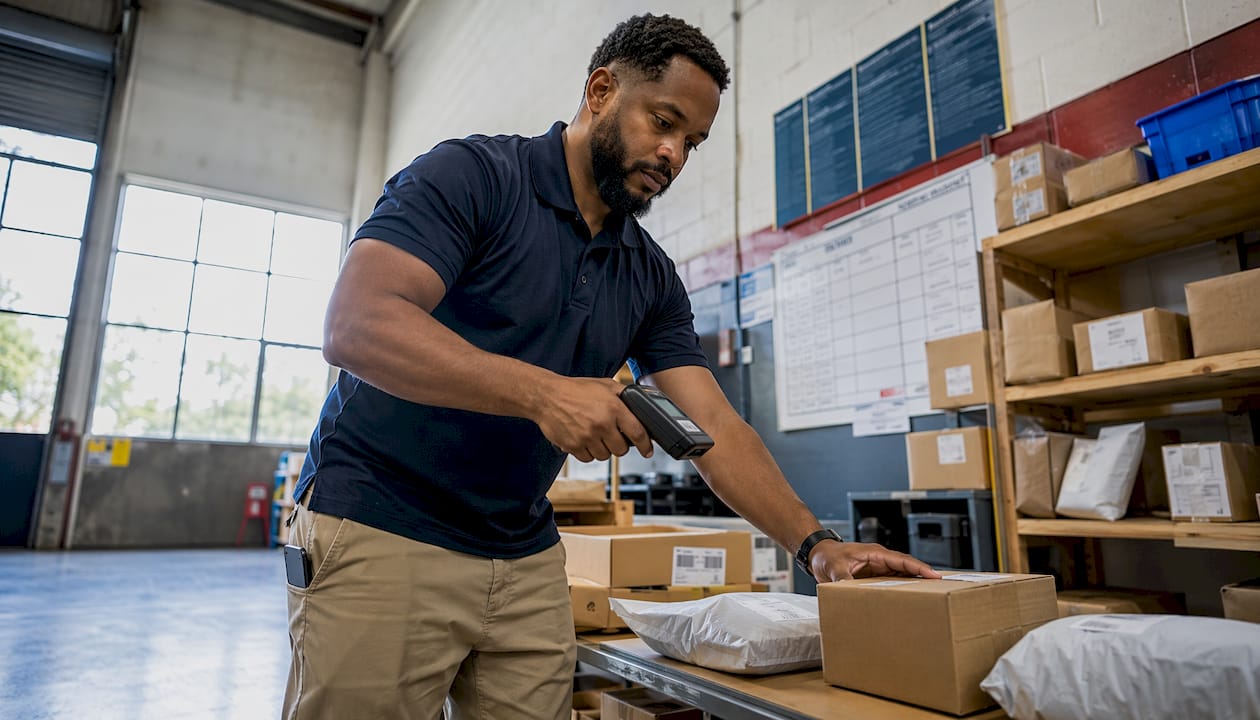
Outsourced package management transfers the daily operational work of receiving, logging, organizing, and notifying residents about parcels to a third-party provider. Your on-site team stops touching packages. The provider handles the workflow from carrier arrival through resident pickup.
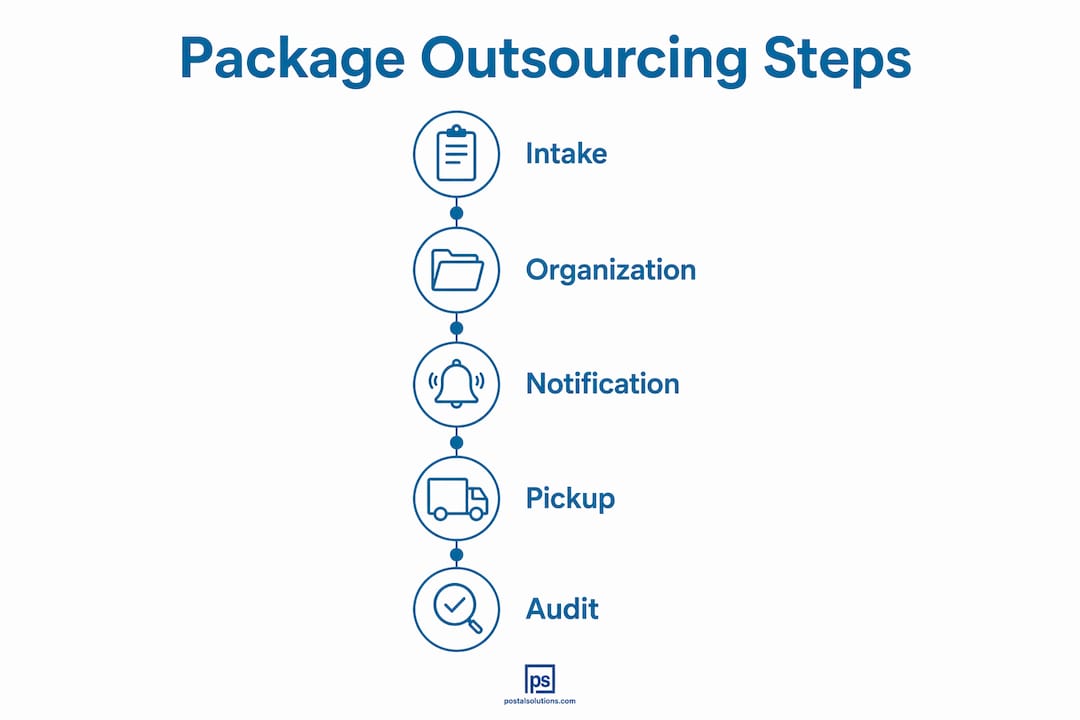
A typical delivery flow looks like this:
- Carrier arrives and deposits packages in a designated room or locker system.
- Provider logs each parcel (manually, via software, or via automated scanning).
- Unit numbers are identified and marked on each box.
- Resident receives an automated notification with pickup instructions.
- Resident retrieves the package using a PIN, QR code, or key access.
- Unclaimed packages are flagged in weekly audits; returns or overflow are escalated.
What shifts to the provider: daily organizing labor, audit cadence, resident notification workflows, and in some models, hardware maintenance. What stays with the operator: lease agreements, carrier access policies, and the physical space itself.
Postal Solutions manages this entire workflow through daily on-site visits. A package manager comes to the property, organizes the room, marks unit numbers on boxes, and completes weekly audits using either the property’s existing package room software or a Luxer One system that Postal Solutions sells and installs. For properties that want a full-service solution, Postal Solutions pairs Luxer One hardware with six-day-per-week managed visits.
Outsourcing vs. on-site management: what are the real trade-offs?
The core argument for outsourcing is straightforward: running a leasing office and running a mailroom are two different jobs. When one team does both, neither gets done well.
Top benefits of outsourcing:
- Staff hours reclaimed for leasing, marketing, and resident relations
- Consistent SLAs and audit trails that reduce liability exposure
- Scalable across a portfolio without proportional headcount growth
- Reduced package theft through controlled access and documented chain of custody
Risks to plan for:
- Reduced on-site visibility if the provider’s communication protocols are weak
- Carrier non-compliance, where drivers bypass the system entirely, creating gaps the provider must own
- Resident resistance to any fees associated with managed or locker-based services
- Loss of direct control over last-mile exceptions (oversized items, refrigerated deliveries, returns)
| Dimension | Outsourced / Managed | On-Site Self-Managed |
|---|---|---|
| Staff impact | Minimal daily involvement | Often significant weekly hours absorbed by leasing staff |
| Space | Dedicated room or locker bank | Same, but operator manages layout |
| Resident convenience | Access with notifications | Hours tied to office staffing |
| Security | Audit trails, access control, cameras | Varies by investment level |
| Integration | Provider manages software sync | Operator configures and maintains |
| Scalability | Portfolio-wide contracts available | Per-property staffing required |
The staffing cost is often invisible until you calculate it. At a mid-size community with moderate package volume, staff can lose significant daily working hours to package handling alone. That is payroll spent on a task that generates no revenue and no lease renewals.
Theft prevention adds another layer to the ROI case. Controlled access, audit trails, cameras, and resident notification systems all reduce theft incidents, and each incident avoided is a complaint, a potential liability claim, and a negative review that never happens.
Which type of package solution fits your property?
70% of multifamily operators use at least one smart locker or package room, and most properties layer an average of 2.4 intake methods. The right solution depends on your property’s volume, layout, resident profile, and budget.
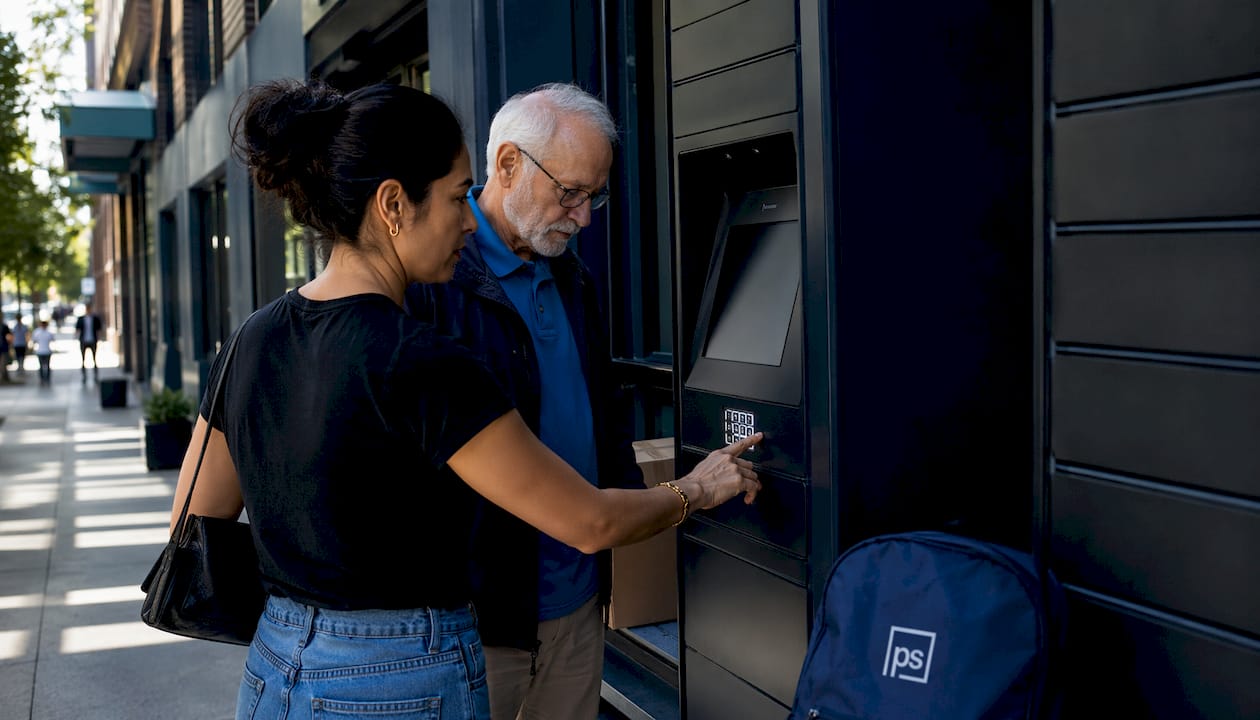
Smart lockers work well for mid-size suburban communities with moderate daily volume. Each parcel goes into a dedicated compartment; residents retrieve it with a PIN or app notification. Hardware costs typically run in the range of several thousand to tens of thousands of dollars for mid-size communities. The limitation: fixed capacity means surge periods (move-in week, holiday shipping) can overflow the system.
Smart package rooms suit high-volume urban properties. Open-shelf layouts accept oversized items, refrigerated deliveries, and irregular parcels that lockers cannot. A single controlled entry point with camera coverage and digital access logs provides security without the per-compartment cost of lockers. Postal Solutions installs Luxer One package rooms in configurations that accommodate all package types.
Off-site consolidation removes packages from the building entirely. A third-party warehouse receives all deliveries and routes them to residents’ doors on demand. Residents generally pay a monthly fee, and resident acceptance of extra fees is lower than operators expect. Best suited for premium communities where residents already pay for concierge-level services.
Staffed or hybrid package centers combine a dedicated room with scheduled staff hours or a managed-service provider. This is the model Postal Solutions operates: daily visits, organized shelving, weekly audits, and software-based tracking.
Software-only access management works as a layer on top of existing infrastructure. It handles notifications and access control but does not solve the physical organization problem without a human or automated system behind it.
Integration matters. Most enterprise package room platforms connect with Yardi, RealPage, Entrata, AppFolio, and ResMan. Confirm that any solution you evaluate integrates with your existing property management system before signing. A package room that generates its own data silo creates more work, not less.
Pro Tip: Design your package room around the delivery flow, not the other way around. Ask: where does a parcel go from arrival to pickup? That answer determines room size, shelving configuration, camera placement, and overflow capacity before you spend a dollar on hardware.
What does outsourcing cost, and when does it pay back?
Cost structures vary by solution type. Hardware-based solutions carry upfront capital costs; managed-service contracts typically run on a recurring fee basis.

| Solution Type | Typical Upfront Cost | Annual Ongoing Cost | Estimated Payback |
|---|---|---|---|
| Smart lockers (several hundred units) | $12,000–$36,000 | — | 12–18 months |
| Smart package room (hardware) | Varies by configuration | Software + maintenance fees | Comparable to lockers |
| Managed service (outsourced visits) | Low/none | Per-visit or monthly contract | Immediate labor offset |
| Hybrid (hardware + managed service) | Hardware cost + service fee | Combined annual fee | 12–18 months |
Source ranges from Smiota implementation data; actual costs vary by property size and configuration.
A basic payback example: A 200-unit community where staff spend 10 hours per week on packages at a fully loaded labor rate of $28/hour loses roughly $14,560 per year to package handling, while communities with higher volume can save $20,000 or more annually after implementing smart lockers or package rooms. A managed-service contract that eliminates that burden at a lower annual cost pays back from day one in labor savings alone, before accounting for reduced theft incidents or improved lease renewal rates.
Implementation timeline for a standard deployment:
- Week 1–2: Site walk, volume assessment, space measurement
- Week 2–4: Hardware procurement or service contract finalization
- Week 4–6: Installation (typically 1–3 days for hardware), carrier onboarding
- Week 6–8: Staff and resident orientation, soft launch
- Week 8+: Full operation, first audit cycle, KPI baseline established
For high-volume properties, plan for surge-period capacity before launch, not after the first holiday season overflows the room.
How do you choose the right outsourcing partner?
Vendor selection is where most operators make avoidable mistakes. A provider that looks capable on paper can collapse under carrier non-compliance or poor audit discipline within 90 days.
Shortlist checklist:
- Does the provider’s service scope match your property type (conventional multifamily, student housing, senior housing)?
- Can they integrate with your existing property management software?
- Do they have documented carrier compliance protocols, not just a general policy?
- What is their escalation workflow when a driver bypasses the system?
- Do they carry adequate liability insurance, and does the contract transfer liability for lost or damaged packages?
- Can they provide references from properties with similar volume and resident profiles?
Interview questions to ask every vendor:
- How do you detect and document driver bypass events?
- What is your escalation path when a carrier repeatedly fails to comply?
- Who owns the package data, and what happens to it if we terminate the contract?
- What is your notification SLA from intake to resident alert?
- How do you handle oversized items, refrigerated deliveries, and returns?
- What breach or data-privacy protocols govern resident notification data?
SLAs to require in writing:
- Intake-to-notification time (target: under 15 minutes for automated systems)
- Weekly audit completion and reporting cadence
- Time-to-resolution for resident complaints (target: same business day)
- Carrier compliance incident documentation and response time
Contract red flags:
- Vague liability language that leaves loss or damage claims with the operator
- Unilateral price-change clauses with no notice period
- No audit rights or data export provisions
- Insurance limits below your property’s replacement value exposure
Pro Tip: During vendor interviews, ask for a specific example of a carrier bypass incident and exactly how it was resolved. Vendors with real operational experience will answer immediately and in detail. Vendors who deflect or speak only in generalities are likely to shift that burden back to your staff when it happens.
Carrier non-compliance is the most common operational failure mode in outsourced package management. Any vendor who cannot give you a specific, documented answer on bypass detection and remediation is not ready to own your operation.
What does the evidence say about outsourcing outcomes?
The operational case for outsourcing is well-supported. At a 200-unit community, eliminating 5–15 hours of weekly staff package handling translates to $14,560–$21,840 in annual labor savings. Smart locker and package room installations typically pay back within 12–18 months through those labor savings and reduced theft incidents, with net annual savings exceeding $20,000 after payback.
“Leasing and concierge teams spend an average of four to six hours per week handling packages, over 300 hours per year, which pulls them away from revenue-generating work.” — Industry operator data cited in Multifamily & Affordable Housing Business
Postal Solutions’ managed package room service covers daily on-site organizing visits, unit-number identification on each parcel, weekly software audits, and resident notification support. As the largest Luxer One sales agency in the U.S., with over 1,200 installations across more than 40% of U.S. states, Postal Solutions manages package room outsourcing for conventional multifamily, student housing, senior housing, and P3 projects.
When outsourcing delivers the highest ROI:
- Properties with consistent daily volume above 30–40 packages
- Communities where leasing staff are currently absorbing package duties
- Portfolios where standardizing operations across multiple properties is a priority
- Student housing communities with extreme surge periods at move-in and holidays
When on-site management may still make sense:
- Very small properties (under 50 units) with minimal daily volume
- Properties with a dedicated facilities team that has capacity and clear protocols
- Communities where residents have already rejected fee-based services
How do you manage the transition for staff and residents?
The technology and the contract are the easy parts. Change management is where outsourcing projects stall or generate resident complaints in the first 60 days.
For staff: Start with a clear communication about what changes and what does not. Staff no longer handle daily package intake, but they remain the point of contact for resident escalations. Train them on the new escalation path before launch, not after the first complaint arrives. Document the new workflow in a one-page SOP and post it at the front desk.
For residents: Send a notice at least two weeks before launch explaining the new system, how to access packages, and what to do if something goes wrong. A brief walkthrough video or in-person demo at move-in orientation reduces friction significantly. Residents who understand the system before they need it generate far fewer complaints than those who encounter it for the first time when they are trying to retrieve a package.
Scaling across a portfolio requires a phased approach. Pilot at one property, collect 60 days of KPI data (notification time, resident complaint volume, staff hours reclaimed), then use that data to refine the rollout at subsequent properties. Operators who skip the pilot phase often discover property-specific edge cases, such as a loading dock layout that creates carrier compliance problems, that a single site test would have caught early.
Property management scalability is a real constraint during multi-site rollouts. Build the change management timeline into your procurement plan, not as an afterthought.
What should you expect from vendor support after installation?
Post-implementation support is where the gap between vendors becomes most visible. A provider that is responsive during the sales process but slow to respond after go-live creates exactly the operational friction you were trying to eliminate.
Minimum support expectations:
- A named account contact, not just a general support queue
- Defined response SLAs for hardware failures (target: same-day for critical issues)
- Regular software updates and security patches without requiring operator intervention
- Quarterly or semi-annual business reviews with KPI reporting
For hardware-based solutions like Luxer One systems, confirm that maintenance and repair coverage is included or clearly priced in the contract. A locker bank that goes offline during a holiday surge without a same-day repair commitment is a resident-experience failure.
Postal Solutions provides ongoing operational support as part of its managed service model, including audit reporting and coordination with the property’s existing software platform. For Luxer One hardware, support terms are established at the point of sale.
Ask vendors specifically: What is the escalation path if the primary account contact leaves the company? Vendor turnover is common, and a contract with no named-contact continuity clause can leave you starting over with a new rep who does not know your property.
Key Takeaways
Outsourcing apartment package handling is the right operational move for many multifamily properties managing consistent daily volume, as the labor cost of on-site handling often exceeds the cost of a managed service or hardware solution within a reasonable timeframe.
| Point | Details |
|---|---|
| Quantify staff time first | At a 200-unit community, eliminating 5–15 hours of weekly package handling translates to $14,560–$21,840 in annual labor savings. Calculate your labor cost before evaluating any solution. |
| Match solution to property profile | Smart lockers fit mid-size suburban; smart rooms fit high-volume urban; managed service fits properties with steady daily volume. |
| Carrier compliance is a critical failure mode | Require documented bypass detection and escalation workflows from every vendor before signing. |
| Payback depends on property size and volume | Hardware installations can pay back through labor savings and reduced theft incidents over time. |
| Postal Solutions manages the full scope | Postal Solutions manages daily package room organizing, audits, and Luxer One hardware sales and installation nationwide. |
The case for outsourcing is stronger than most operators realize
The conventional wisdom in multifamily is that package management is a staffing problem you solve by adding a process. After seeing the operational data across hundreds of properties, the more accurate framing is that it is a structural problem you solve by removing your leasing team from the equation entirely.
Properties that treat package handling as a core amenity, with the same operational discipline they apply to maintenance or leasing, consistently outperform those that treat it as an afterthought. The resident who cannot find their package at 9 PM does not file a maintenance ticket. They post a one-star review. And the leasing team member who spent 45 minutes sorting packages that morning was not following up on a prospect.
The operators who get the most out of outsourcing are the ones who commit to it structurally: dedicated space, a real SLA, carrier compliance enforcement, and a provider who owns the outcome. A managed service that is treated as optional support rather than a core operational contract will underperform every time.
Postal Solutions has managed this work across conventional multifamily, student housing, senior housing, and P3 projects since 2016. The pattern is consistent: properties that outsource with clear SLAs and hardware that matches their volume profile reclaim staff time, reduce complaints, and see measurable improvement in resident satisfaction within the first quarter.
Postal Solutions manages package room outsourcing for multifamily operators
If your leasing team is still absorbing daily package duties, Postal Solutions offers a direct path out. Postal Solutions manages daily package room organizing for conventional multifamily, student housing, senior housing, and P3 projects, with six-day-per-week managed visits, weekly audits, and full integration with your existing package room software. For properties that need hardware, Postal Solutions sells and installs Luxer One package rooms, locker systems, and combo configurations nationwide, backed by over 1,200 installations across more than 40% of U.S. states.
The next step is a site assessment. Postal Solutions evaluates your current volume, space, and software setup, then recommends the right combination of managed service and hardware for your property. Request an assessment to get a proposal specific to your community.
Useful sources
- Renter Technology Expectations Reshaping Multifamily Leasing | Knockli — 85% leasing-influence figure and resident expectation data
- Smart Lockers for Apartments: Benefits, ROI, and Implementation Guide | Smiota — hardware cost ranges, labor savings estimates, and payback timelines
- A Framework for Solving Multifamily’s Package Management Problem | Insights by Blueprint — carrier compliance frameworks and multi-method intake data
- Package Theft in Apartments: 6 Ways to Prevent It | ButterflyMX — theft prevention tactics and security protocols
- How To Choose Amenities Part 5: Package Delivery | Victor Menasce — resident fee sensitivity and self-service preference data
- Apartment Package Management Services | Postal Solutions — managed service scope and Luxer One partnership details
- Apartment Mail & Package Resources | Postal Solutions — guides, comparisons, and use cases for further due diligence
FAQ
What is outsourced apartment package management?
Outsourced package management means a third-party provider handles daily parcel intake, organization, resident notification, and audits so your leasing staff does not have to. Postal Solutions manages this through daily on-site visits and optional Luxer One hardware.
How do you prevent package theft in an apartment community?
Controlled access, camera coverage, digital audit trails, and automated resident notifications are the most effective theft-prevention measures. Managed package rooms and smart lockers provide all four in a single system.
Can an apartment community refuse to accept packages on residents’ behalf?
Yes, apartment communities can set their own package acceptance policies, though doing so typically harms leasing competitiveness, as package delivery convenience influences the leasing decisions of 85% of renters. Most operators choose to manage the process rather than opt out of it.
Do residents have to pay for outsourced package services?
It depends on the model. Managed package room services are typically funded by the operator as an operating expense. Some locker or concierge platforms charge residents a registration or monthly subscription fee, so review provider terms carefully and disclose any resident-facing fees before launch.
How long does it take to implement a package management solution?
A standard deployment runs 6–8 weeks from site assessment through full operation, including hardware procurement, installation (typically 1–3 days), carrier onboarding, and resident orientation.
Recommended
- Apartment Package Management Services | Multifamily Package Room Operations | Postal Solutions
- Apartment Mail & Package Resources — Guides, Comparisons, Use Cases | Postal Solutions
- Managed Package Room Visits: Top Strategies for Property Managers | Postal Solutions
- The Complete Guide to Outsourced Apartment Mailrooms | Postal Solutions