How to Organize Chaotic Apartment Package Storage
Learn how to organize chaotic apartment package storage with effective strategies. Maximize space and streamline your delivery process today!
Published
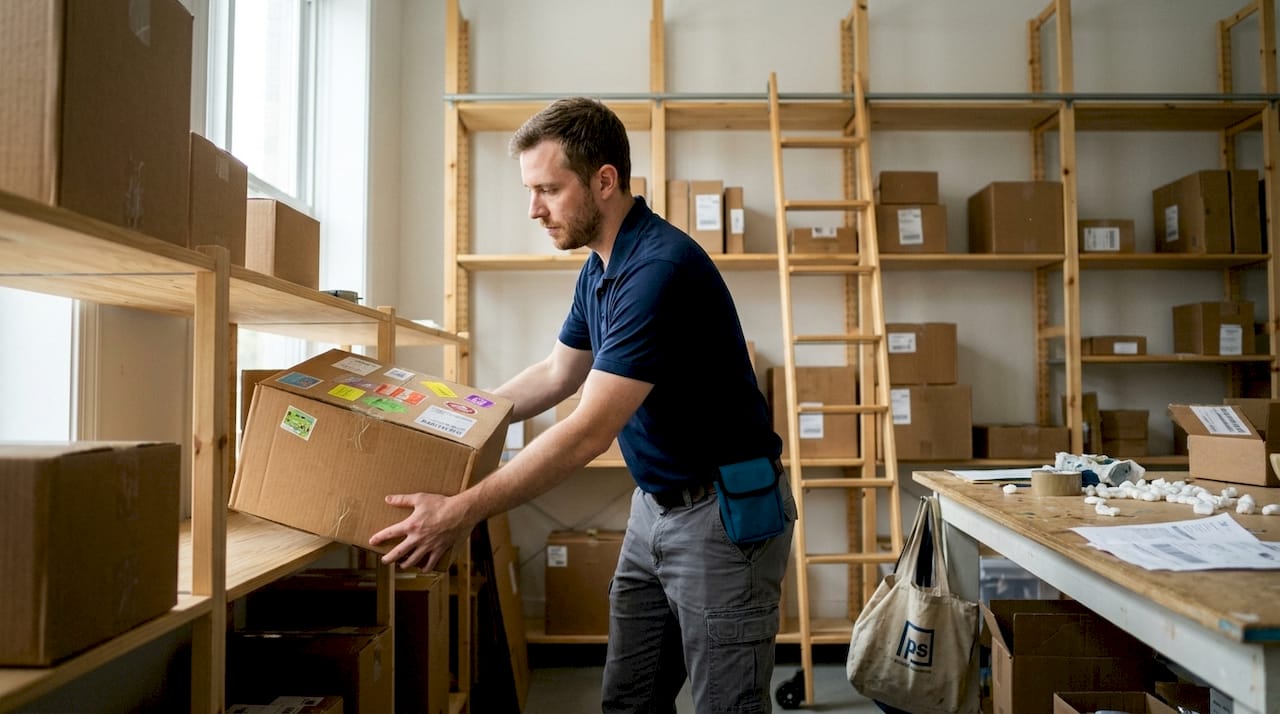
Organizing chaotic apartment package storage is defined as the process of creating a structured, secure, and scalable system for receiving, sorting, and retrieving parcels in a multifamily residential building. The core challenge is not a lack of space. It is a mismatch between fixed storage capacity and unpredictable delivery volume. Property managers and residents who solve this problem use a layered approach: secure overflow staging areas, vertical shelving, carrier coordination, and parcel tracking technology. This article covers each strategy in practical terms, so you can apply them immediately regardless of your building’s size or current setup.
What are the common challenges when you organize chaotic apartment package storage?
Fixed locker systems are the most common source of package room failure in apartment buildings. A building receiving 200 daily packages but equipped with only 100 locker compartments will leave over half unsecured during peak periods. That is not a minor inconvenience. It creates theft risk, resident complaints, and staff hours spent locating misplaced parcels.
The core problem is capacity mismatch. Package volume in multifamily buildings spikes sharply during the holiday season, back-to-school periods, and major retail sales events. Fixed locker banks are sized for average volume, not peak volume. When demand exceeds capacity, packages pile up on floors, get stacked in hallways, or end up in leasing offices where staff are not equipped to manage them.
“A package room that works on a Tuesday in March will fail on a Monday in December. The system has to be designed for the worst day, not the average day.”
The consequences compound quickly. Residents who cannot find their packages lose trust in the property. Staff spend time triaging package chaos instead of handling leasing and maintenance. Ad hoc stacking and open shelves without tracking technology scale poorly, meaning the problem grows worse as delivery volume increases year over year.
Common failure points in apartment package rooms include:
- Fixed locker banks that fill up within hours on high-volume days
- No overflow policy, leaving staff to improvise with floor space
- Missing unit number labels, causing packages to sit unclaimed for days
- No digital notifications, so residents do not know their parcel arrived
- Unrestricted access, increasing theft and misplacement risk
Recognizing these failure points is the first step. The next step is building a system that handles them before they escalate.
How do you create overflow staging areas to relieve package room congestion?
An overflow staging area is a designated, locked secondary space where packages go when the primary package room or locker bank reaches capacity. It is not a permanent solution. It is a pressure valve that keeps the main room functional while you work on longer-term fixes.
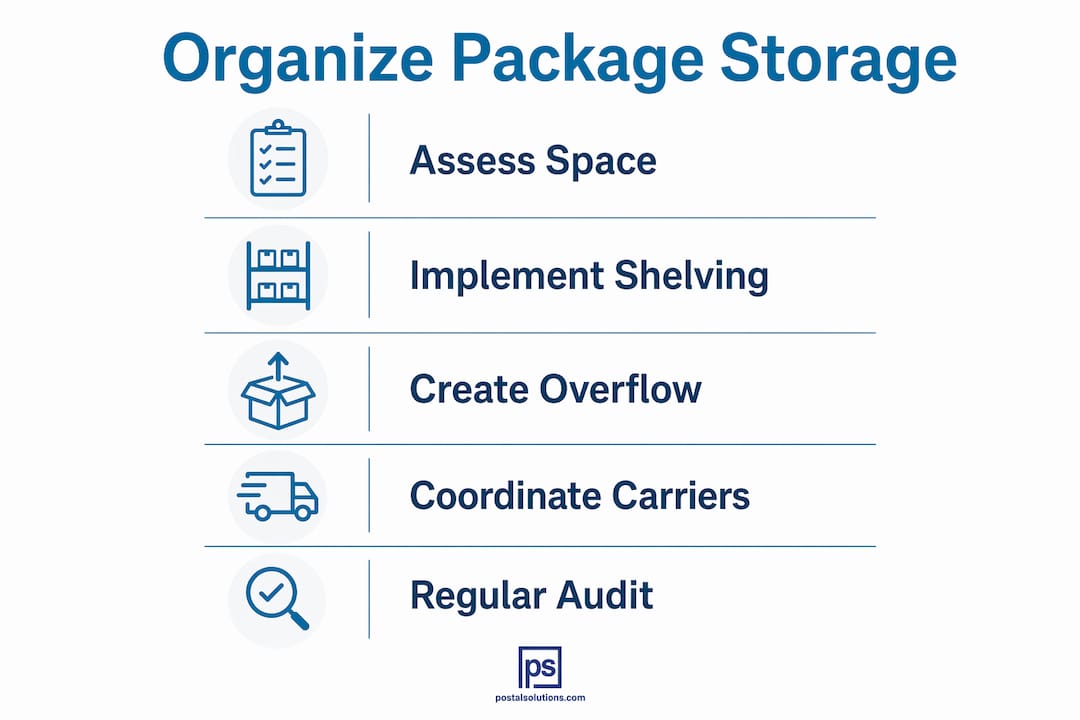
Setting up an effective overflow area requires three things: restricted access, clear labeling, and a defined pickup window. Secure overflow staging means the space is locked and accessible only to authorized staff. Residents should not be able to enter unsupervised. This protects against theft and keeps the area organized.
Follow these steps to establish a functional overflow staging area:
- Identify the space. A storage closet, unused utility room, or sectioned-off area of a parking garage works. The space must be lockable and dry.
- Prioritize large packages first. Oversized items that cannot fit in standard lockers should go directly to overflow. This frees locker capacity for standard parcels.
- Label every package on arrival. Write or print the unit number clearly on the top of each box. Do not rely on the carrier label alone. Carrier labels face different directions and use small fonts.
- Set a pickup window. Notify residents within 24 hours and require pickup within 48–72 hours. Packages held longer than the window move to a secondary hold area.
- Log every package in and out. Use a spreadsheet, a property management platform, or dedicated package tracking software. A paper log is better than no log.
Pro Tip: Highlight the unit number on the carrier label with a bright marker before placing the package in overflow. This cuts retrieval time in half when a resident or staff member is searching through a full staging area.
Digital notifications and clear signage increase pickup speed and reduce the time packages sit in overflow. The faster residents retrieve their parcels, the less pressure the overflow area absorbs.
How can apartment buildings coordinate with delivery carriers to reduce package confusion?
Carrier coordination is one of the most overlooked tools in apartment package management. USPS, UPS, FedEx, and Amazon each follow different delivery protocols, and those differences directly affect where packages land in your building.
USPS uses cluster box units for centralized mail delivery. Private carriers like UPS, FedEx, and Amazon may deliver to locker systems, leasing offices, or directly to unit doors, depending on the building’s agreements and physical setup. That inconsistency is a primary cause of package misplacement.
Practical steps to coordinate with carriers:
- Establish a single designated drop point for all non-USPS carriers. Post clear signage at every building entrance directing drivers to that location.
- Contact your local USPS postmaster to confirm your cluster box unit assignments and flag any recurring delivery errors.
- Register your building with UPS My Choice for Business and FedEx Delivery Manager to set building-level delivery preferences.
- Post carrier-specific instructions at the package room entrance. Drivers follow posted instructions when they are clear and visible.
- Secure parcel lockers and controlled access areas reduce theft risk and misplaced items by limiting where packages can be left unattended.
Different carriers have distinct handling procedures, and a building that does not account for those differences will see packages scattered across multiple locations. Centralizing drop points is the single fastest way to reduce that scatter.
What apartment organization tips maximize space in a crowded package room?
Space optimization in a package room follows the same principles as storage solutions for small spaces anywhere in an apartment building. The goal is to increase usable capacity without expanding the room’s physical footprint.
Use vertical space aggressively
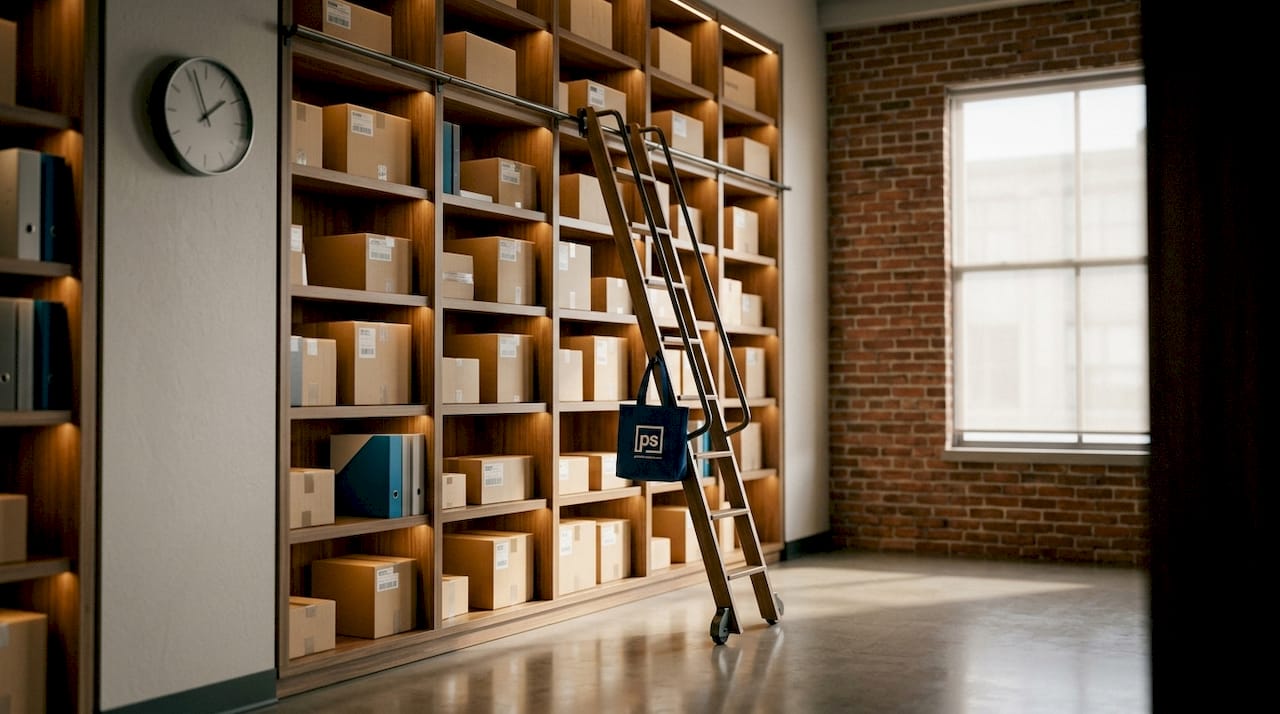
Ceiling-height shelving with rolling ladders can effectively double storage capacity in a standard package room. Most package rooms use only the bottom four feet of wall space. Installing shelving units that reach eight to ten feet, paired with a rolling ladder for safe access, puts that unused vertical space to work immediately.
Declutter and edit regularly
Removing unused items and replacing single-purpose furniture with multi-purpose carts frees floor space for active package storage. A package room is not a general storage area. Any item that does not serve the package workflow should be removed.
| Storage approach | Best for | Limitation |
|---|---|---|
| Fixed locker bank | Standard parcel sizes, high security | Fails at peak volume |
| Open shelving with tracking | High volume, mixed sizes | Requires active management |
| Overflow staging area | Peak periods, oversized items | Short-term use only |
| Vertical shelving with rolling ladder | Dense rooms, all sizes | Needs staff training for safe access |
Pro Tip: Use clear plastic bins on upper shelves for smaller packages. Label each bin by unit number range (e.g., units 100–150). Residents and staff can spot the right bin at a glance without pulling everything down.
Additional apartment organization tips for package rooms:
- Use rolling carts for packages awaiting same-day pickup. Clear the cart each evening to reset the room.
- Mark floor zones with tape or painted lines to designate areas by carrier or package size.
- Post a visual map of the room layout at the entrance so residents can navigate independently.
- Conduct a weekly reset. Pull every unclaimed package, cross-reference against your tracking log, and send a second notification to residents with outstanding parcels.
What are common mistakes that keep apartment package storage chaotic?
The most common mistake is treating package room problems as a hardware issue when they are actually an operations issue. Buying more lockers without fixing labeling, notification, and pickup policies produces the same chaos at higher cost.
Combining short-term operational discipline with long-term scalable infrastructure is the proven path to sustainable package room management. That means layering overflow staging, layout upgrades, and parcel tracking technology rather than relying on any single fix.
Use this checklist to diagnose ongoing problems:
- [ ] Are unit numbers written on every package before it enters the room?
- [ ] Do residents receive a digital notification within two hours of delivery?
- [ ] Is there a written overflow policy that staff follow consistently?
- [ ] Are packages older than 72 hours flagged and followed up on?
- [ ] Is the room reset and audited at least once per week?
- [ ] Are large packages separated from standard parcels on arrival?
- [ ] Is access to the package room restricted to residents and authorized staff?
Resident cooperation is also a factor that property managers underestimate. Residents who pick up packages promptly, report damaged parcels, and follow posted storage rules reduce pressure on the entire system. A short welcome email or posted notice explaining the pickup policy and its purpose goes a long way toward building that cooperation.
Pro Tip: Track package dwell time monthly. If the average package sits in your room for more than 48 hours, your notification system or pickup policy needs adjustment, not your shelving.
Key Takeaways
Organizing apartment package storage requires layered operations, not just better hardware. The most effective approach combines secure overflow staging, vertical shelving, carrier coordination, and consistent labeling to prevent chaos at any volume level.
| Point | Details |
|---|---|
| Fixed lockers fail at peak volume | Size your system for peak delivery days, not average days, to prevent overflow. |
| Overflow staging areas provide relief | Lock the space, label every package with the unit number, and set a 48–72 hour pickup window. |
| Carrier coordination reduces misplacement | Establish one drop point for all non-USPS carriers and post clear delivery instructions. |
| Vertical shelving doubles capacity | Install ceiling-height shelving with rolling ladders to maximize space without expanding the room. |
| Operations drive outcomes | Labeling, digital notifications, and weekly audits matter more than hardware alone. |
What working in package management actually teaches you
After years of managing package rooms across conventional multifamily, student housing, and senior communities, the clearest lesson is this: the buildings with the most organized package rooms are not the ones with the most expensive lockers. They are the ones with the most consistent daily operations.
A Luxer One locker system installed in a building with no labeling protocol and no pickup policy will fail just as visibly as a room with no lockers at all. The technology creates the structure. The daily discipline fills it in. That is why Postal Solutions focuses on both sides of the equation. Selling and installing Luxer One systems is one part of the work. Managing the daily organization of those rooms is the other.
The buildings that struggle most are the ones that treat package management as a one-time setup task. Volume grows every year. Carrier behavior changes. Resident expectations rise. A package room that worked well in 2022 may be overwhelmed by 2026 without any deliberate updates to layout, policy, or technology.
The fix is not complicated. Audit your room quarterly. Adjust your overflow policy before peak seasons. Retrain staff on labeling when turnover happens. These are not big investments. They are the habits that separate a functional package room from a chaotic one.
— Postal Solutions
How Postal Solutions supports apartment package room organization
Postal Solutions manages package room outsourcing for apartment communities across the country, including conventional multifamily, student housing, and senior housing. The service includes daily visits to organize the package room, handwriting or highlighting unit numbers on packages, and completing weekly audits using your existing package room software. For communities that need a hardware upgrade, Postal Solutions is the largest Luxer One sales agency in the United States, with over 1,200 installations across more than 40 states. Whether you need package lockers for apartments, daily management outsourcing, or a combined solution, Postal Solutions manages the full scope so your staff can focus on leasing and resident services.
FAQ
What causes the most chaos in apartment package rooms?
Fixed locker banks that fill up during peak delivery periods are the leading cause of package room chaos. When capacity is exceeded, packages are left unsecured, misplaced, or stacked without tracking.
How do overflow staging areas work in apartment buildings?
An overflow staging area is a locked secondary space where packages go when the main room is full. Access is restricted to staff, every package is labeled with the unit number, and residents are notified within 24 hours.
Why do packages get misplaced in apartment buildings?
Different carriers, including USPS, UPS, FedEx, and Amazon, follow different delivery procedures and drop packages in different locations. Without a single designated drop point and clear carrier instructions, misplacement is predictable.
What is the fastest way to increase package room capacity?
Installing ceiling-height shelving with a rolling ladder can effectively double storage capacity without expanding the room’s footprint. This is the fastest physical upgrade available to most property managers.
How often should a package room be audited?
A weekly audit is the minimum standard. Staff should cross-reference all packages against the tracking log, flag items held longer than 72 hours, and send follow-up notifications to residents with unclaimed parcels.
Recommended
- Apartment Package Management Services | Multifamily Package Room Operations | Postal Solutions
- Daily Package Room Organizing for Chicago, IL Apartments | Postal Solutions
- Daily Package Room Organizing for Austin, TX Apartments | Postal Solutions
- Daily Package Room Organizing for Boston, MA Apartments | Postal Solutions