Protect 3–5 Year TCO With Locker Financing for Property Managers
Protect 3–5 Year TCO With Locker Financing for Property Managers Yes, you can finance a locker system, and most property managers should. The strongest routes are an equipment loan for lockers you plan to keep long term, an equipment lease
Published

Yes, you can finance a locker system, and most property managers should. The strongest routes are an equipment loan for lockers you plan to keep long term, an equipment lease when the technology will need upgrading in three to five years, or vendor financing arranged directly through your installer. Before you sign anything, build a 3- or 5-year total cost of ownership model and get a financing-ready itemized quote from your vendor. That single step determines whether the deal actually pencils out.
TL;DR:
- Equipment loans are suitable for long-lasting hardware with a fixed ownership timeline, typically over a decade, providing full ownership from the start.
- Leasing offers lower monthly payments and flexible upgrades, making it ideal for technology that requires refreshing every three to five years.
- Building a 3- or 5-year total cost of ownership model including installation, software, and ongoing support is essential before seeking financing.
- Lenders usually approve smaller deals within 24 to 72 hours using an itemized vendor quote, financials, and proof of insurance, with equipment typically serving as collateral.
- Separating locker system financing from real estate through equipment carve-outs simplifies approval and protects property lenders’ interests.
Table of Contents
- Locker System Financing Options at a Glance
- How Do You Choose Between a Loan and a Lease for Smart Lockers?
- Budgeting and TCO: The Five Cost Buckets That Determine ROI
- What Lenders Typically Ask For and How Fast Approval Happens
- Structuring Locker Financing Inside Your Capital Stack
- From Vendor Quote to Funded Purchase: A Step-by-Step Checklist
- What Risks Should You Plan For Before You Sign?
- What Postal Solutions Has Learned from 1,200+ Installations
- Get a Financing-Ready Quote Before You Talk to a Lender
- Sources
- FAQ
Locker System Financing Options at a Glance
Most property managers land on one of three financing routes, and each fits a different situation.
Equipment loans give you ownership from day one. You make fixed payments, the asset sits on your balance sheet, and once it’s paid off, it’s yours outright. This works well for durable hardware like steel locker banks that won’t need replacing for a decade.
Equipment leases trade ownership for flexibility. Monthly payments tend to run lower than loan payments, and many leases include an upgrade path at term end, which matters when you’re financing electronics rather than steel cabinets. Leases suit technology that needs refreshing every three to five years, while loans suit assets with a longer useful life.
Vendor financing comes bundled directly from your locker supplier or installer, often through a captive finance arm or a partner lender. It’s worth considering when the vendor can quote hardware, software, and installation as one package, since that usually speeds up approval and keeps the paperwork simpler.
- Equipment loan: full ownership, fixed payments, best for long-life hardware
- Equipment lease: lower payments, upgrade flexibility, often favorable balance-sheet treatment
- Vendor financing: bundled quote, faster approval, single point of contact
How Do You Choose Between a Loan and a Lease for Smart Lockers?
The right choice depends on how long the equipment will stay useful, not just what fits this month’s budget.
- Match the term to the asset’s life. Smart locker software, touchscreens, and connectivity modules typically need a refresh every three to five years, while the physical cabinet frame can last well beyond that.
- Weigh the lease trade-offs. Lower monthly payments and built-in upgrade options make leasing attractive for tech-heavy systems, and many leases qualify for favorable off-balance-sheet accounting treatment.
- Weigh the loan trade-offs. Ownership from the start often produces a lower total cost over time for equipment you’re confident you’ll keep for the long haul, and it avoids end-of-term buyout negotiations.
- Consider a blended approach for portfolios. Larger operators often finance long-life building assets with loans while leasing the tech-heavy locker and access-control components, so the electronics can be upgraded on a normal cycle without touching the real estate financing.
Pro Tip: Align your lease term to your software vendor’s stated update cycle, not to a round number like five years. If the platform pushes major upgrades every three years, a five-year lease locks you into outdated software for two extra years.
Budgeting and TCO: The Five Cost Buckets That Determine ROI
Sticker price on a locker system tells you almost nothing about what you’ll actually pay. Buyers routinely undercount installation, software, integrations, and ongoing support, which throws off every financing comparison that follows.
Build your model around five buckets:
- Equipment: the locker units, kiosks, and hardware components themselves
- Installation and site prep: electrical work, networking, mounting, and any structural changes
- Software and licensing: the platform fee in year one and every renewal after
- Integrations: connections to your existing property management or access-control software
- Ongoing support: warranty extensions, maintenance calls, and eventual refresh costs
Most smart-locker buyers should calculate a 3- to 5-year TCO because software fees and equipment aging change the math substantially over that window. On the revenue side of the ledger, quantify the labor you’ll get back. If a system cuts staff package-handling time by even an hour a day, translate that hourly rate into a monthly dollar figure and weigh it against the financing payment. Properties that pair hardware with managed package-room organizing tend to realize more of that labor savings than properties that leave staff to manage the locker room on top of everything else. Ask your vendor for an itemized quote covering all five buckets before you request financing terms; a bundled number with no breakdown is a red flag for both your budget and your lender.
What Lenders Typically Ask For and How Fast Approval Happens
Rate and term depend on your credit profile, business revenue history, and the expected life of the equipment. Approval speed varies more than most property managers expect.
- Timeline: smaller, straightforward deals often approve in 24 to 72 hours through alternative equipment lenders and specialty lessors, while larger transactions through traditional banks take longer.
- Documentation checklist: an itemized vendor quote, recent business financials, proof of insurance, site photos, and a basic installation plan.
- Collateral structure: most lenders take a first lien on the equipment itself rather than your real estate, and a down payment is common on larger deals.
Having your paperwork assembled before you approach a lender is the single biggest factor in cutting review time, more than credit score or deal size.
Structuring Locker Financing Inside Your Capital Stack
Isolating equipment debt from your real estate financing protects both you and your property lender, and it often makes approval easier on both sides.
An equipment carve-out separates the locker financing from your mortgage or construction loan entirely; equipment lenders take a first lien on the hardware only, while your property lender keeps its first lien on the real estate, so neither loan complicates the other. Equipment lenders take a first lien on the hardware only, while your property lender keeps its first lien on the real estate, so neither loan complicates the other.
- Structure equipment payments as additional rent line items rather than pure overhead
- This framing can strengthen your debt service coverage ratio by making the amenity look self-sustaining
- Loop in your property lender early, before you sign an equipment financing agreement, so covenants stay clean on both sides
From Vendor Quote to Funded Purchase: A Step-by-Step Checklist
- Collect matched vendor quotes that break out equipment, installation, software, integrations, and support separately.
- Decide between a loan and a lease using your TCO model and expected labor-savings offset.
- Assemble your lender package: quotes, financials, insurance, and site details.
- Request term sheets from at least two sources and compare effective interest rates and buyout terms, not just the monthly payment.
- Schedule your installation window to align with financing closing so equipment isn’t sitting idle.
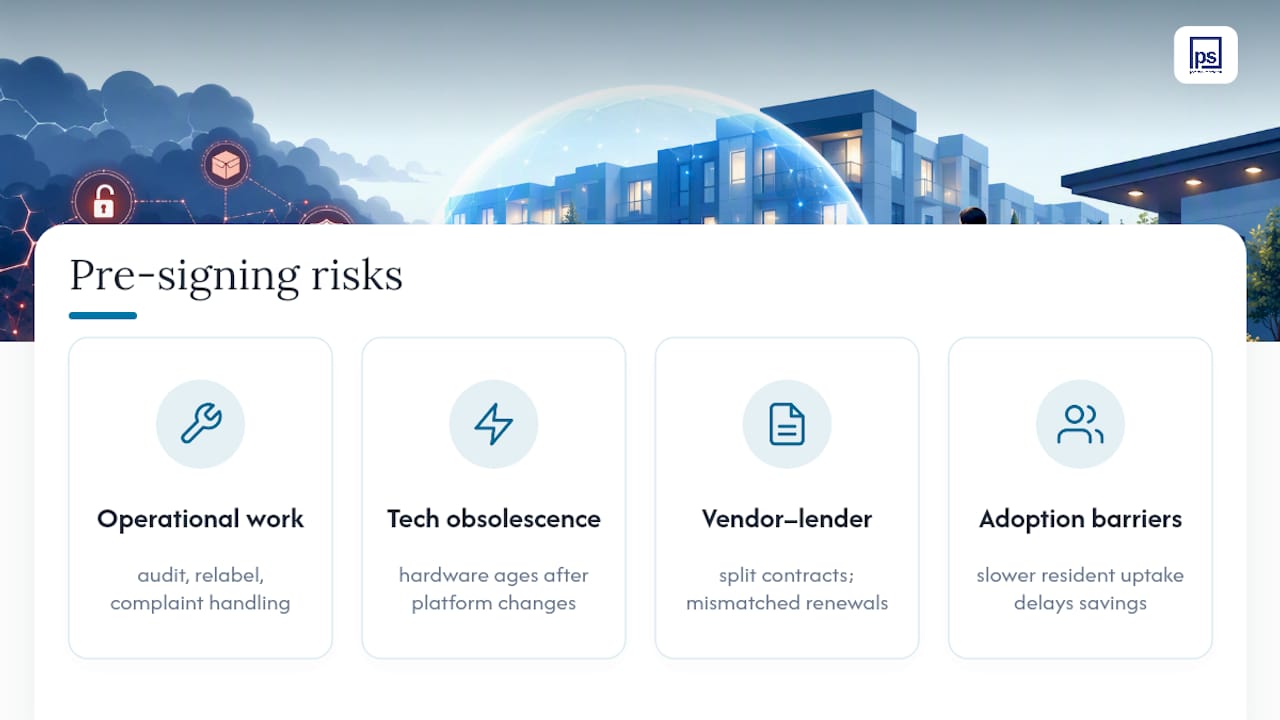
What Risks Should You Plan For Before You Sign?
Financing a locker system isn’t risk-free, and the biggest mistakes happen before the first payment is even due.
Underestimating operational workload tops the list. A locker system that looks self-service on paper still needs someone auditing overstuffed units, relabeling misdelivered packages, and handling resident complaints. Skip that line item in your ROI model and your realized savings will fall short of your financing payment, sometimes by a wide margin.
Technology obsolescence is a real contingency, particularly on longer loan terms. A seven-year loan on a locker system whose software vendor issues a major platform change every three years leaves you paying for hardware that no longer runs current features.
Vendor and lender mismatch creates friction too. Some lenders won’t finance software subscriptions bundled into hardware quotes, which can force you to split financing across two agreements with different terms and renewal dates. Ask this question before you submit an application, not after a term sheet comes back incomplete.
Adoption barriers deserve a mention as well. Research on on-premises parcel lockers found that upfront capital and ongoing costs slow adoption even when the operational case is strong, which is exactly why cost-sharing arrangements and vendor financing exist. Build a contingency line into your budget for a slower resident adoption curve than you expect, since that affects how quickly labor savings materialize and offset your payment.
What Postal Solutions Has Learned from 1,200+ Installations
Since 2016, Postal Solutions has sold and installed more than 1,200 Luxer One systems across over 40% of U.S. states, working with student housing, conventional multifamily, and institutional operators. The most common procurement mistake we see is a bare hardware quote with no installation, integration, or support pricing attached, which makes financing conversations harder than they need to be. Property teams that pair a locker system with managed package-room organizing consistently report a bigger gap between projected and realized labor savings, because someone is actually keeping the room current instead of letting friction pile up.
— Postal Solutions
Get a Financing-Ready Quote Before You Talk to a Lender
Postal Solutions sells and installs Luxer One package rooms and locker systems, and we build the itemized quote your lender or leasing company will actually want to see, broken out by equipment, installation, software, and support instead of one bundled number. Pair that hardware with our managed package-room organizing and you offset more of the payment through real labor savings, not projected ones. If you’re comparing a loan against a lease, we’ll help you model both scenarios on a 3- or 5-year basis so the numbers hold up under lender review. Visit our smart package lockers page to request a quote, or reach out directly to start building your financing package this week.
Sources
- Hotel equipment financing: The complete guide for hospitality business owners
- Smart locker installation cost guide
- Real estate equipment financing | PE carve-outs
FAQ
Is a locker system fee charged monthly or yearly?
It depends on the component: hardware financing payments are almost always monthly, while software licensing is typically billed annually with the first year often bundled into the purchase quote.
What are the disadvantages of financing a locker system instead of paying cash?
Financing adds interest cost over the loan or lease term, and it typically requires a lien on the equipment until the balance is paid off, though it preserves cash flow for other capital needs.
How much does a locker system typically cost to install?
Total installed cost varies by system size and site conditions, since it depends on electrical work, networking, and site prep in addition to the hardware itself; always request a full itemized quote rather than relying on a hardware sticker price.
How does locker system financing actually work?
A lender or vendor finance partner pays the equipment cost upfront, and you repay it through fixed monthly loan payments or lease payments, with the equipment itself typically serving as collateral rather than your real estate.
Can Postal Solutions help with the financing process itself?
Postal Solutions doesn’t act as a lender, but we produce the itemized, financing-ready quotes and documentation that lenders and leasing companies request during underwriting.