Outdoor Package Lockers: Procurement Risks for Property Managers
Outdoor Package Lockers: Procurement Risks for Property Managers Outdoor package lockers are a practical, secure fit for most apartment communities, and they cut staff time spent chasing packages while sharply reducing porch theft. The catc
Published
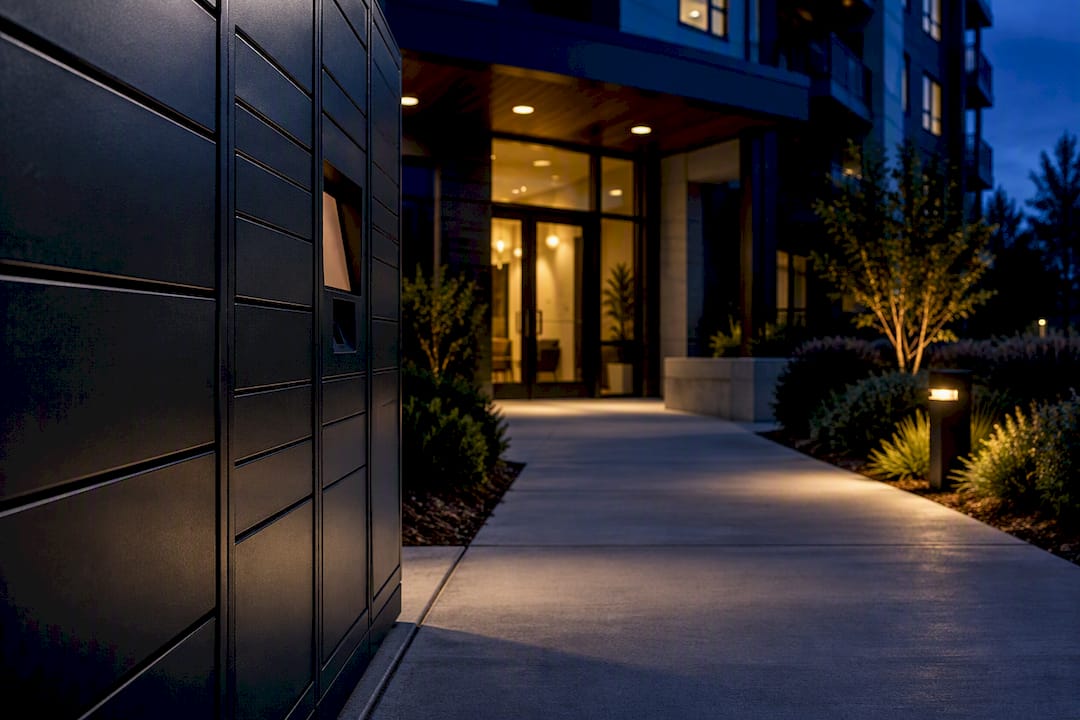
Outdoor package lockers are a practical, secure fit for most apartment communities, and they cut staff time spent chasing packages while sharply reducing porch theft. The catch: you need outdoor-rated hardware, not repurposed indoor units, and a proper site survey before you sign anything. Get those two things right and the payoff shows up fast in reduced complaints and freed-up staff hours.
TL;DR:
- Outdoor lockers require weatherproof features such as sealed compartments, rain lips, and UV-resistant finishes to withstand exterior exposure.
- Proper site planning includes drainage, approach routes, power and network access, lighting, and ADA compliance to prevent installation delays and damage.
- Certification documentation like UL reports and IP ratings are crucial, especially with new regulations requiring UL 60335-2-100 compliance by July 2026.
- Costs depend on capacity, finish, and refrigeration options, with installation typically adding tens of thousands of dollars, plus ongoing maintenance and service fees.
- Successful resident adoption hinges on early carrier onboarding, clear signage, simple how-to instructions, and routine pickup audits.
Table of Contents
- What Features and Benefits Should You Expect From Outdoor Package Lockers?
- Outdoor vs. Indoor Lockers: Which Fits Your Property?
- Site Planning and Installation Checklist for Outdoor Deployments
- Technical Specs, Safety, and U.S. Compliance Requirements
- Costs, Budget Planning, and Financing Considerations
- How Do You Get Residents to Actually Use the Lockers?
- How Postal Solutions Supports Outdoor Locker Deployments
- Why Lowest-Bid Procurement Backfires on Outdoor Lockers
- Ready to Plan Your Outdoor Locker Installation?
- Sources
- FAQ
What Features and Benefits Should You Expect From Outdoor Package Lockers?
Outdoor units live in a different world than their indoor cousins, and vendor spec sheets don’t always make that distinction obvious. Weatherproofing matters most: look for sealed electronic compartments, rain lips over door seams, and powder-coated or UV-rated finishes that resist fading and corrosion. Weather-resistant package lockers built for exterior exposure typically include overhang roof kits and gasketed doors designed to keep moisture out of the control board, not just the parcel bay.
Beyond materials, a handful of functional features separate a workable system from a maintenance headache:
- Modular compartment sizing so you can adjust the mix of small, large, and oversized bays as delivery patterns shift
- Multiple access methods (PIN codes, mobile app, RFID) so residents aren’t locked out by a single point of failure
- Automated notifications and a digital audit trail that logs every open and close event
- Direct integration with the property management software your leasing team already uses
- Documented uptime commitments and a clear path to spare parts, not just a support phone number
Ask vendors for real service-level numbers, not marketing language. A locker bank that goes dark for three days during a parts delay creates more resident friction than the theft problem it was meant to solve.
Outdoor vs. Indoor Lockers: Which Fits Your Property?
Outdoor placement wins on convenience: carriers can drop packages any time without buzzing into a locked building, residents get 24/7 pickup, and you reclaim lobby square footage that used to disappear under a pile of boxes. The tradeoffs are real too. Weather exposure, nighttime visibility, and the need for camera coverage all raise the planning bar compared to an indoor package room.
Here’s how to think through the decision:
- Choose outdoor when carrier access to the building is restricted, when lobby space is limited, or when the property spans multiple buildings with no central indoor hub.
- Choose indoor when you already have a secure mailroom and climate control matters more than 24/7 access, such as for temperature-sensitive deliveries.
- Choose hybrid when volume is high enough that a locker bank alone can’t absorb oversized items. Practitioner guidance on hybrid locker and package-room models recommends pairing outdoor lockers with a package room specifically to handle overflow during peak shipping weeks.
Most mid-size and larger communities land on the hybrid model once volume climbs.
Site Planning and Installation Checklist for Outdoor Deployments
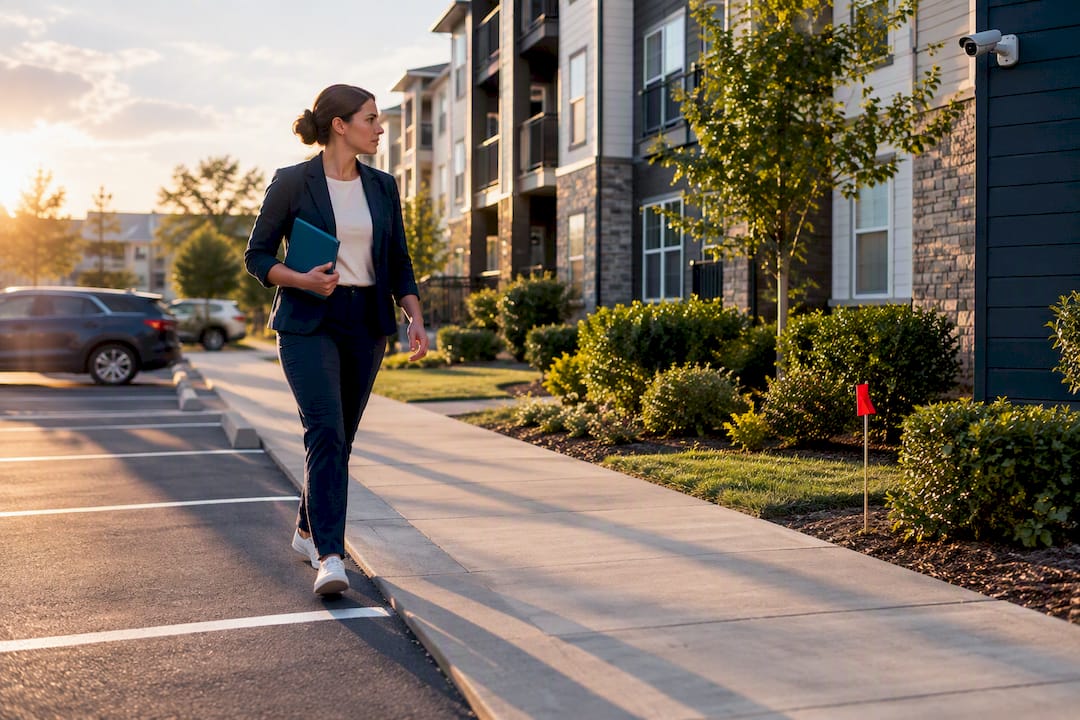
Outdoor installations fail more often from skipped groundwork than from bad hardware. Before you finalize a purchase order, walk the site with these items in hand:
- Confirm drainage away from the unit’s base and verify the concrete pad meets the manufacturer’s anchoring specifications
- Map carrier approach routes so delivery trucks and USPS carriers can reach the unit without blocking fire lanes or resident parking
- Document available power and network connectivity, including conduit routing and expected electrical load
- Plan lighting and camera sightlines that eliminate blind spots around the locker face
- Verify the approach path meets ADA accessibility requirements, including clear width and slope
- Install a protective canopy where exposure to direct sun or heavy rain is significant
- For elevated platforms or wind-exposed sites, consult a structural engineer on anchoring and wind-load tolerance
Site survey best practices call for documenting bolt patterns and conduit routing before the crew arrives, since change orders discovered mid-install routinely add days and unplanned cost.
Pro Tip: Walk the proposed site at the same time of day carriers typically deliver. Shadows, glare, and parking congestion look completely different at 10 a.m. versus 4 p.m., and that difference affects both camera placement and resident access.
Technical Specs, Safety, and U.S. Compliance Requirements
Certification paperwork is not a formality you can skip to save a week on procurement. Request three documents from any vendor before you sign: a current UL or third-party test report, the unit’s IP ingress rating, and electrical safety documentation covering the control panel and lock mechanism.
That paperwork matters more now than it did a few years ago. A regulatory update taking effect in July 2026 requires outdoor smart parcel lockers sold or imported into the United States to meet UL 60335-2-100 testing, covering electric shock protection, overheating protection, and flame-retardant enclosure grades. Units without valid, current certification risk being held at the port or pulled from sale entirely.
For property owners, that translates into a direct procurement risk: an uncertified unit can delay your installation timeline by weeks, and it can void manufacturer warranty support down the line. Rising parcel theft volumes reported industry-wide already put pressure on properties to move fast on locker installs. Don’t let an incomplete compliance file turn that urgency into a stalled project.
- Request the vendor’s most recent UL 60335-2-100 test report, dated within the current product revision
- Confirm the IP rating matches your climate exposure (coastal, desert heat, freeze/thaw cycles)
- Ask how certification status affects your warranty terms in writing, not verbally
Costs, Budget Planning, and Financing Considerations
Hardware cost scales with capacity, outdoor rating, refrigeration options, and cabinet finish. Installation for a typical mid-size property commonly lands in the tens of thousands of dollars once you factor hardware and site work together, with refrigerated compartments adding meaningfully to the total.
Installation costs move independently of hardware price and deserve their own line item:
- Concrete pad prep and anchoring
- Electrical and network trenching or conduit runs
- Canopy or shade structure if the site lacks natural cover
- Surveillance camera additions and permits where required by local code
Recurring costs then follow: a service agreement, routine maintenance, and any software subscription tied to the access system. When you build the ROI case for ownership, weigh staff hours currently spent sorting and searching for packages against the locker’s monthly cost, then factor in reduced theft claims. Properties that track this closely usually find the staff-time savings alone justify the investment within a year or two.
How Do You Get Residents to Actually Use the Lockers?
Adoption depends on how well you set up the first thirty days, not on the hardware itself. Follow this sequence:
- Onboard your carriers first: give USPS, UPS, FedEx, and Amazon drivers clear signage and simple drop-off instructions at the unit.
- Define your overflow policy before launch, deciding which items route to a package room versus the locker bank.
- Send residents a short, visual how-to guide at move-in and again at the launch date.
- Schedule recurring audits to reconcile pickups and catch faulty compartments before residents notice.
Pro Tip: Track adoption by monitoring the percentage of packages picked up within 24 hours during the first month. A slow climb usually points to unclear signage, not resident reluctance.
How Postal Solutions Supports Outdoor Locker Deployments
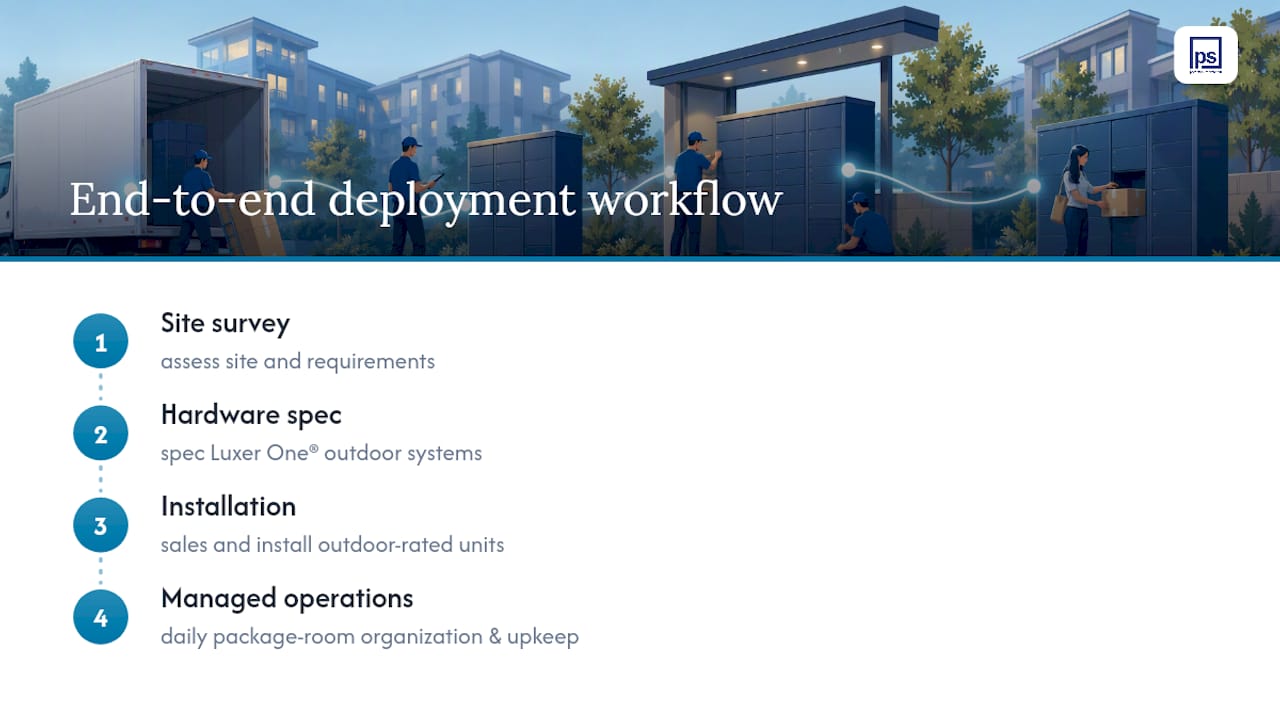
Postal Solutions runs the process end to end: a site survey, hardware specification, sales and installation of outdoor-rated Luxer One® systems, and ongoing package-room organization once the units go live. As a Luxer One sales partner with installation experience across more than 1,200 properties, we’ve built the survey-to-operations workflow so property teams don’t have to piece it together themselves. The typical engagement runs survey, then spec, then install, then managed daily operations. If your team has procurement bandwidth and a clear spec, self-sourcing is workable; if compliance verification and daily upkeep feel like a stretch, that’s exactly where a managed partner earns its keep.
Why Lowest-Bid Procurement Backfires on Outdoor Lockers
The most expensive mistake in this category isn’t overspending. It’s underspecifying. Property teams that award outdoor locker contracts on price alone routinely discover the unit lacks proper sealing, the site survey was skipped, or the certification paperwork doesn’t hold up. Each of those gaps turns into downtime, and downtime is what erodes resident trust faster than any single stolen package. Write your outdoor rating, IP class, and site-survey requirements directly into the RFP. Vendors who balk at documenting those specs in writing are telling you something.
— Postal Solutions
Ready to Plan Your Outdoor Locker Installation?
We give you a path most self-procurement projects miss: a single partner handling the site survey, certified hardware selection, installation, and the day-to-day organizing that keeps a package room or locker bank from sliding into chaos. Rather than juggling a hardware vendor, an electrician, and a separate operations plan, you get one point of contact experienced with similar systems across many properties nationwide.
Start your inquiry with three things ready: a rough site plan, your average weekly package volume, and your target installation timeline. From there, request a site survey, certification verification, and an installation quote through Apartment Package Management or explore Luxer One® Locker Solutions directly to see hardware options suited to your property’s size and climate.
Sources
The guidance in this article draws on published specification and regulatory sources worth reviewing directly:
- Are There Weather-Resistant Package Lockers for Properties With No Indoor Space? — Luxer One
- CPSC Rule takes effect for smart parcel lockers — SectorSourceHQ
- Package Lockers for Apartments: A Playbook for Security, Scale, and Resident Experience — Swiftlane
- Package lockers have become a real amenity in multi-family — Technology Install Partners
FAQ
How Do Outdoor Package Lockers Work at Apartments?
Residents receive a notification when a carrier deposits a package into an assigned compartment, then unlock that compartment using a PIN code, mobile app, or RFID credential. The system logs every open and close event, creating an audit trail property staff can review without physically checking the unit.
What’s the Best Package Locker Setup for an Apartment Community?
The right setup depends on package volume and site layout, but most mid-size and larger properties do best with a hybrid model combining an outdoor-rated locker bank with an indoor package room for oversized items. Hybrid models handle overflow more reliably than locker-only systems during high-volume periods like the holiday shipping season.
What Are Apartment Package Lockers Actually Called?
Industry professionals typically call them smart parcel lockers, automated package rooms, or residential parcel lockers, depending on the configuration. Luxer One is one widely installed brand name in this category, and Postal Solutions sells and installs Luxer One® systems for apartment and student housing communities.
How Much Does a Parcel Locker System Cost?
Hardware and installation for a typical mid-size property commonly falls in the tens of thousands of dollars, with site prep, electrical work, and refrigerated compartments adding to that baseline. Postal Solutions doesn’t publish fixed hardware pricing since costs vary by property size and configuration; request a quote through Luxer One® Locker Solutions for a figure specific to your site.