6–8 Week Pilot: University Package Lockers Playbook for Housing
6–8 Week Pilot: University Package Lockers Playbook for Housing Smart university package lockers give students secure, 24/7 pickup and cut mailroom queues dramatically, while freeing housing and facilities staff from hours of daily package
Published
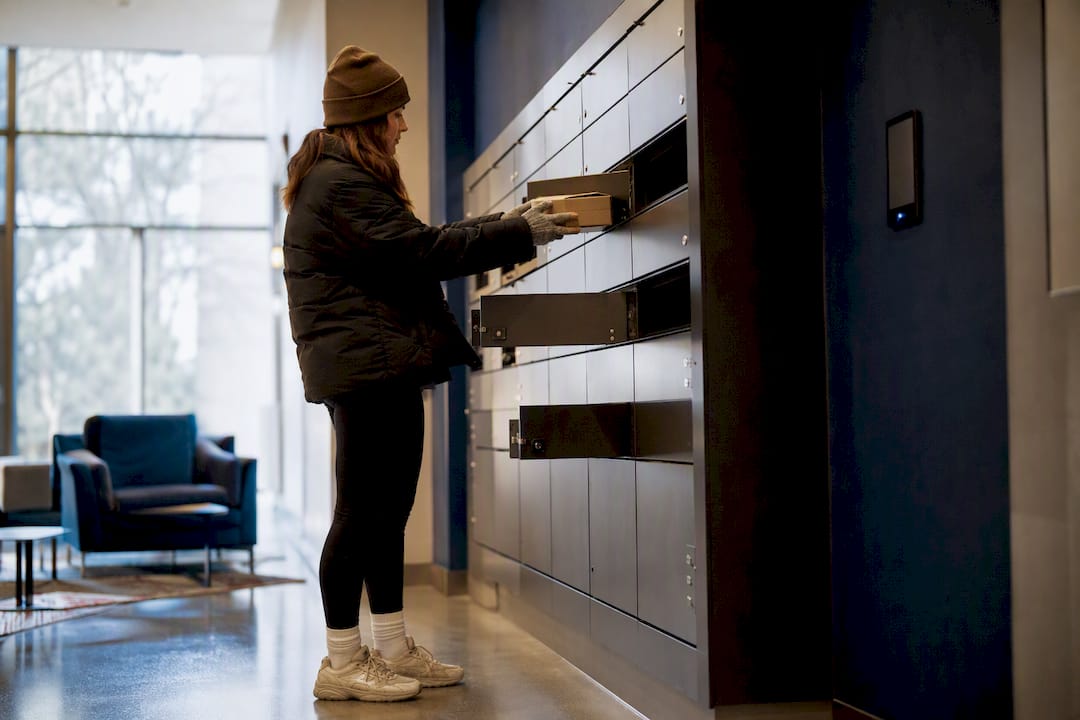
Smart university package lockers give students secure, 24/7 pickup and cut mailroom queues dramatically, while freeing housing and facilities staff from hours of daily package handling. Students, mailroom staff, and campus security all benefit: fewer lines at peak times, fewer lost or misdelivered parcels, and a searchable record of every pickup.
TL;DR:
- Lockers should be placed in high-traffic areas like residence hall lobbies and nearby academic buildings to handle peak package volumes efficiently.
- Scaling should focus on peak demand periods, such as move-in weeks, to avoid undersizing and student complaints.
- Operations require clear policies for retention, exceptions, and accessibility to ensure continuous, complaint-free service.
- IT integration must include campus ID systems, carrier APIs, and reporting tools to enable seamless system functioning and auditing.
- A phased pilot in the highest-volume location is recommended before expanding, with continuous monitoring of dwell times and capacity thresholds.
Table of Contents
- How Do University Package Lockers Work?
- Where Should You Place Campus Package Lockers?
- What Retention Policies and Staff Workflows Should You Set?
- What IT Integrations Does a Locker System Need?
- What Does a University Locker System Cost, and What’s the ROI?
- How Do You Pilot and Scale a Campus Locker Rollout?
- When Does a Managed Package Room Beat a Locker-Only Setup?
- Get a Site Survey or Pilot Quote from Postal Solutions
- Sources
- FAQ
How Do University Package Lockers Work?
The mechanics are simpler than most housing managers expect. A carrier arrives, scans a package, and deposits it into an open compartment sized to fit. The system assigns that compartment, logs the transaction, and fires off a notification within seconds. From there, the student handles the rest without ever needing staff involvement.
The retrieval flow generally runs through one of a few access paths:
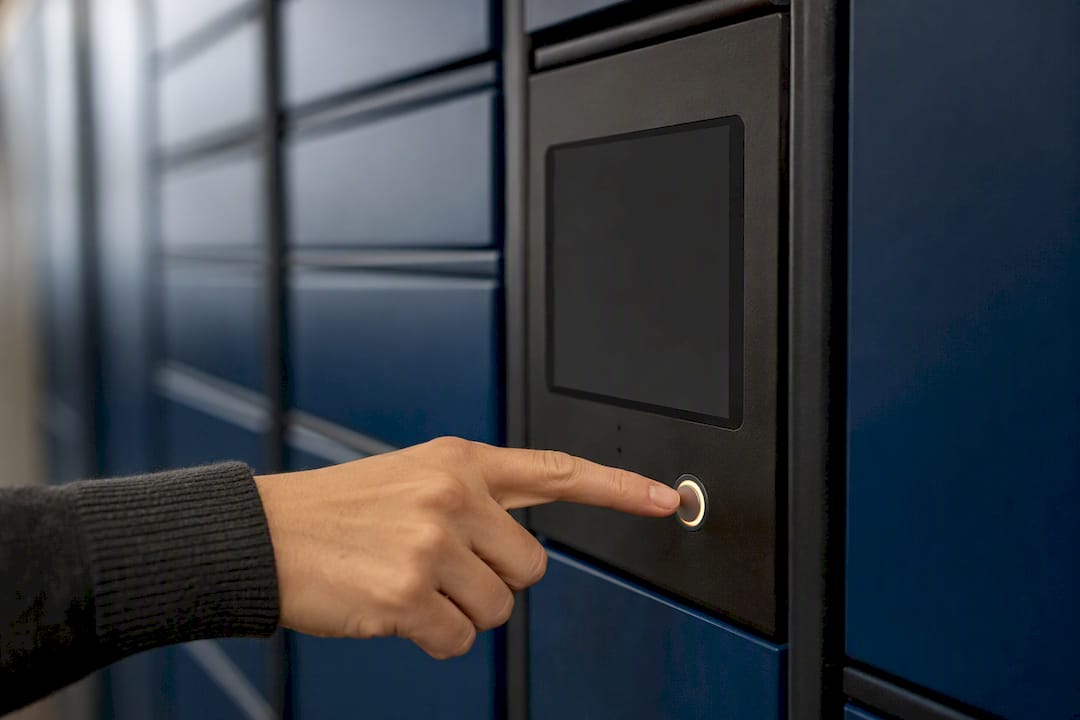
- QR code or PIN sent directly to the student’s phone or email
- Mobile app access tied to the student’s account
- Campus ID or badge integration for one-tap retrieval
- Kiosk fallback for students without a smartphone or app access
Notification speed matters more than most managers assume. UT Knoxville’s locker system pairs email alerts with app-based retrieval, and that immediacy is what keeps students from flooding the mailroom with “where’s my package” calls. Oversized items, like furniture or bulk textbook orders, still need to route to a staffed mailroom or loading dock. No locker bank, no matter how large, replaces that overflow path entirely.
Where Should You Place Campus Package Lockers?
Placement decisions come down to foot traffic, not convenience for the maintenance team. The strongest locations tend to be:
- Residence hall lobbies, where students already pass through daily
- Mailroom-adjacent hallways, so overflow items have a clear staffed backup
- Satellite hubs near dining halls or academic buildings, for commuter students or apartment-style housing spread across a larger footprint
Sizing should track peak daily package volume, not average volume. A hall that receives 40 packages a day in October can see 300 or more during the fall move-in surge or the December gift rush, and undersized banks during those weeks are the single biggest source of student complaints.
Distributed banks across multiple residence clusters generally produce faster pickup and shorter queues than one large centralized bank, according to a university case study on campus package management. Indoor placement protects hardware and reduces weatherproofing costs, but outdoor kiosks near high-traffic entry points can serve commuter or off-campus populations that never enter a residence hall.
Pro Tip: Run your pilot in the highest-volume hall on campus, not the easiest one to access. If lockers can absorb that hall’s peak load, scaling to quieter buildings is straightforward. Testing on a low-volume hall first tells you almost nothing about how the system holds up during move-in week.
What Retention Policies and Staff Workflows Should You Set?
A locker system is only as good as the policy wrapped around it. Most campuses land on a retention window between 3 and 7 days before a package gets flagged for staff review, with an immediate pickup notification followed by reminders at 24 and 48 hours if the compartment stays full.
Oversized or flagged deliveries need a documented exception path. Someone on staff should own that queue daily rather than letting it pile up until a compartment jams.
The operational payoff shows up in what disappears from a staff member’s day:
- No more manually logging incoming packages by hand
- No more searching a crowded mailroom shelf to match a name to a box
- No more answering repeated “has my package arrived” phone calls
- No more fielding complaints about lines during peak pickup hours
Accessibility can’t be an afterthought. ADA-compliant compartment heights, alternate retrieval for students with mobility limitations, and a clear escalation process for guests or proxy pickups all need to be written into policy before launch, not patched in after a complaint. Princeton’s Print and Mail Services FAQ is a useful model for how to communicate access rules tied to campus ID systems in plain language.
What IT Integrations Does a Locker System Need?
Facilities teams often underestimate how much of this project belongs to IT, not maintenance. Before a locker bank goes live, confirm these integrations are mapped and tested:
- Campus SSO or ID system, so students log in with credentials they already use
- Student directory sync, to keep names and unit assignments current each semester
- Carrier scanning or API hooks, so USPS, UPS, FedEx, and Amazon deliveries route into the system automatically
- Mailroom inventory software, if the campus already runs a package-tracking platform
Reporting needs matter just as much as the front-end experience. Pickup timestamps, access logs, and retention audit trails should be exportable, since housing directors and auditors will eventually ask for them. Student data access should be limited strictly to what retrieval requires, avoiding any storage of information beyond name, unit, and pickup history. Most campuses budget a few weeks of IT staff time for initial integration testing, plus ongoing time each semester when directory data refreshes.
What Does a University Locker System Cost, and What’s the ROI?
Budgeting breaks into five buckets: hardware, installation and site prep, software or subscription fees, connectivity, and ongoing maintenance. None of those is optional, and skipping site prep is the most common budgeting mistake facilities teams make.
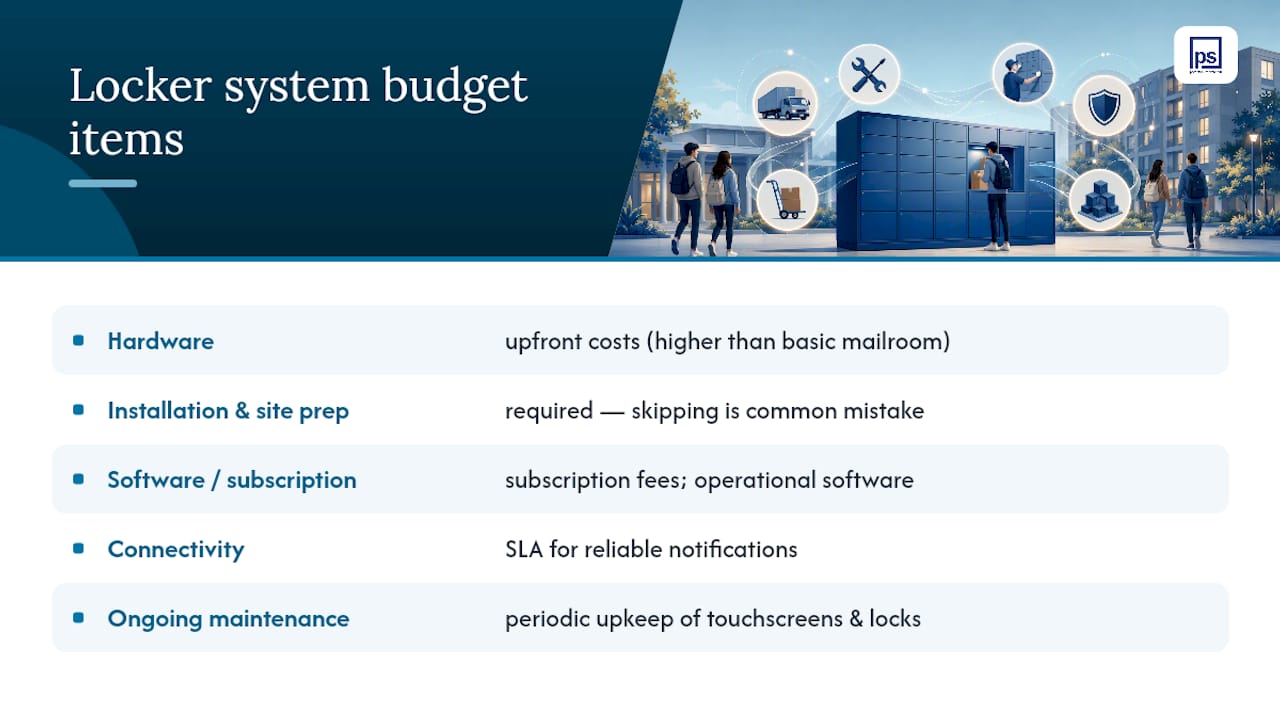
The payback case comes from labor, not hardware savings. If a mailroom currently spends staff-hours per 100 packages logging and handing off parcels manually, and a locker system reduces that to a near-automated process, the savings compound fast during peak season. Luxer One’s industry guidance notes that upfront costs run higher than a basic mailroom setup, but the operational return, measured in reduced staff hours and dramatically lower package-theft incidents, tends to close that gap within one to two academic years for high-volume campuses.
Less obvious costs include power runs to each bank, a connectivity service-level agreement to keep notifications reliable, and periodic maintenance for touchscreens and locking mechanisms. Build those into year-one budgeting, not as a surprise line item in year two.
How Do You Pilot and Scale a Campus Locker Rollout?
A phased approach protects your budget and your credibility with campus leadership. The sequence that works:
- Pre-pilot: secure stakeholder sign-off, complete a site survey, contact major carriers about your delivery workflow, and record baseline metrics like average pickup wait time and current mailroom staff hours
- Run a 6 to 8 week pilot in your highest-volume location, tracking pickup time (target under 5 minutes), dwell time distribution across 24, 48, and 72 hours, staff-hours saved per 100 packages, and the uncollected-package rate
- Scale decisions: add bays once dwell time in the pilot bank consistently exceeds capacity, and set an audit cadence, typically weekly, alongside a training refresh each semester for new student staff
This pilot framework mirrors guidance from industry best-practice research on smart locker deployment, and it lines up with the KPI thresholds Postal Solutions uses when supporting hardware sales, installation, and optional managed daily organizing visits with weekly audits.
Pro Tip: Track dwell time in buckets, not averages. A locker bank with a great average pickup time can still hide a bottleneck if 20 percent of packages sit past 72 hours. That’s the number that predicts your next capacity problem.
When Does a Managed Package Room Beat a Locker-Only Setup?
Lockers solve throughput. They don’t solve every operational headache on a campus with multiple residence halls, inconsistent carrier drop-off times, and student staff turnover every semester. In those situations, a managed daily organizing visit with weekly audits catches the problems lockers alone miss: mislabeled boxes, overflow during move-in surge, and compartments left jammed over a long weekend.
Our guidance: self-managed lockers work well for steady-volume campuses; pair lockers with managed visits when your peak-season surge regularly outpaces staff capacity.
— Postal Solutions
Get a Site Survey or Pilot Quote from Postal Solutions
Postal Solutions is the practical middle ground between a locker-only install and a fully staffed mailroom. As a Luxer One premier partner with more than 1,200 systems sold and installed nationwide, Postal Solutions handles the hardware sale and installation, then layers on optional daily organizing visits and weekly audits so packages never pile up between deliveries.
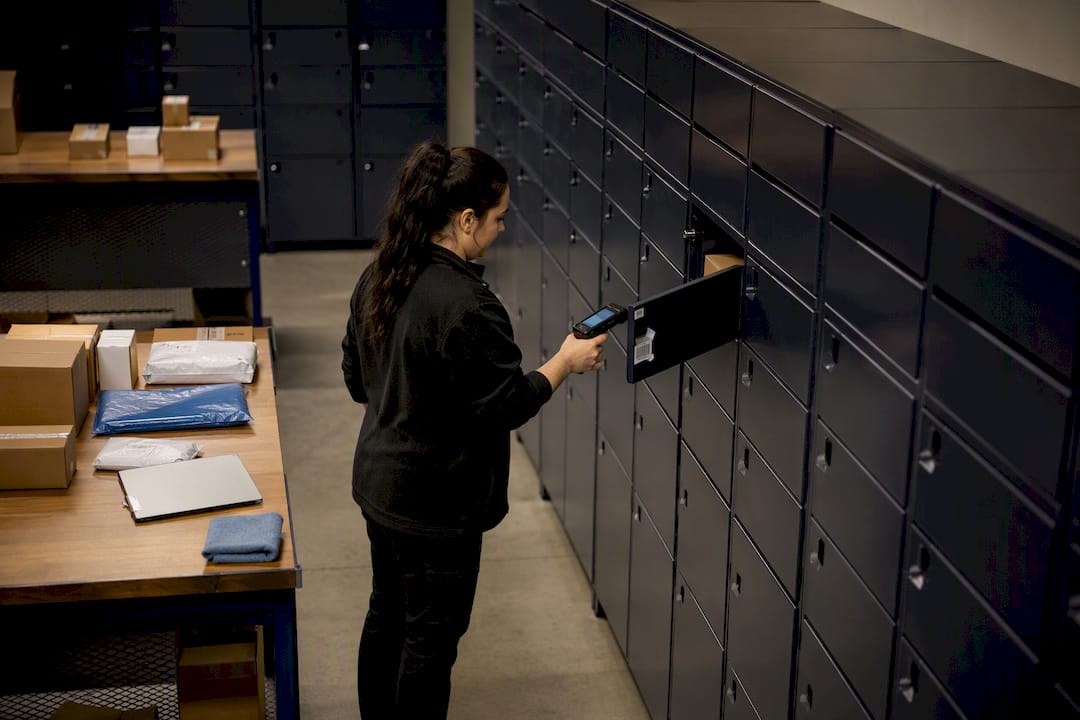
A combined hardware-plus-managed approach removes the guesswork of running a pilot alone: no scrambling to staff move-in week, no unaudited backlog during finals. To start, request a site survey through Postal Solutions with your current package volume, building layout, and carrier mix ready to share. Housing teams evaluating placement across dorms should also review the white paper on package-room workflows before finalizing a pilot location. Facilities teams weighing access control near common areas may find guidance on automated entry systems useful when planning locker bank security alongside building access points.
Sources
Several universities publish their locker policies publicly, which makes them useful reference points when drafting your own. Tulane’s Mail Services page lists specific locations and pickup windows. Princeton’s Print and Mail Services covers access rules tied to campus ID systems. For a vendor-side view of best-practice operational models, Luxer One’s university guidance walks through scalability and integration planning in more depth than most campus FAQ pages attempt.
- UT Package Lockers | University Printing & Mail
- Package Lockers - Print and Mail Services - Princeton University
- What is the Best Way to Manage Packages in a University? | Luxer One
FAQ
What Are University Package Lockers Called?
They’re most commonly called smart lockers, parcel lockers, or automated package lockers. Some campuses also use “package pods” or “locker banks” in internal facilities documentation.
What Are the Downsides of Using Parcel Lockers?
The main downsides are upfront hardware and installation cost, the need for ongoing IT integration support, and the fact that oversized packages still require a staffed mailroom fallback. Maintenance and connectivity service agreements also add recurring costs beyond the initial purchase.
Do School Lockers Still Exist?
Traditional hallway lockers for personal belongings have declined at many K-12 and college campuses, but package lockers are a separate category entirely and are expanding fast, especially in residence halls and student housing complexes.
How Do Package Lockers Work?
A courier scans and deposits a package into an assigned compartment, the system sends an instant notification, and the student retrieves it using a QR code, PIN, app, or campus ID badge. The full transaction is logged automatically for audit purposes.
Are Package Lockers Worth the Investment for a University?
For most mid-to-large campuses, yes: reduced staff hours, lower theft incidents, and 24/7 student access typically offset the upfront hardware cost within one to two academic years, especially when paired with managed organizing support during peak seasons like move-in and finals.