Correct Apartment Address Format for Deliveries
Correct Apartment Address Format for Deliveries Here is the format that follows USPS standards and cuts down on delivery exceptions: Jordan Ramirez 482 Willow Creek Dr Apt 3B Austin, TX 78704 When the street name is long and the unit won’t
Published
Get the apartment line right before the package ships
Use the examples below to place the apartment number, choose USPS-standard abbreviations, and reduce avoidable address exceptions. Property operators can also review our daily student housing mail management service.
Explore mail management
Here is the format that follows USPS standards and cuts down on delivery exceptions:
Jordan Ramirez 482 Willow Creek Dr Apt 3B Austin, TX 78704
When the street name is long and the unit won’t fit on that line, USPS wants the unit placed above the delivery line instead of below it:
Jordan Ramirez Apt 3B 482 Willow Creek Dr Austin, TX 78704
The core rule is simple: put an approved unit designator like APT, STE, or UNIT at the end of the delivery address line, and always keep city, state, and ZIP on the final line by themselves.
- Use a USPS-approved abbreviation, not a made-up label like “Unit No.” or “Apartment”
- Confirm the ZIP code before shipping, since automated sorting relies on it heavily
- Skip the pound sign (#) when you already know the correct designator
Key Takeaways
Correct apartment address formatting means placing the USPS-approved unit designator at the end of the delivery line, keeping city, state, and ZIP accurate on the final line, and matching that same structure across every carrier and resident-facing form.
| Point | Details |
|---|---|
| Unit designator placement | Put APT, STE, UNIT, FL, RM, or DEPT at the end of the delivery address line whenever the line has room. |
| Long addresses | Move the unit designator to its own line directly above the delivery address, never below it. |
| ZIP accuracy matters most | Sorting machines read city, state, and ZIP first, so a mismatch there causes misrouting before the street address is even checked. |
| Fix missing-unit exceptions fast | Send the shipper a tracking number, corrected address, and phone number in one short message. |
| Standardize at lease signing | Require a locked unit-designator field on lease forms and tenant portals instead of a free-text address box. |
Table of Contents
- USPS Rules for Apartment Address Format
- Why Do Packages Get Delivery Exceptions?
- How Do You Address Packages for Package Rooms and Gated Buildings?
- Standardizing Apartment Addresses: A Manager’s Checklist
- Formatting Apartment Addresses for International Deliveries
- Do UPS, FedEx, and DHL Format Apartment Addresses Differently?
- Our Take on Apartment Address Standards
- Sources
- FAQ
USPS Rules for Apartment Address Format
Automated sorting equipment doesn’t read an address the way a person does. It scans from the bottom up, meaning it locates the city, state, and ZIP Code first, then works upward to the delivery address line. If that bottom line is wrong or the unit number is buried in the wrong spot, the machine can misroute or delay the piece before a human ever sees it.
USPS maintains an official list of secondary unit designators. Use these instead of writing out “Apartment” or inventing your own shorthand:
- APT — apartment
- STE — suite
- FL — floor
- UNIT — unit
- RM — room
- DEPT — department
These abbreviations, along with the placement rule that puts the designator at the end of the delivery address line, are exactly what automation is trained to recognize. A properly formatted example looks like this:
482 Willow Creek Dr Apt 3B
If the street name runs long and the unit number would push the line past a reasonable length, move the unit designator to its own line directly above the delivery address, never below it. That single positioning choice keeps the parcel readable to both a human sorter and a machine.
The pound sign (#) is technically allowed, but only when you don’t know the correct designator. If you do use it, always leave a space before the number: 482 Willow Creek Dr # 3B. Skip it entirely once you know the real designator.
Nearly 25% of all mailpieces carry some kind of addressing error, and a missing or misplaced apartment number is one of the most common culprits. Adding ZIP+4 when you know it tightens accuracy further, and you can verify any ZIP code in seconds through the USPS ZIP Code Lookup tool before a package ever ships.
Why Do Packages Get Delivery Exceptions?
Three mistakes account for most delivery exceptions in multifamily buildings, and each one has a fast fix.
Missing apartment or unit number. This is the single most frequent cause of an “address not found” exception. When it happens, send the shipper or carrier a short, clean message rather than a long explanation:
Tracking #: [number] Corrected address: [Name], [Street Address] Apt [Number], [City, State ZIP] Phone: [number]
Carriers and shipping platforms recommend this exact format because it gives their team everything needed to reroute the package without back-and-forth questions.
City, state, and ZIP mismatches. Since sorting machines read that bottom line first, a ZIP code that doesn’t match the city or state sends the package to the wrong regional facility before anyone notices. Run the address through the USPS ZIP lookup tool before shipping, especially for buildings near a ZIP boundary or a recently renumbered street.
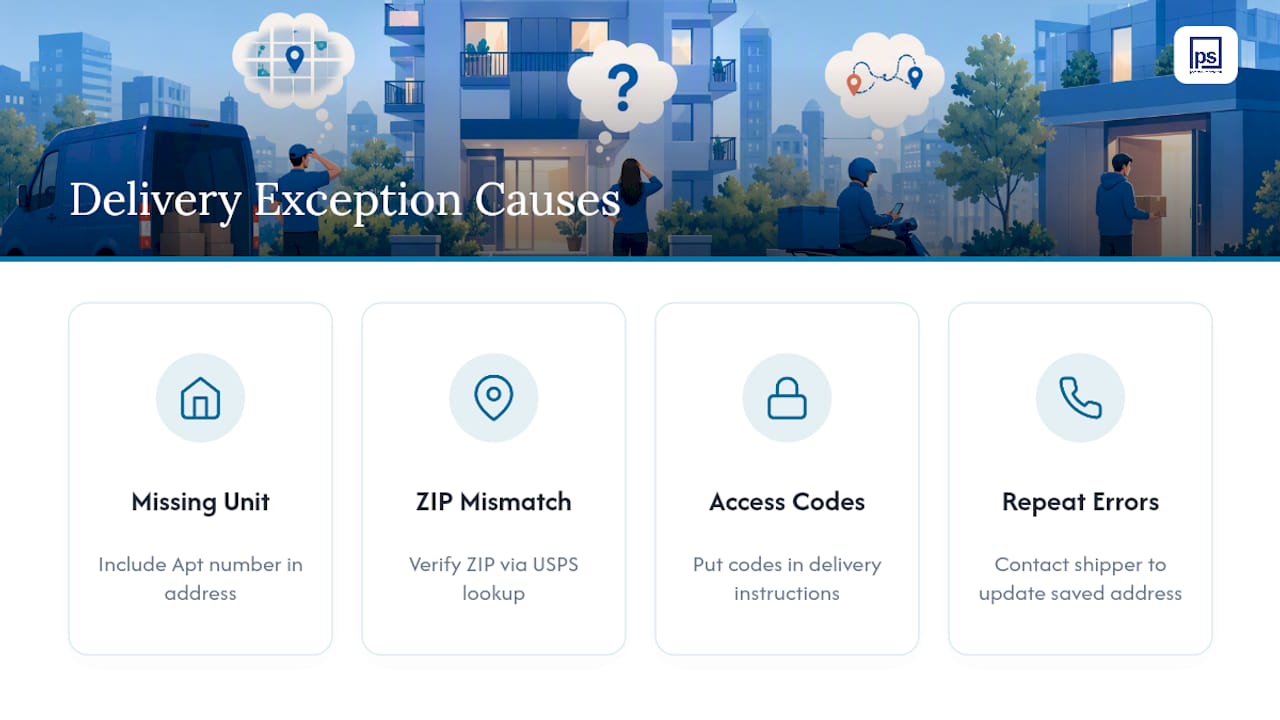
Access codes in the wrong field. Gate codes, buzzer numbers, and “leave with leasing office” notes belong in a carrier’s delivery instructions field, never inside the address itself. Mixing the two confuses automated readers and can bump the address line past the character limit that keeps it machine-readable.
Pro Tip: If a package has already bounced back once for a bad address, don’t wait for a second attempt. Contact the shipper immediately with the corrected address template above. Carriers move faster on a proactive correction than on a live misdelivery.
When a single mistake repeats across multiple deliveries, that points to a listing error, not a one-off typo. That’s the moment to contact the shipper’s customer service team directly and ask them to update the saved address on file.
How Do You Address Packages for Package Rooms and Gated Buildings?
Centralized package rooms, lockers, and gated communities all add a layer between the street address and the resident, and getting that layer wrong is what causes most misdeliveries in these settings.
- Recipient line first. Full name, then the unit designator (Apt 3B, Unit 214), then the standard street address and city/state/ZIP. Any carrier instructions, such as a locker code or gate entry note, go in the delivery instructions field, not the address block.
- Building identifiers need a consistent placement. If your property has multiple buildings, write “Bldg A” or “Tower 2” directly above the delivery address line, in the same spot USPS reserves for unit designators. Never insert it mid-line, where it can break automated parsing.
- Gated communities and mailbox clusters benefit from early planning. Properties that consult with a local postmaster during construction or a mailroom redesign avoid the delivery refusals that come from routes USPS considers inefficient or inaccessible, a point NAA’s package management guidance raises directly for new developments.
- Locker or package-room IDs stay separate from the address. The delivery address should still resolve to the resident’s actual unit; the locker number or pickup code belongs in delivery notes so the carrier can find the right slot after the package physically arrives.
Standardizing Apartment Addresses: A Manager’s Checklist
Most delivery exceptions at a property trace back to inconsistent data entry, not carrier error. Fixing it starts at move-in, not at the package room.
Require these exact fields on every lease application and tenant portal entry: full legal name, street address, USPS-approved unit designator, city, state, ZIP, and a phone number. Locking the unit-designator field to a dropdown of APT, STE, UNIT, or FL, rather than a free-text box, prevents residents from typing “Apt.,” “#,” or “Unit No.” interchangeably across your system.
On the operations side, daily package-room habits matter as much as the address on the label. A consistent labeling routine, one that highlights or handwrites the unit number clearly on every box, paired with weekly audits against your package-room software, catches mislabeled parcels before they turn into a resident complaint. This is the daily discipline Postal Solutions builds into its outsourced package-room management for apartment and student housing communities: a team member visits the property, organizes incoming packages, marks unit numbers clearly, and reconciles the log against what the software shows on hand.
Properties juggling high package volume, especially student housing with predictable delivery surges each semester, often reach a point where a monitored locker system pays for itself in staff time recovered. Postal Solutions sells and installs Luxer One package room and locker systems for exactly that reason, and pairs the hardware with six-day-per-week managed visits so the room stays organized and audited without adding headcount to the leasing office.
- Require a standardized address field set at lease signing, not just a single “address” text box
- Post move-in instructions that show residents the exact address format to give shippers
- Keep a laminated address-format card at the leasing desk for quick resident reference
Pro Tip: Give new residents a one-line sample address in their welcome email, using their actual unit number filled in. A template they can copy directly into a shipping form beats a paragraph explaining the rule.
Formatting Apartment Addresses for International Deliveries
International carriers don’t follow USPS conventions, so an apartment address bound for a U.S. building from overseas needs a different structure than a domestic label.

Most countries place the unit or apartment designation before the street number and name, and international postal services generally expect the recipient’s full name on its own line, followed by the unit and building details, then the street address, city, state, and ZIP, and finally the country name in capital letters on its own last line. Leaving “UNITED STATES” off the final line is a common reason international parcels stall in customs or get misrouted to the wrong national sorting hub.
Residents receiving packages from abroad, or property managers fielding questions from international students in off-campus housing, should tell senders to keep the U.S. portion of the address in the standard domestic format described earlier: unit designator at the end of the delivery line, then city, state, ZIP. The only addition is the country name beneath it. Skipping USPS-style abbreviations in favor of a home-country format (writing “Wohnung” instead of “Apt,” for example) is a frequent source of confusion once the package reaches the U.S. sorting network, since domestic automation is built around the approved English-language designators.
For high-volume student housing properties with a large international resident population, distributing a one-page address template in the welcome packet, showing the exact U.S. format senders overseas should use, prevents a recurring category of “insufficient address” exceptions before they start.
Do UPS, FedEx, and DHL Format Apartment Addresses Differently?
USPS publishes the most detailed public standard for apartment addressing, but private carriers generally follow the same structural logic: unit number, street address, then city, state, ZIP. Where they diverge is in how much room their systems and drivers have for judgment calls.
UPS and FedEx route many multifamily deliveries through drivers who scan a barcode and physically locate the unit, rather than relying purely on automated sorting. That means a clearly handwritten or highlighted unit number on the package itself often matters as much as how the shipping label was formatted, especially at large complexes with confusing signage. DHL, handling more international volume, tends to be stricter about complete formatting, including the country name, since its packages cross a customs boundary that domestic UPS and FedEx shipments never see.
None of the three carriers publish a secondary-unit-designator list as detailed as USPS Publication 28, so the safest approach is to use the USPS-approved abbreviations regardless of which carrier is shipping the package. APT, STE, and UNIT are recognized across the industry even though only USPS formally standardizes them. Where private carriers genuinely differ from USPS is delivery access: a UPS or FedEx driver may need a gate code or buzzer number that USPS letter carriers, who often have a master key or cluster box, don’t require. Keep that access information in the courier’s delivery-instructions field on the shipping platform, not inside the address block itself.
Our Take on Apartment Address Standards
Most advice on this topic treats address formatting as a resident problem: tell people to write “Apt 3B” correctly and move on. That misses where the real breakdown happens. A resident can format an address perfectly and a package still gets misdelivered if the property’s own signage, package-room labeling, and lease-form address fields aren’t built around the same USPS conventions.
The fix isn’t better resident education alone. It’s matching the front end, how tenants are told to write their address, to the back end, how staff label and audit incoming packages against that same standard. Properties that lock unit-designator fields on move-in forms and pair that with consistent daily labeling in the package room see fewer “insufficient address” exceptions than properties relying on resident awareness alone.
If you manage a property, standardize the intake form first. Everything downstream, from carrier accuracy to package-room chaos, traces back to that one data field.
— Postal Solutions
Sources
These are the primary references behind the formatting rules and operational recommendations in this guide.
- Delivery Address | Postal Explorer
- Package Management (National Apartment Association guidance)
- Insufficient Address on Package: How to Fix It | ParcelTrack Online
FAQ
What Is the Correct Apartment Address Format?
Write the unit designator, such as APT or UNIT, at the end of the street address line, then put city, state, and ZIP on the final line by themselves. If the line is too long, move the unit designator above the street address instead.
Should I Use a Pound Sign or APT for My Apartment Number?
Use APT, STE, or UNIT whenever you know the correct designator. The pound sign is allowed only when you’re unsure of the proper abbreviation, and it needs a space before the number if used.
Why Did My Package Get Delivered to the Wrong Unit?
A missing or misplaced apartment number is the most common cause, since sorting machines read city, state, and ZIP first and may not process an unclear unit number correctly. Sending a corrected address with the tracking number to the shipper usually resolves it quickly.
Where Do Gate Codes or Locker Numbers Go on a Package?
Access codes, buzzer numbers, and locker IDs belong in the carrier’s delivery instructions field, not inside the address itself. Mixing them into the address block can confuse both human sorters and automated readers.
Do UPS and FedEx Use the Same Apartment Address Rules as USPS?
They follow the same general structure but rely more on drivers physically locating the unit rather than pure automation. Using USPS-approved abbreviations like APT and UNIT is still the safest choice across every carrier.