Property Managers: Cut Failed Apartment Deliveries with SOPs and KPIs
Property Managers: Cut Failed Apartment Deliveries with SOPs and KPIs Most apartment delivery failures trace back to two things: broken building access and inconsistent intake procedures, with theft close behind once packages sit unclaimed.
Published
Most apartment delivery failures trace back to two things: broken building access and inconsistent intake procedures, with theft close behind once packages sit unclaimed. The single fastest fix is posting a pictorial intake standard operating procedure at the delivery entrance and enforcing it with every carrier. Properties that do this see fewer bypassed scans, fewer misdelivered units, and fewer angry calls within days.
TL;DR:
- Posting a pictorial standard operating procedure at the delivery entrance reduces missed scans and misdeliveries within days, cost-effectively improving compliance.
- Standardizing address formats and marking clear intake zones help prevent guesswork that often causes delivery failures and unclaimed packages.
- Frequent audits, carrier-specific documentation, and immediate resident notifications decrease bypassed scans and curb theft risks associated with long dwell times.
- Using hybrid storage models like lockers, smart rooms, and overflow plans tailored to property size optimizes package handling capacity and reduces failed deliveries.
- Engaging managed services for ongoing organizing and audits can significantly lower failure rates and free property staff from daily package management burdens.
Table of Contents
- What Causes Failed Delivery Apartments to Rack Up So Often?
- What Should You Fix First, Today?
- How Do You Get Carriers to Actually Follow Your Intake Process?
- Lockers, Smart Rooms, or Off-Site: Which Storage Model Fits Your Property?
- Which KPIs Prove Your Fixes Are Working?
- How Postal Solutions Supports Property Teams on Package Operations
- Why Package Operations Deserve the Same Attention as Renewals
- Ready to Fix Your Property’s Package Operations?
- Sources
- FAQ
What Causes Failed Delivery Apartments to Rack Up So Often?
A “failed” delivery notification rarely means the carrier gave up randomly. It usually means one specific link in the chain broke, and the same handful of failure modes repeat across nearly every multifamily property in the country.
Building access problems top the list. A broken intercom, a vestibule that locks automatically, or a gate code that changed last month without notifying carriers all stop a driver cold before the package ever reaches a resident’s door or the package room.
Address ambiguity is next. Missing apartment or unit numbers, inconsistent formatting between the leasing system and what residents write on their own labels, and vague delivery notes (“leave with neighbor,” “side door”) create guesswork that carriers resolve by marking the delivery failed rather than guessing wrong.
Carrier non-compliance compounds both problems. Drivers under time pressure sometimes bypass intake procedures entirely, dropping boxes in a lobby corner without scanning or logging them, which is a leading cause of package system breakdowns according to industry frameworks that study multifamily’s package management problem.
Other recurring culprits include:
- Oversized or overflow items that don’t fit assigned lockers, left unsecured in hallways
- Porch piracy and theft from unmonitored common-area storage
- Staff interruptions during peak hours that break the handoff chain between shifts
- Inconsistent labeling that leaves packages unclaimed until residents give up searching
What Should You Fix First, Today?
You don’t need a six-month capital project to cut apartment package not delivered complaints. Start with the highest-impact, lowest-cost moves and layer from there.
- Post the pictorial SOP in three places: the delivery entrance, the front desk, and inside the package room itself. Photos of the correct drop zone, scanning requirement, and staging shelves communicate faster than any written memo, and posting them at the entrance is one of the cheapest interventions a property can make to reduce driver confusion.
- Standardize address guidance at move-in. Give leasing staff a script that tells new residents exactly how to format their unit number for every carrier, not just USPS.
- Mark a clear intake and staging zone with signage that tells drivers precisely where packages go and what counts as an acceptable drop.
- Turn on a resident notification cadence. Alert on arrival, then follow up at 48 hours and again at 96 hours if a package sits unclaimed, since longer dwell time raises theft risk.
- Build a temporary overflow plan before peak season hits. Repurpose an underused room or add exterior lockers so November and December volume doesn’t collapse your intake zone.
Pro Tip: Laminate the pictorial SOP and zip-tie it to the delivery door frame. Paper signs disappear or fade within a season; laminated ones survive an entire peak cycle.
None of these fixes require new hardware. They require discipline, and a week of consistent enforcement will show up in your failure numbers before the month is out.
How Do You Get Carriers to Actually Follow Your Intake Process?
Hardware and signage only work if carriers use them correctly every single time. That means building a carrier-facing system, not just a resident-facing one.
Start with a one-page SOP built specifically for drivers: what to scan, exactly where to stage packages, and what to do with oversized items that won’t fit standard slots. Attach this packet to your carrier onboarding conversation rather than assuming a driver will figure it out on day one. Where your locker or package room system supports it, issue driver PINs or single-use QR codes so every entry is logged to a specific carrier and a specific delivery window.
Monitoring matters as much as the initial setup. Run periodic scan audits comparing what your system logged against what actually arrived, keep an exception log for bypassed intake, and review both weekly rather than monthly. Waiting a month to catch a pattern means a month of residents filing missing package apartment complaints.
When a carrier bypasses your process, document it specifically: date, carrier, driver if identifiable, and what rule was broken. Escalation works better with evidence. Notify affected residents immediately, and where the pattern repeats, report it through the carrier’s commercial account channel or, for USPS-related issues, through your postmaster contact.
A short carrier onboarding checklist covers the essentials:
- Confirm access credentials and hand over the driver SOP packet
- Walk the physical route from entrance to staging zone
- Set expectations on scanning and oversized-item handling
- Establish a point of contact for exceptions
Pro Tip: Keep your exception log in a shared spreadsheet accessible to every shift. A bypass caught by the morning team is useless if the evening team doesn’t see it.
Lockers, Smart Rooms, or Off-Site: Which Storage Model Fits Your Property?
The right storage model depends on your unit count, staff levels, and how much floor space you can dedicate. There’s no universal answer, but the trade-offs are consistent enough to map out.
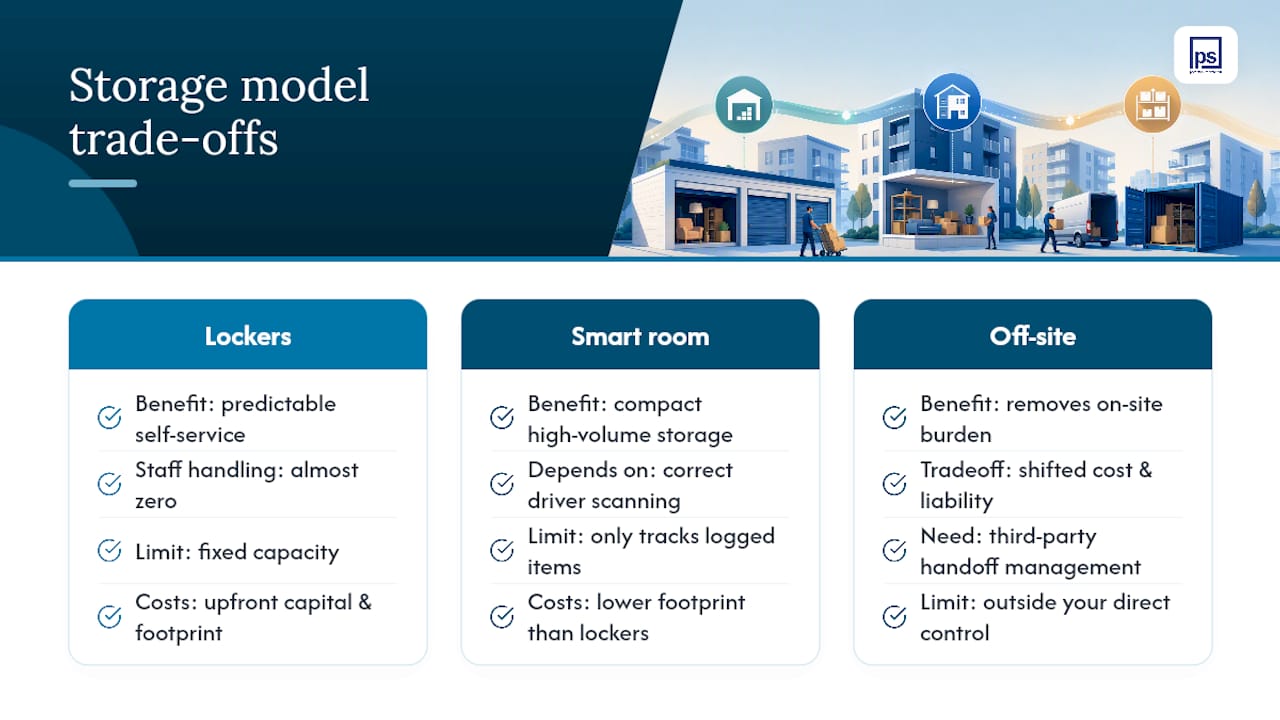
Locker banks give residents a predictable, self-service experience and reduce staff handling to almost zero once a package is loaded. The tradeoff is fixed capacity: oversized items and true peak-season volume can outstrip locker slots fast, and the upfront capital and footprint requirements are real considerations before installation.
Smart package rooms use space far more efficiently than individual lockers, storing high volumes in a compact footprint. Their performance depends almost entirely on correct driver intake and scanning, since a smart room only tracks what actually gets logged into it.
Off-site delivery models remove the on-site burden entirely, which can work well for smaller properties without room to dedicate to package operations. The tradeoff is shifted cost and liability. Someone still has to manage the handoff, and that someone is now a third party outside your direct control.
Many properties land on a hybrid approach: a locker bank for standard parcels, a staging area for oversized items, and a documented overflow plan for peak weeks. A Seattle locker pilot reduced in-building delivery handling time by 78 percent and produced zero first-attempt failures during the pilot window, a strong signal that solving the access and intake problem, not just adding hardware, is what drives results.
Property profile should drive the decision more than trend-chasing. High-rise buildings with staffed lobbies often lean toward lockers; garden-style communities with tight leasing office space often need a smart room instead.
Which KPIs Prove Your Fixes Are Working?
Fixing failed deliveries once is easy. Keeping the failure rate down requires a routine, and routines need numbers attached to them or they quietly erode within a quarter.
Weekly audits are the backbone. Check scan logs against physical inventory, note every discrepancy, and track who resolved it and how. Guidance from the National Apartment Association points to documented audit routines as the practice that keeps carrier compliance honest over time, not a one-time policy announcement.
Track four numbers on a recurring basis:
- Delivery failure rate: failed or bypassed deliveries as a percentage of total volume
- Pickup dwell time: aim for under 48 hours during peak periods
- Staff hours per 100 packages: your clearest cost signal
- Resident complaint rate: tied directly to package issues, not general maintenance tickets
Set targets based on your own trailing baseline rather than an industry average pulled from a different property type. A 300-unit student housing community and a 60-unit senior community will never share the same benchmark. Once you have three months of consistent data, package the trend into a one-page summary for regional managers. A falling dwell-time trend is far more persuasive than an anecdote when you’re asking to fund a locker upgrade.
How Postal Solutions Supports Property Teams on Package Operations
Some properties fix the process themselves. Others need a managed option, and that’s where a dedicated partner earns its place in the conversation.
A managed package room organizing service for apartment communities and student housing can include sorting incoming parcels, highlighting or hand-labeling unit numbers on packages that arrive mislabeled, and completing weekly audits through whatever software the property already runs.
Operational outcomes to expect from a managed setup include fewer staff interruptions from residents searching for missing packages and faster resident pickup once notifications go out consistently. Actual figures vary by property size and volume, so ask any provider for property-specific projections rather than industry averages.
Before signing with any managed provider, request:
- Defined visit frequency and what “daily organizing” actually includes
- Weekly audit documentation format and how exceptions get reported
- Response time SLAs for missing package escalations
- Clear scope on what the provider installs versus what it manages ongoing
A detailed cost-per-package breakdown helps frame these conversations against your current staff-hour spend.
Why Package Operations Deserve the Same Attention as Renewals
Property managers tend to treat package failures as a carrier problem to complain about rather than a process problem to fix. That framing costs money. Trade coverage of multifamily operations consistently links smoother package handling to fewer resident complaints, better tour impressions, and stronger renewal outcomes, because a resident who spends fifteen frustrated minutes hunting for a missing box remembers that experience at renewal time.
The properties that get this right stop blaming USPS and carriers exclusively and start auditing their own intake process first. Most failures are fixable at the property level, not the carrier level.
Run a one-week intake audit this month. Watch how packages actually move from the door to the resident’s hands, and you’ll find your biggest failure point within days, not months.
— Postal Solutions
Ready to Fix Your Property’s Package Operations?
If your team is stuck patching the same intake problems every peak season, a managed solution removes the daily grind without requiring you to build an entire SOP program from scratch. Managed services can handle daily package room organizing, run the weekly audits that catch carrier bypasses before they become resident complaints, and also offer sales and installation of Luxer One locker and package room systems sized to a property’s actual volume.
A discovery call typically starts with a short site walkthrough of your current intake zone, storage footprint, and peak-season pain points, followed by a recommendation on whether a managed visit schedule, a Luxer One installation, or both fit your community best. There’s no obligation attached to that first conversation.
Visit Postal Solutions to schedule a site discussion and get a property-specific plan for cutting failed deliveries.
Sources
This article draws on the USPS Office of Inspector General’s package theft white paper, investigative reporting from CBS News on unsecured mailbox keys, operational guidance from the National Apartment Association, and industry analysis from Insights by Blueprint and ApartmentList.
- Package theft white paper (USPS OIG / Oversight) — delivery theft scale and mitigation strategies
- A framework for solving multifamily’s package management problem (Insights by Blueprint)
- From boxes to competitive edge: best practices for multifamily package management (ApartmentList)
FAQ
Who Is Responsible for a Failed Delivery?
Responsibility typically splits between the carrier and the property. Carriers must follow posted intake procedures, but property teams are responsible for maintaining clear access, accurate address signage, and functioning storage systems that make compliance possible.
What Do I Do if My Delivery Attempt Was Unsuccessful?
Check your intake log and exception records first to confirm whether the carrier bypassed the process or if a building access issue blocked the attempt. Notify the resident, document the cause, and correct the underlying issue before the next delivery window.
What Does It Mean if It Says Delivery Failed?
It means the carrier could not complete the drop-off as scheduled, usually because of a locked entry point, an unreadable address, or a package that didn’t fit assigned storage. It does not automatically mean the package was lost.
What Does “Attempted Failed Delivery” Mean?
It means the carrier physically attempted the delivery but could not complete it, often because no one answered a gated entry or the driver couldn’t access the required drop zone. A follow-up attempt or resident action, like providing a gate code, is usually required.
Can Managed Package Services Reduce Failed Deliveries?
Yes. Managed services that combine daily organizing, weekly audits, and Luxer One installations address both the intake compliance and storage capacity issues that cause most failed apartment deliveries, and Postal Solutions structures its service around exactly those two controls.