How City Apartment Buildings Manage Deliveries
Discover how city apartment buildings manage deliveries efficiently. Learn about systems that enhance resident satisfaction and streamline logistics.
Published
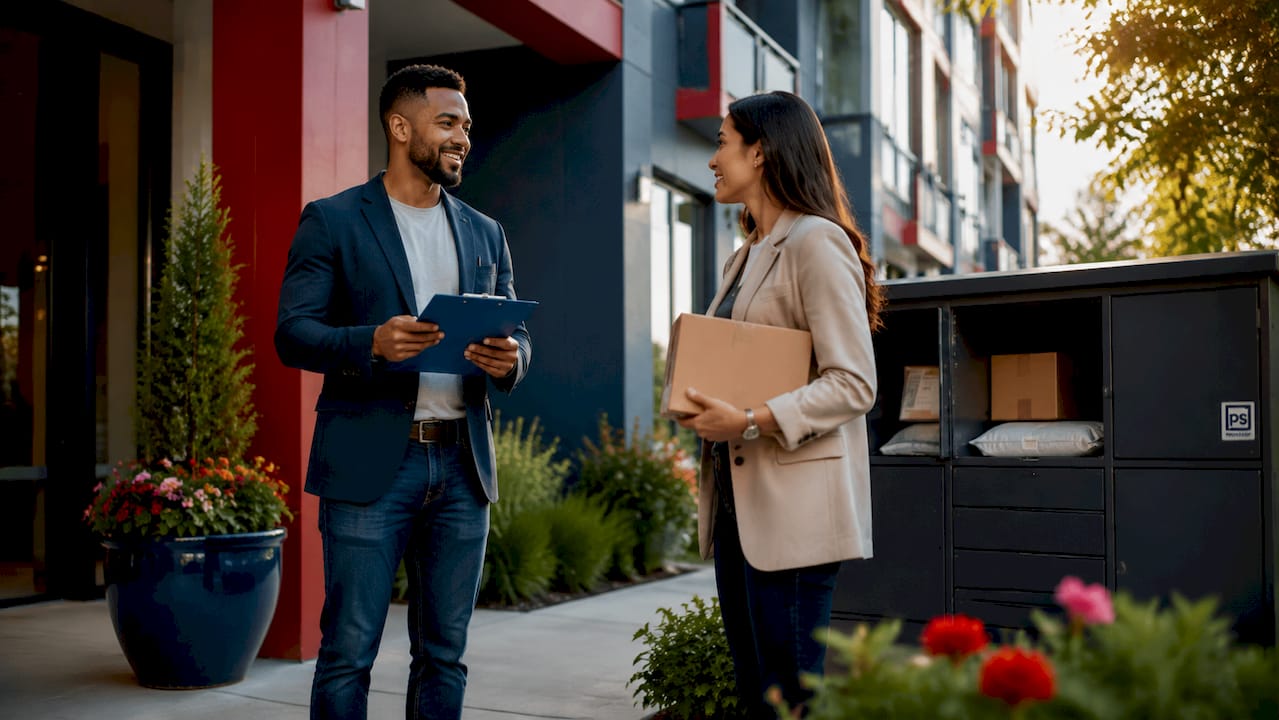
Package management in multifamily housing is defined as the coordinated system of receiving, securing, organizing, and distributing parcels across a residential building, and it has become one of the most operationally demanding responsibilities a property manager faces. How city apartment buildings manage deliveries today depends on three core infrastructure models: automated smart lockers, access-controlled package rooms, and standardized carrier communication protocols. A typical 400-unit building in New York City receives roughly 187 packages per day. That volume requires a deliberate system, not improvised workarounds. Property managers who treat delivery logistics as a core operational function, not an afterthought, consistently outperform peers on resident satisfaction and staff efficiency.
What are the main systems apartment buildings use for managing deliveries?
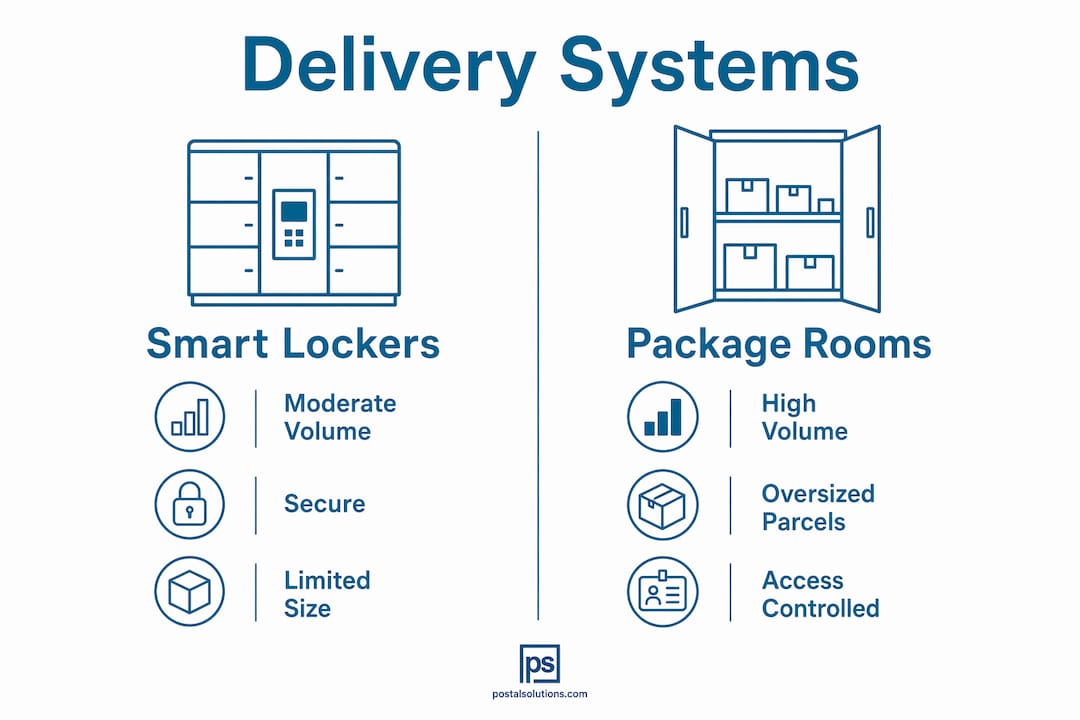
Three primary models define how apartment buildings handle carrier deliveries: automated smart lockers, dedicated package rooms, and third-party offsite delivery services. Each carries distinct operational tradeoffs, and many urban properties now deploy hybrid combinations to cover volume spikes and carrier variability.
Automated smart lockers are self-contained, electronically controlled units installed in a building’s lobby or mailroom. When a carrier deposits a parcel, the system generates a unique access code and notifies the resident by text or email. Smart locker systems reduce package theft rates from a range of 47 to 73 percent down to under 5 percent by securing each parcel in a locked compartment. That security improvement alone justifies the capital investment for most urban properties.
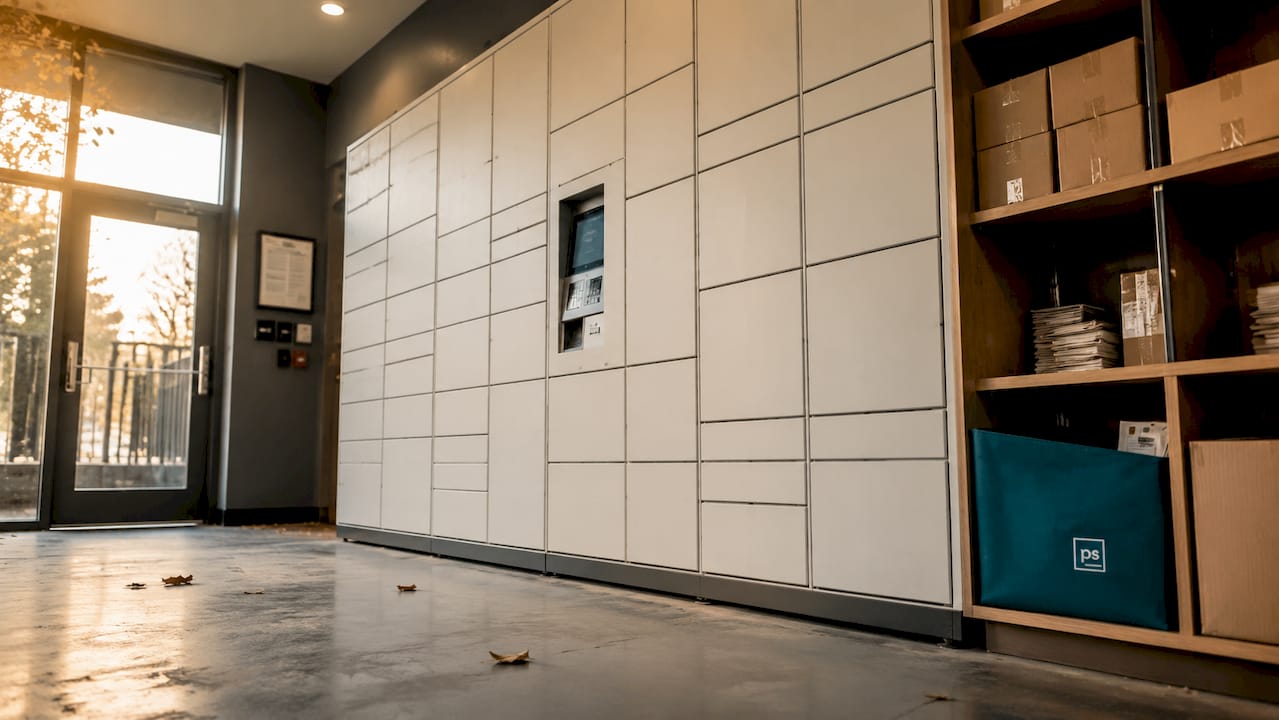
Access-controlled package rooms serve buildings with higher daily volumes or oversized parcels that lockers cannot accommodate. These rooms use PIN codes, key fobs, or mobile credentials to restrict entry to authorized carriers and residents. The room functions as a centralized staging area where packages are sorted by unit number, either by staff or by a managed service provider. Without consistent organization, package rooms become chaotic quickly, which creates resident complaints and staff time loss.
Third-party offsite delivery services route parcels to an external warehouse, where they are held and scheduled for door delivery on the resident’s timeline. Offsite delivery models eliminate on-site space requirements and reduce staff involvement, but they typically pass service fees to residents and depend on external logistics coordination that the property cannot directly control.
| System | Best for | Key tradeoff |
|---|---|---|
| Automated smart lockers | Buildings with moderate volume and security concerns | Limited capacity for oversized parcels |
| Access-controlled package rooms | High-volume or mixed-size parcel environments | Requires consistent organization to function well |
| Third-party offsite delivery | Properties with no dedicated package space | Resident fees and external dependency |
| Hybrid locker plus package room | Large urban buildings with diverse carrier mix | Higher upfront cost, maximum flexibility |
The right model depends on building size, available square footage, resident demographics, and budget. Most properties above 200 units benefit from a hybrid approach that pairs a locker bank for standard parcels with a managed package room for oversized freight.
How do delivery carriers interact with apartment buildings?
The role of delivery carriers at apartment buildings is more complex than most property managers anticipate. UPS, FedEx, Amazon Logistics, and USPS each operate under different internal protocols, and none of them are automatically aligned with your building’s intake system. Carrier non-compliance is the largest single breakdown point in even well-designed apartment delivery systems, and it requires a proactive management strategy from day one.
Carrier access is typically granted through one of three methods: physical key or fob, PIN code entry, or mobile credential via a building intercom system. PIN codes are the most auditable option because they create a compliance trail. Standardized QR or PIN codes for regular-route drivers generate audit records and incentivize correct package intake workflows, which gives property managers data to address non-compliance directly.
The most effective carrier management tool is a pictorial standard operating procedure posted at the point of entry. Text-based instructions are frequently ignored by drivers under time pressure. A laminated, image-based guide showing exactly where to deposit packages, how to scan into the system, and what to do with oversized items takes less than 60 seconds to follow and dramatically reduces misplaced parcels. Carrier non-compliance is the largest breakdown point in advanced automated systems, which is why pictorial SOPs outperform software prompts alone.
- Post pictorial SOPs at every carrier entry point, not just the package room door
- Assign unique PIN codes per carrier company, not per individual driver, for easier auditing
- Conduct a monthly review of access logs to identify patterns of non-compliance
- Communicate directly with local carrier depot managers when systemic issues arise
- Update SOPs whenever the building changes its intake system or locker configuration
Pro Tip: Contact the local depot manager for UPS, FedEx, and Amazon Logistics directly when you install a new package system. Carriers who receive a formal briefing at system launch experience far fewer process failures than those who encounter new protocols without notice.
Proactive carrier communication at system deployment reduces non-compliance and package mishandling more reliably than reactive complaint management. Treat your building’s carrier relationships the way you treat vendor relationships: with documented expectations and regular follow-up.
What steps reduce package workload and improve resident experience?
Reducing the operational burden of package management requires a combination of automation, role clarity, and physical organization. Property managers who address all three consistently report the largest gains in staff time recovery and resident satisfaction scores.
-
Integrate resident notification software. Every package room and locker system should connect to an automated notification platform. Residents who receive immediate alerts retrieve packages faster, which prevents backlog buildup. Most Luxer One installations include built-in notification workflows that trigger the moment a carrier scans a parcel into the system.
-
Designate a single point of accountability. Assign one staff member or a managed service provider as the daily package room owner. Diffused responsibility produces inconsistent results. When no one owns the room, organization degrades within days.
-
Label every package with the unit number at intake. This single practice eliminates the most common resident complaint: arriving at the package room and being unable to locate their parcel. Writing or highlighting the unit number on the label at the time of deposit takes seconds and saves minutes of staff-assisted searching later.
-
Conduct weekly audits. A weekly audit cross-references packages in the room against the notification log to identify unclaimed parcels, misrouted deliveries, and system errors. Audits also flag packages that have been sitting for more than five to seven days, which is the threshold at which residents begin filing complaints.
-
Provide 24/7 resident access. Residents expect self-service access to packages around the clock, comparable to fitness centers and lounges. Properties that restrict package room hours to business hours create unnecessary friction and generate avoidable service requests.
Pro Tip: If your building uses package room software already, you may not need a new platform. Postal Solutions manages daily package room organization using the software your community already owns, which eliminates the cost and learning curve of switching systems.
The operational efficiency gains from structured package management are measurable. Buildings with properly managed systems have reduced full-time staff involvement from 12 to 2 people, cutting labor costs while improving retrieval speed from minutes to seconds.
How does delivery management affect operations and resident retention?
Efficient city apartment logistics produce measurable returns across three dimensions: labor cost reduction, resident retention, and competitive positioning. These are not soft benefits. They appear directly in operating budgets and lease renewal rates.
On the labor side, automated and managed intake workflows have reduced staff handling time by 80 percent while cutting resident wait times by over 600 percent in high-volume urban buildings. That means leasing agents and maintenance staff spend less time fielding package questions and more time on revenue-generating or retention-focused activities.
Package management is now a critical amenity affecting resident retention, and 24/7 self-service package retrieval is becoming a baseline expectation in the rental market, not a premium differentiator. Properties that still rely on front desk staff to manage parcels are operating below market standard. That gap shows up in online reviews, renewal conversations, and leasing tours.
Properties that treat their buildings as logistics nodes rather than passive delivery destinations earn preferential treatment from carriers, including more reliable delivery windows and fewer misrouted parcels. This framing shifts the property from a reactive recipient to an active participant in the last-mile delivery chain.
“Operators who standardize carrier communication and SOPs at system launch experience fewer process failures and complaints than those who take a reactive approach.” — Insights by Blueprint
The amenity value of reliable package delivery is increasingly factored into resident satisfaction scores and renewal decisions. A well-run package operation is no longer a back-office function. It is a front-facing amenity with direct revenue implications.
Key takeaways
Effective delivery management in city apartment buildings requires combining automated systems, organized physical spaces, and proactive carrier communication to reduce staff burden and retain residents.
| Point | Details |
|---|---|
| Three core systems exist | Smart lockers, package rooms, and offsite services each solve different volume and space constraints. |
| Carrier compliance is the top failure point | Pictorial SOPs and PIN-based access codes reduce mishandling more reliably than software prompts alone. |
| Weekly audits prevent backlog | Cross-referencing packages against notification logs weekly catches errors before residents complain. |
| 24/7 access is now a baseline expectation | Restricting package room hours creates friction and drives negative reviews and non-renewals. |
| Managed services recover staff time | Outsourcing daily package room organization eliminates the double cost of payroll plus lost productivity. |
The case for combining technology with daily human oversight
From our experience working with multifamily communities across more than 40 U.S. states, the properties that struggle most with package management are not the ones that lack technology. They are the ones that installed technology and assumed the problem was solved.
A Luxer One locker system or a well-designed package room is a significant operational asset, but it requires consistent human attention to perform at its best. Packages get misrouted. Carriers skip the scan. Residents ignore pickup notifications for two weeks. None of these problems are solved by software alone. They are solved by someone showing up daily, organizing the room, writing unit numbers on boxes, and running the weekly audit that catches what the system missed.
The properties we work with that achieve the highest resident satisfaction scores are the ones running a combination: a Luxer One system for automated, secure parcel intake, paired with daily managed visits to keep the room current and organized. That combination removes friction for residents at the moment of pickup, which is the moment that matters most. It also removes the hidden cost that most property managers do not account for: the leasing agent who spends 45 minutes per day helping residents find packages instead of closing leases.
Improving apartment delivery processes is not a one-time project. It is an ongoing operational commitment. The buildings that treat it that way are the ones that show up at the top of resident satisfaction surveys and hold renewal rates above market average.
— Postal Solutions
How Postal Solutions manages apartment delivery operations
Postal Solutions offers outsourced package room management and Luxer One locker system sales and installation for multifamily communities across the United States. As the largest Luxer One sales agency in the country, with over 1,200 installations in more than 40 U.S. states, Postal Solutions manages daily package room organization, unit-number labeling, weekly audits, and carrier compliance support for conventional multifamily, student housing, and senior housing communities. For properties that want a full-service solution, Postal Solutions sells and installs Luxer One package rooms, locker systems, and combo configurations, then provides six-day-per-week managed visits to keep the system organized and current. Learn more about apartment package management services or explore smart locker options for your community.
FAQ
What systems do city apartment buildings use to manage deliveries?
City apartment buildings primarily use automated smart lockers, access-controlled package rooms, and third-party offsite delivery services. Many urban properties combine two or more of these systems to handle varying parcel volumes and carrier types.
Why is carrier compliance so important for apartment delivery systems?
Carrier non-compliance, including failure to scan or stage deliveries correctly, is the largest breakdown point in even advanced package systems. Pictorial SOPs posted at entry points and PIN-based access codes improve driver adherence and create auditable compliance records.
How do smart lockers reduce package theft in apartment buildings?
Smart locker systems secure each parcel in a locked compartment and notify residents with a unique access code upon delivery. This approach reduces package theft rates from a range of 47 to 73 percent down to under 5 percent.
How does package management affect resident retention?
Package delivery experience is now a core amenity in urban multifamily housing, and 24/7 self-service access to parcels is becoming a market baseline. Properties that remove friction from the pickup process gain a measurable competitive advantage in lease renewals.
What is the benefit of outsourcing daily package room management?
Outsourcing daily package room organization eliminates the double cost of staff payroll plus lost productivity from leasing agents handling package inquiries. Managed services also provide consistent weekly audits and unit-number labeling that prevent backlog and resident complaints.