Buy Weatherproof Package Lockers, Ops for Multifamily & Student Housing
Buy Weatherproof Package Lockers, Ops for Multifamily & Student Housing Yes: deploy commercial, outdoor-rated package lockers built for multifamily and student-housing volume, not consumer-grade boxes. Pair that hardware with a real ope
Published
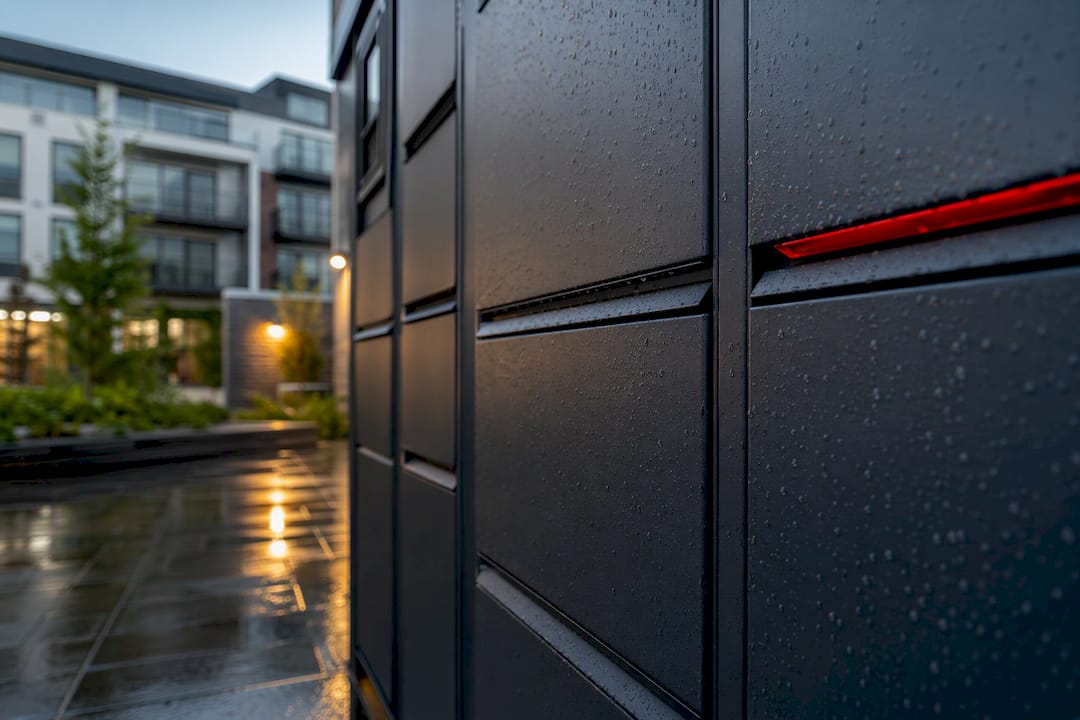
Yes: deploy commercial, outdoor-rated package lockers built for multifamily and student-housing volume, not consumer-grade boxes. Pair that hardware with a real operations plan, since outsourcing daily package-room management is often the smarter move once delivery volume climbs. Postal Solutions sells and installs Luxer One systems and offers managed package-room operations, so property teams get both the equipment and a labor plan option in one decision.
TL;DR:
- Outdoor package lockers must be constructed from 12-gauge steel with UV-stable powder coating and sealed weatherproof electronics to withstand harsh climate conditions.
- Proper site preparation, including drainage, anchoring, and ADA compliance, is essential to ensure the lockers’ durability and accessibility over time.
- Outsourcing daily operations to a specialized provider can significantly reduce staff workload and improve delivery tracking, especially during high-volume periods.
- Hardware costs depend on size, finish, and features, while installation and recurring software fees vary based on site conditions and carrier integrations.
- Clarify liability coverage and vendor SLA terms upfront to prevent disputes over lost packages or equipment failures after installation.
Table of Contents
- What “Weatherproof Package Lockers” Means for Multifamily and Student Housing
- Essential Weatherproof Features and Build Specs to Require
- Site Planning and Installation Checklist for Outdoor Lockers
- Managed Service vs. Self-Managed Locker Operations
- Cost Drivers and Budgeting Guide for Weatherproof Locker Projects
- Vendor Questions and Contract Terms to Require
- Insurance and Liability Considerations for Package Locker Installations
- Postal Solutions’ Field Perspective
- How Postal Solutions Supports Weatherproof Locker Projects
- Sources
- FAQ
What “Weatherproof Package Lockers” Means for Multifamily and Student Housing
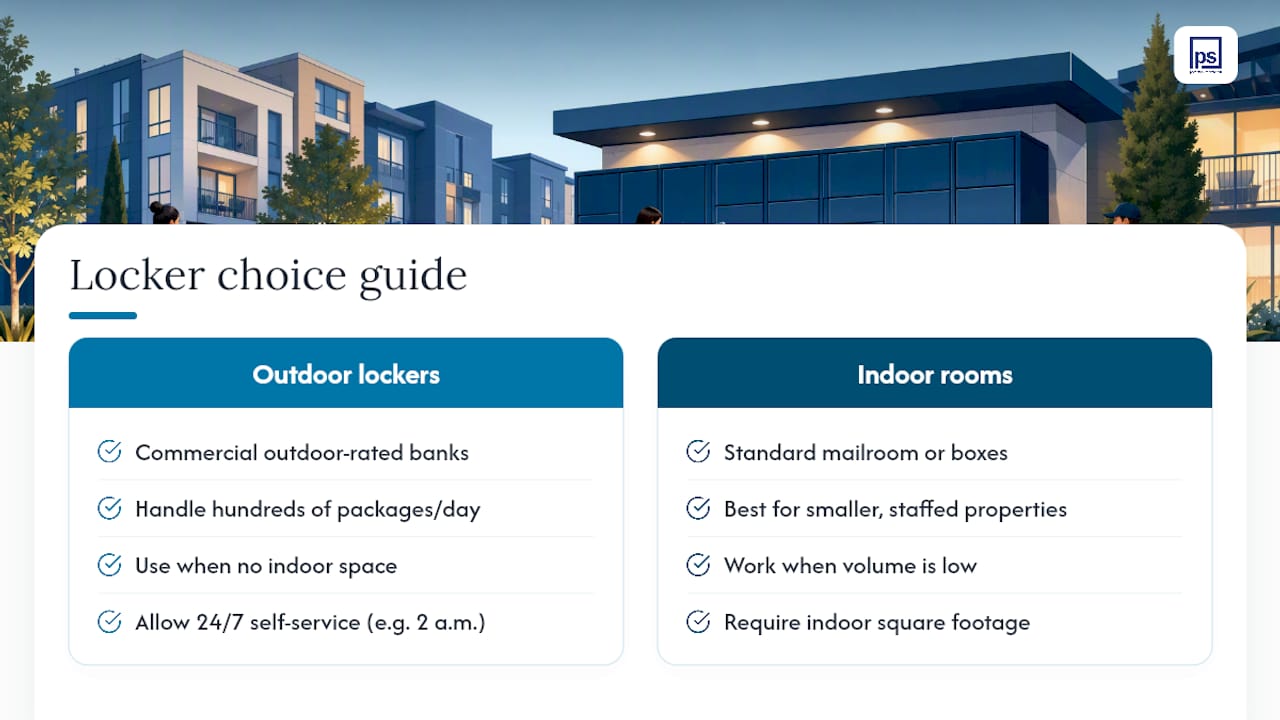
When property managers search for weatherproof package lockers, they are not shopping for a lockbox bolted to a porch rail. They need commercial, outdoor-rated locker banks engineered to handle hundreds of parcels a day across every season, not a single household’s mail.
Delivery volume at a sizable student housing property can hit a very high number of packages during move-in week alone, and resident behavior compounds the pressure: everyone wants same-day pickup, and nobody wants to stand in line. That volume, combined with constant turnover and high foot traffic, makes a standard mailroom or a folding table of overflow boxes unworkable within a semester.
Outdoor-rated lockers earn their place when a property lacks indoor square footage, when the leasing office wants a self-service amenity residents can access at 2 a.m., or when management wants to shrink the number of outside carriers walking through hallways and into buildings, a security and liability improvement operators increasingly cite as their reason to switch to third-party package management. Indoor package rooms still work for smaller, staffed properties. Outdoor lockers make sense once volume, hours, or security concerns outgrow that model.
Essential Weatherproof Features and Build Specs to Require
Any vendor proposal should spell out inspectable specs, not marketing language. Outdoor locker banks are typically built from 12-gauge steel with a powder-coated finish rated for UV exposure, the same commercial-grade construction manufacturers use across coastal humidity, snow, and desert heat alike.
Require these specs in writing before you sign anything that confirm the unit is engineered to resist weather exposure, including structural steel bodies with UV-stable powder coating, water-management features like rain lips and sealed gaskets, electronics protection such as sealed displays and weatherproof wiring, security features including tamper-resistant locks and audit trails, and serviceability aspects like modular panels and field-replaceable parts.
Manufacturer specs confirm these builds combine weather protection with the same access controls and tracking you’d expect indoors.
Pro Tip: Ask any vendor for the compartment failure rate on units installed in your climate zone, not just the national average. Coastal salt air and desert UV exposure wear differently, and a generic spec sheet won’t tell you which failures are common where you actually operate.
Site Planning and Installation Checklist for Outdoor Lockers
Hardware quality only matters if the installation site sets it up to succeed. Concrete pad sizing, drainage slope, and anchoring all affect whether a locker bank survives its first hard freeze or flash flood.
- Confirm pad dimensions and anchoring match the manufacturer’s load spec, with drainage sloped away from the unit base.
- Decide power and data early, choosing between hardwired electrical, Power over Ethernet, or cellular backup for connectivity during outages.
- Verify ADA placement, including reach ranges for the lowest and highest compartments, adequate path width, and lighting for nighttime access.
- Check CCTV sightlines before pouring the pad, so cameras cover the full bank without blind spots.
- Map sprinkler zones and adjust placement to avoid daily soaking that shortens seal life.
- Assign responsibility for permits, trenching, and utility work between vendor and property, in writing, before installation begins.
Skipping the site survey is the single most common reason installations run late. Proper planning around pads, drainage, ADA access, and sprinkler exposure is what actually determines whether an outdoor locker lasts through its expected service life.
Managed Service vs. Self-Managed Locker Operations
Buying the hardware is the easy part. Running it well, every day, is where properties either save staff hours or quietly bleed them.
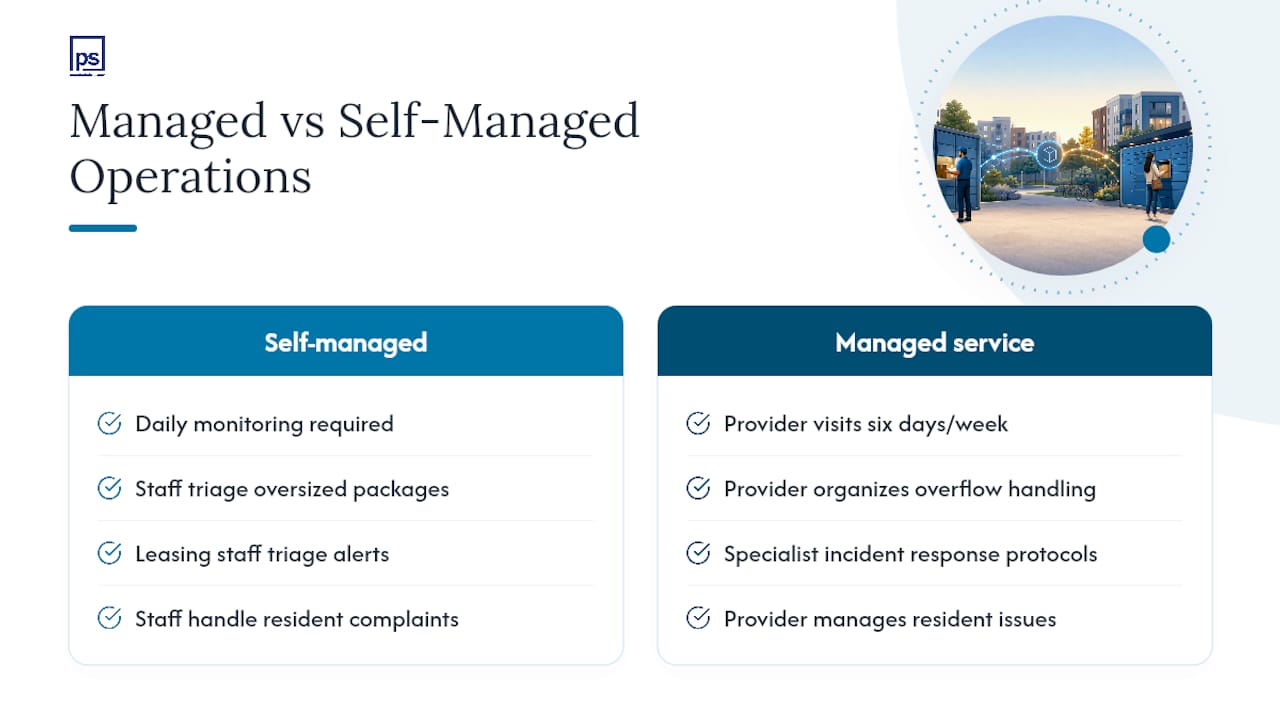
A self-managed locker bank still needs daily monitoring: someone has to handle oversized packages that won’t fit any compartment, triage software alerts when a door won’t latch, and field resident complaints when the system misreads a barcode. None of that disappears just because the locker is automated.
Outsourcing that daily grind to a specialist changes the math. Instead of a leasing agent stopping mid-shift to sort an overflow shelf, a dedicated package manager visits six days a week, organizes the room or bank, and keeps carrier access to a single controlled point rather than multiple couriers wandering the property. That single-access-point model is exactly what reduces the number of outside personnel entering buildings while improving delivery tracking.
If you write a managed-service scope of work, specify details like audit frequency with verifiable proof, incident response protocols, reporting requirements, and software access levels.
There are integrated services combining Luxer One hardware sales, installation, and daily package management with regular audits, providing a comprehensive single contract covering both equipment and operations.
Pro Tip: Before you sign a managed-service agreement, ask the vendor to walk through what happens on a day when the courier drops 40 oversized packages that don’t fit the lockers at all. That answer tells you more about operational maturity than any brochure.
Cost Drivers and Budgeting Guide for Weatherproof Locker Projects
Hardware price swings mostly on door count, oversized module count, and finish customization, since a wrapped or color-matched exterior for leasing appeal costs more than a standard powder coat. Installation costs move separately, driven by site prep, electrical and data trenching, and local permit requirements. A property with existing conduit and a flat, drained pad site will spend far less than one requiring new trenching and a poured foundation.
Software and integration fees add a recurring line: site licensing and carrier integrations (USPS, UPS, FedEx, Amazon) typically run as an annual or monthly cost layered on top of the hardware purchase. Operational costs follow the model you choose. Managed service carries a recurring fee that replaces staff hours spent sorting and troubleshooting; self-managed keeps that labor in-house, on payroll, whether or not it’s the most productive use of that time.
Model ROI by comparing current staff hours spent on package handling against the managed-service fee, then layer in resident satisfaction metrics like reduced office foot traffic and fewer “where’s my package” tickets.
Vendor Questions and Contract Terms to Require
Before signing anything, run every proposal through the same checklist:
- Verify weatherproof ratings and material specs against your climate, not a generic spec sheet.
- Confirm who handles installation, the full timeline, and who pulls permits.
- Demand SLA terms in writing: uptime guarantee, incident response window, audit cadence, and reporting format.
- Test integration reliability, especially resident notification delivery across all major carriers.
- Require warranty terms and stated replacement part timelines, plus clear liability language for damaged or lost packages.
- Ask for pilot metrics from a comparable property to confirm the improvements the vendor is promising actually materialize.
Any vendor unwilling to commit these terms to paper is telling you something about how the relationship will run after the sale closes.
Insurance and Liability Considerations for Package Locker Installations
Package lockers shift risk, they don’t eliminate it. Once a parcel scans into a locker compartment, most properties and vendors consider the delivery complete, meaning liability for a package that’s lost or damaged after that point often falls into a gray zone between carrier, resident, and property.
Review your general liability policy to confirm it covers claims tied to locker malfunctions, whether that’s a jammed door trapping a package or a software error that assigns the wrong compartment. Ask your insurance carrier directly whether outdoor equipment installations trigger any policy riders, particularly around slip-and-fall risk near the locker bank or damage from severe weather events like hail or flooding.
Contracts with your locker vendor and any managed-service provider should state plainly who carries liability for equipment failure versus who carries liability for lost or stolen packages after resident pickup notification. That distinction should be spelled out in the service agreement, not left to assumption. Properties that outsource daily package management often gain an additional layer of protection here, since a managed-service provider typically carries its own liability coverage tied to its handling of packages inside the room or locker bank.
Residents should also understand, through lease addenda or posted policy, that the property’s responsibility ends once a package is confirmed delivered into a secure compartment. Clear documentation at that handoff point protects both the property and the resident when disputes arise, and it gives leasing staff a straightforward answer when a resident claims a package went missing after pickup notification was sent.
Postal Solutions’ Field Perspective
Hardware quality and operational discipline are two separate purchases, and treating them as one is where most properties get stalled. A steel locker bank rated for coastal humidity still fails a property that has nobody organizing overflow or running weekly audits. Student housing and any site with high delivery volume and thin front-office staff should weigh managed operations seriously, not as a luxury add-on but as the piece that makes the hardware actually work.
— Postal Solutions
How Postal Solutions Supports Weatherproof Locker Projects
Some vendors sell and install Luxer One systems and manage what happens after installation day, which is the part most vendors leave to the property. This can mean combining Luxer One® Locker Solutions with Daily On-site Package Management, so you’re not left choosing between good equipment and reliable operations. Properties may get one point of contact for hardware and package management that keeps rooms organized and audits current, potentially reducing payroll and lost productivity when staff are diverted to sort packages.
If you’re scoping a new installation or comparing your current setup against outdoor package lockers built for apartments, consider requesting a site survey to get a realistic view of pad requirements, power options, and pricing before you commit to a vendor. For student housing specifically, Student Housing Mail Management services can cover the delivery volume patterns unique to academic calendars. You may contact service providers for bundled quotes covering hardware, installation, and ongoing management in a single proposal.
Sources
- Multifamily solutions for package management | Luxer One
- Student housing outlook (third-party package management benefits)
- Navigating surge (NAAHQ article on package management and third-party solutions)
FAQ
What Makes a Package Locker Truly Weatherproof?
A weatherproof locker uses 12-gauge steel construction, UV-stable powder coating, sealed door gaskets, rain lips, and sealed electronics to withstand rain, snow, heat, and coastal humidity. Look for these specs in writing on any manufacturer proposal rather than relying on general marketing claims.
Should Student Housing Outsource Package Room Management?
High delivery volume and constant resident turnover make student housing a strong candidate for outsourced management, since third-party package handling reduces staff burden and gives residents app-based pickup control. Some vendors offer direct services combining daily organizing with weekly audits.
How Long Does Installation Take From Purchase to Go-Live?
Timelines depend on site readiness: a property with existing power and a flat, drained pad site can go live faster than one requiring new trenching or a poured foundation. Site surveys upfront identify which scenario applies before you commit to a delivery date.
Does Postal Solutions Only Sell Hardware, or Does It Manage Operations Too?
Some vendors sell and install Luxer One locker systems and also run daily package-room organizing and weekly audits as ongoing managed services. Pricing for services and installations is available directly through Postal Solutions based on property size and scope.
Who Is Liable If a Package Is Lost After Locker Pickup Notification?
Liability typically shifts to the resident once a package scans into a secure compartment and pickup notification is sent, but this should always be spelled out in your lease addenda and vendor contract. Review your general liability policy and vendor agreement together to confirm coverage gaps don’t exist between the two.