Accountable Package Handling for Property Managers
Accountable Package Handling for Property Managers Accountable package handling is outsourced, auditable package-room management: daily organization, chain-of-custody tracking, weekly audits, and optional Luxer One locker installs that redu
Published

Accountable package handling is outsourced, auditable package-room management: daily organization, chain-of-custody tracking, weekly audits, and optional Luxer One locker installs that reduce staff touches, protect NOI, and improve resident retention. The recommended approach is to contract a third-party provider that enforces carrier compliance, delivers documented audit logs, and integrates with your existing property software. Here are three immediate next steps:
- Run a baseline: Count daily package volume and estimate staff time spent per package today.
- Request a site survey: Have a provider assess your current package room layout and volume capacity.
- Pilot before committing: Run a 30-day pilot on one property before expanding portfolio-wide.
Pro Tip: Before any vendor demo, pull 30 days of package-related maintenance requests and resident complaints. That number is your accountability gap and your negotiating leverage.
Key Takeaways
Accountable package handling, defined as outsourced daily organization, chain-of-custody tracking, and weekly audits, is the most direct way to reduce staff touches, protect NOI, and document parcel accountability at scale.
| Point | Details |
|---|---|
| Define it in the contract | Require weekly audits with timestamps, photo intake records, and a specified delivery format. |
| Labor cost is the ROI driver | At 75 packages/day and 5 minutes per touch, a property absorbs 6+ staff hours daily before any system is in place. |
| Carrier compliance is the top failure mode | Issue a standardized carrier communication packet before go-live and re-send it every peak season. |
| Match the model to the property | Smart lockers fit mid-size suburban communities; open package rooms handle high-volume or oversized-item properties better. |
| Postal Solutions as a starting point | Postal Solutions manages daily package-room outsourcing and sells/installs Luxer One systems across 40%+ of U.S. states. |
Table of Contents
- What does accountable package handling look like in practice?
- Why package handling is costing you more than you think
- What solution models are available and what are the tradeoffs?
- How to evaluate vendors: the checklist that matters
- Implementation checklist and realistic timeline
- How do you measure success after deployment?
- Why outsourced management plus Luxer One hardware is the practical recommendation
- Contract considerations and negotiation tips
- Training requirements and support after go-live
- The case for treating package handling as a portfolio-level decision
- How Postal Solutions approaches package accountability
- Ready to audit your current package room operations?
- Sources
- FAQ
What does accountable package handling look like in practice?
In the multifamily, student, and senior housing context, accountable package handling is a contracted service with specific, auditable deliverables, not just a locker system or a staff policy. The term “accountable” here means every parcel has a documented chain of custody from carrier drop-off to resident pickup.
Core contract deliverables include:
- Daily package-room organization with unit numbers marked on each box
- Photographic receipt at intake and QR-code or ID-verified pickup flow
- Chain-of-custody logs accessible to property management
- Weekly audits completed via your existing package-room software or a provided platform
- Oversized and perishable item handling protocols
- Resident notifications triggered at intake
This definition is distinct from USPS “accountable mail” (certified, registered, or insured letters requiring a signature) and from warehouse package-handler roles. The scope here is multifamily package room operations: the daily, on-site management of resident parcels in an apartment, student housing, or senior living setting.
Pro Tip: When reviewing a vendor contract, require that audit logs include timestamps, package counts, and a photo record. Vague language like “regular audits” is unenforceable. Specify weekly cadence and a delivery format you can pull into your monthly reporting.
Why package handling is costing you more than you think
The labor math is straightforward and sobering. Industry data shows that a typical community of roughly 370 units receives about 75 packages per day. At multiple staff touches per package and several minutes per touch, that property is absorbing several staff hours daily just on package handling.
That labor cost compounds quickly. At an average staff wage, several hours daily amount to a significant annual labor cost dedicated to packages alone, before accounting for overtime or turnover. Resident-side costs add another layer: a single unit turnover can cost a property $4,000 or more when vacancy loss, make-ready, and leasing fees are included. Package complaints are a documented driver of non-renewal decisions.
Locker ROI analysis from Luxer One puts average volume at about 30 packages per 100 units per day, with teams spending roughly 5 minutes per package. At that rate, labor savings from a well-run system frequently pay back the investment within the first operational year.
What solution models are available and what are the tradeoffs?
A portfolio-level framework matches solution type to property type rather than applying one model universally. Four dominant models exist:
Smart lockers assign each delivery to a dedicated compartment. Security and chain-of-custody are strong; resident pickup is self-serve and fast. Fixed infrastructure costs are high, and surge capacity is limited by the number of doors installed. Best fit: mid-size suburban communities with predictable daily volumes.
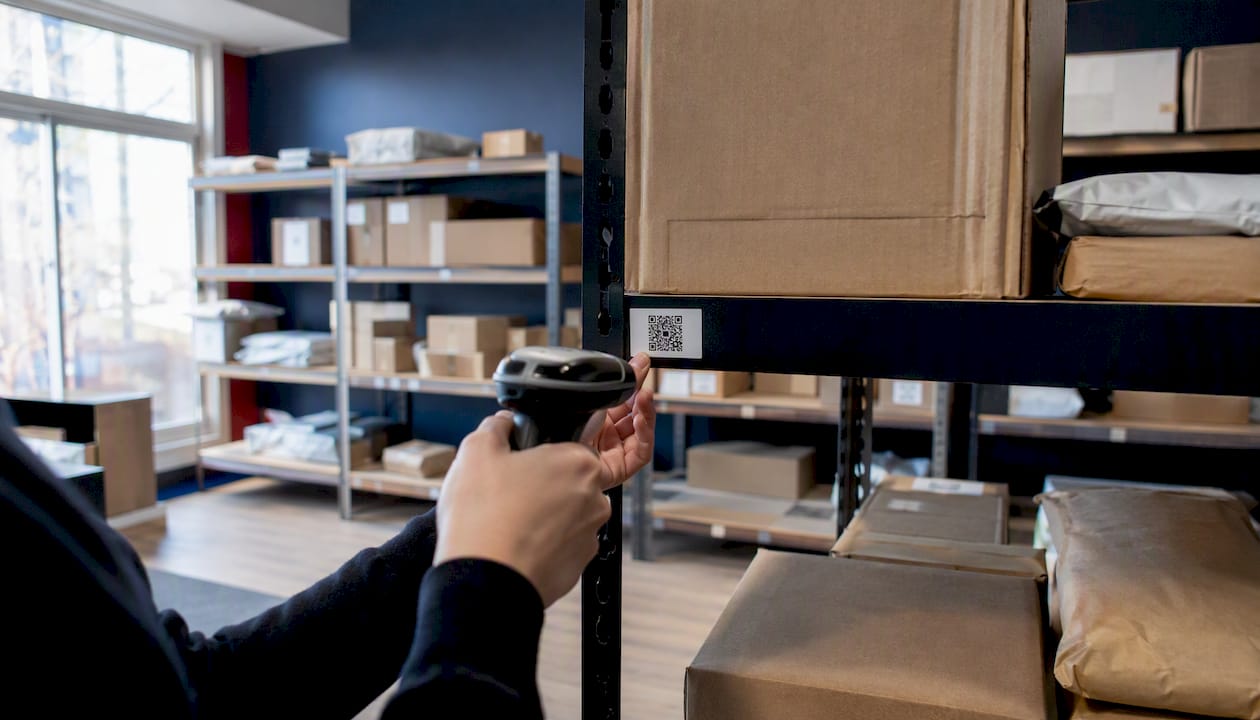
Smart package rooms use open shelving with visual scanners, label-photo capture, and QR-coded pickup instructions. They cost less than full locker banks, handle oversized items, and reconfigure easily for holiday surges. Audit trails depend on the software layer. Best fit: high-volume urban properties where package sizes vary widely.
Off-site third-party delivery routes packages to a nearby hub for resident pickup. It removes on-site burden entirely but adds friction for residents and depends on carrier compliance with the redirect protocol. Best fit: premium communities where residents accept the trade-off.
Outsourced managed package centers combine on-site daily visits, organized package rooms, weekly audits, and optional hardware. Labor is contracted out; accountability is contractual. This model scales across a portfolio without requiring identical hardware at every property.
Carrier compliance is the most common failure mode across all four models. Whichever solution you choose, a standardized carrier communication packet distributed before go-live is not optional. It is the single step most often skipped and most often cited when systems fail.
How to evaluate vendors: the checklist that matters
Use these questions during every vendor demo or RFP review:
- Can you show me a sample audit log with timestamps and package counts?
- What photo documentation is captured at intake and at pickup?
- How do you detect and remediate carrier non-compliance?
- Which property management platforms does your system integrate with natively?
- What are your SLA penalties if audit cadence or pickup-time targets are missed?
- Who holds liability for lost or stolen packages under your contract?
- How do you handle volume surges during peak shipping seasons?
- Can you provide references from properties with similar unit counts and demographics?
Red flags to watch for:
- Audit logs described as “available on request” rather than delivered on a set schedule
- No documented carrier communication protocol
- Liability language that shifts entirely to the property
- References only from properties significantly smaller than yours
- No integration with your existing software stack
Pro Tip: Ask vendors to walk you through a specific lost-package incident from a current client. How they describe the resolution process tells you more about their accountability culture than any sales deck.
Implementation checklist and realistic timeline
A medium-size property (200–400 units) can typically reach full go-live in 6–8 weeks. Here is the sequence:
- Site survey (Week 1): Measure package room dimensions, assess current volume, identify carrier entry points.
- Carrier communication packet (Week 2): Draft and distribute delivery instructions to all major carriers serving the property.
- Space preparation (Weeks 2–3): Clear the package room, install shelving or hardware, label zones.
- Hardware install, if applicable (Weeks 3–4): Locker or smart-room hardware installation and network connection.
- Software integration (Week 4): Connect package-room platform to your property management system.
- Staff onboarding (Week 5): Train on-site team on the new workflow, escalation path, and audit process.
- Resident education (Week 5): Send move-in packet updates, post signage, and push a community notification.
- Pilot period (Weeks 5–6): Run the full workflow with close monitoring; log every exception.
- Full go-live (Week 7+): Remove manual workarounds and activate all resident-facing features.
Peak-season planning deserves its own note. If your go-live falls between October and January, add two weeks to the pilot phase and pre-order any additional shelving or temporary locker capacity. Carrier compliance protocols should be re-sent to carriers at the start of November regardless of when you launched.
How do you measure success after deployment?
Primary KPIs to track from day one:
- Touches saved per package: Target fewer than two staff touches per parcel post-implementation.
- Average pickup time: Industry benchmarks show well-run systems can achieve pickup in under a minute.
- Audit log completeness: 100% of weekly audits completed and filed is the baseline, not the goal.
- Resident NPS for package experience: Survey quarterly; a 10-point improvement is achievable in the first six months.
- Lost or stolen package incidents: Track monthly; any upward trend triggers an audit review.
- Renewal rate correlation: Compare renewal rates before and after implementation on the same property.
A simple ROI formula: multiply touches saved per day by labor cost per touch, then annualize. Subtract the annual service and hardware cost. Against a service contract in the range of $15,000–$20,000 annually, the net return is positive within the first year.
Reporting cadence: daily intake summaries from your package-room software, weekly audit reports from your provider, and a monthly executive summary that rolls up volume, pickup time, and incident counts.
Why outsourced management plus Luxer One hardware is the practical recommendation
Properties receiving a high number of packages per day, or any community above a moderate size threshold, typically benefit most from combining outsourced daily management with purpose-built hardware. The operational advantages are concrete:
- Guaranteed weekly audit logs with timestamps and package counts
- Carrier compliance protocols enforced on-site, not just in a policy document
- Flexible space use: open package rooms handle oversized items that lockers cannot
- Staff time returned to leasing and resident services rather than package sorting
- Resident pickup friction reduced through QR-code or PIN-based self-serve access
Outsourcing package management removes the burden from on-site teams and allows staff to focus on leasing and resident services, according to operator experiences documented by Multifamily Executive.
Postal Solutions has managed package-room outsourcing since 2016 and is the largest Luxer One sales agency in the country, with over 1,200 Luxer One sales and installations across more than 40% of U.S. states. That footprint covers on-campus universities, large Public Private Partnerships, conventional multifamily, student housing, senior living, municipalities, and businesses of all sizes. The combination of daily managed visits, weekly audits, and Luxer One hardware gives operators a single accountable vendor for both the service and the system.
Contract considerations and negotiation tips
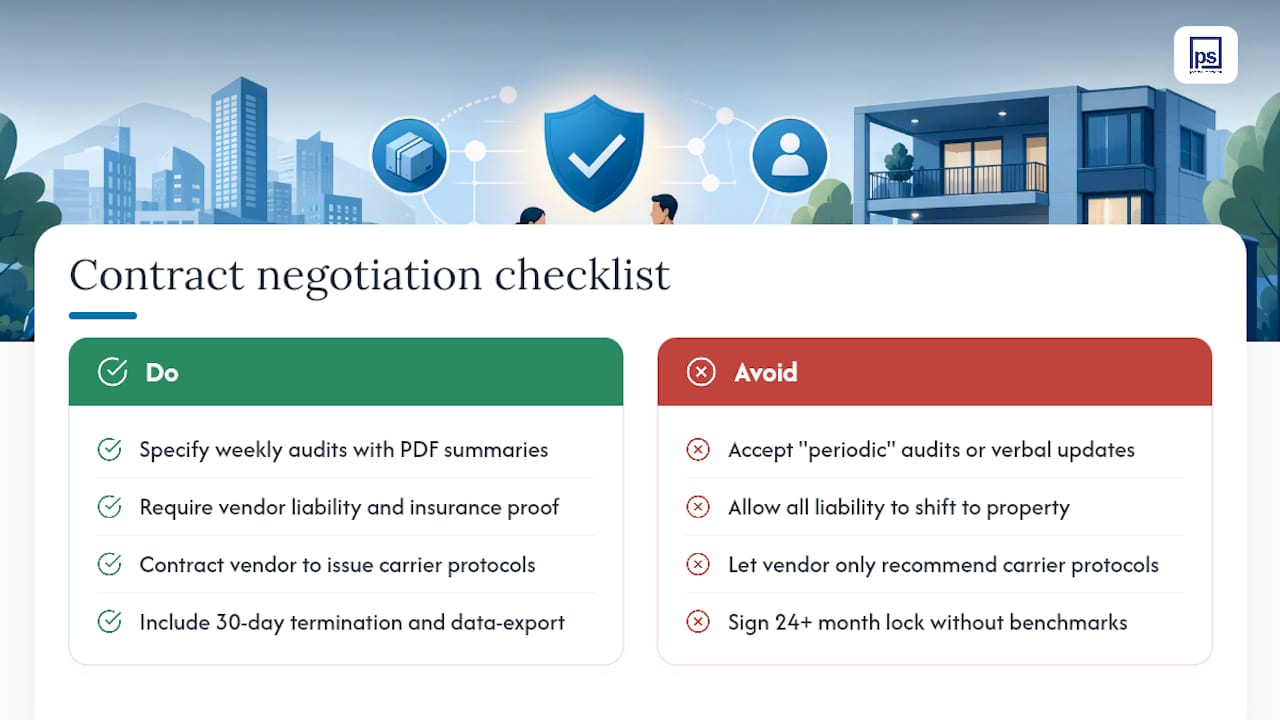
Before signing any third-party package management agreement, focus on four contract elements that most operators overlook:
Audit cadence and format. The contract should specify weekly audits, not “periodic” ones, and define the deliverable format. A PDF summary emailed to the property manager is auditable. A verbal update is not.
Liability and insurance. Confirm who holds liability for lost or stolen packages and require proof of the vendor’s insurance coverage. Some contracts shift all liability to the property by default.
Carrier compliance obligations. The vendor should be contractually responsible for issuing and re-issuing carrier communication protocols, not just recommending that you do it yourself.
Termination and transition terms. A 30-day termination clause with a data-export provision protects you if the relationship underperforms. Avoid contracts that lock you in for 24+ months without performance benchmarks tied to exit rights.
On pricing, ask for itemized line items rather than a bundled monthly fee. Knowing the cost per managed visit, per audit, and per hardware component gives you leverage when volumes change or when you want to add properties.
Training requirements and support after go-live
Staff training needs to cover three things: how to handle packages that arrive outside the system (a carrier who bypasses the protocol), how to escalate a lost-package complaint, and how to pull an audit log on demand. Most providers offer a one-time onboarding session; push for written SOPs you can use for new-hire orientation.
Resident education is often underinvested. A one-time community notification at launch is not enough. Build package-room instructions into your move-in packet, post laminated signage at the room entrance, and send a reminder notification at the start of each peak shipping season. Organized, well-labeled package rooms reduce resident friction and cut the number of staff-assisted pickups significantly.
Ongoing support should include a direct contact for escalations, not just a general support ticket queue. Ask your vendor how quickly they respond to a lost-package complaint and what the resolution path looks like. That answer is a direct indicator of how accountable they will be six months after the contract is signed.
The case for treating package handling as a portfolio-level decision
Most operators still manage packages property by property, which produces inconsistent outcomes, uneven audit quality, and no portfolio-wide data. The smarter approach is to standardize the service model across assets, require the same audit format from every property, and use aggregate data to identify which locations need hardware upgrades or additional managed visits.
A portfolio-level view also changes the vendor conversation. When you bring five or ten properties to a provider rather than one, you have real negotiating leverage on pricing, SLA terms, and pilot conditions. Carrier compliance protocols can be standardized across the portfolio and distributed from a single source, which reduces the risk of a single property’s non-compliance creating liability for the whole organization.
How Postal Solutions approaches package accountability
Package accountability is not a technology problem. It is an operational discipline problem. Properties that struggle with lost packages, resident complaints, and staff burnout almost always have the same root cause: no one is specifically responsible for the package room every day. A locker system without daily management still produces chaos. A package room with great software but no consistent organization still generates friction.
What Postal Solutions has seen since 2016 is that the properties with the best outcomes combine three things: a daily managed visit that keeps the room organized and current, a weekly audit that catches discrepancies before they become complaints, and hardware (whether a Luxer One locker bank, a smart package room, or a combination) that matches the property’s actual volume and space. The result is staff time returned to leasing, fewer resident complaints, and an audit trail that protects the property if a package dispute escalates.
Ready to audit your current package room operations?
Properties spending more than two staff hours per day on package handling are paying twice: once in payroll and once in lost productivity. Postal Solutions manages daily package-room outsourcing, conducts weekly audits, and sells and installs Luxer One locker and package-room systems nationwide. Whether you need a managed service contract, a hardware installation, or a full turnkey solution, the starting point is a site survey that quantifies your current cost and maps the fastest path to a documented, auditable system.
Request a site survey to get a baseline assessment and a proposal tailored to your property’s volume, layout, and budget.
Sources
- Smart Package Room — What Package Wrangling Is Really Costing Your Team
- A Framework for Solving Multifamily’s Package Management Problem | Insights by Blueprint
- The benefits of outsourcing — Multifamily Executive
FAQ
What is accountable package handling for apartments?
Accountable package handling is outsourced, auditable management of resident parcels in a multifamily, student, or senior housing setting. It includes daily package-room organization, chain-of-custody logs, and weekly audits that document every parcel from carrier drop-off to resident pickup.
How many staff hours does package handling typically consume?
When does a property need a Luxer One locker system vs. a managed package room?
Smart lockers work well for mid-size communities with predictable daily volumes; open package rooms with daily managed visits handle high-volume or oversized-item properties more cost-effectively. Many properties benefit from a combination of both.
What should every package management contract include?
At minimum: weekly audit cadence with a specified deliverable format, photo documentation at intake and pickup, carrier compliance obligations on the vendor, liability and insurance terms, and a termination clause with a data-export provision.
How quickly can a package management system pay for itself?
Luxer One’s ROI analysis shows that locker systems frequently reach payback within the first operational year when labor savings are significant, and properties can also accelerate payback by adding resident usage fees or premium delivery options.