Package Lockers That Enforce Carrier Compliance for Property Teams
Package Lockers That Enforce Carrier Compliance for Property Teams For most property and facility teams, a hybrid smart locker deployment paired with managed operational workflows is the fastest, lowest-risk way to stop package chaos. Fixed
Published
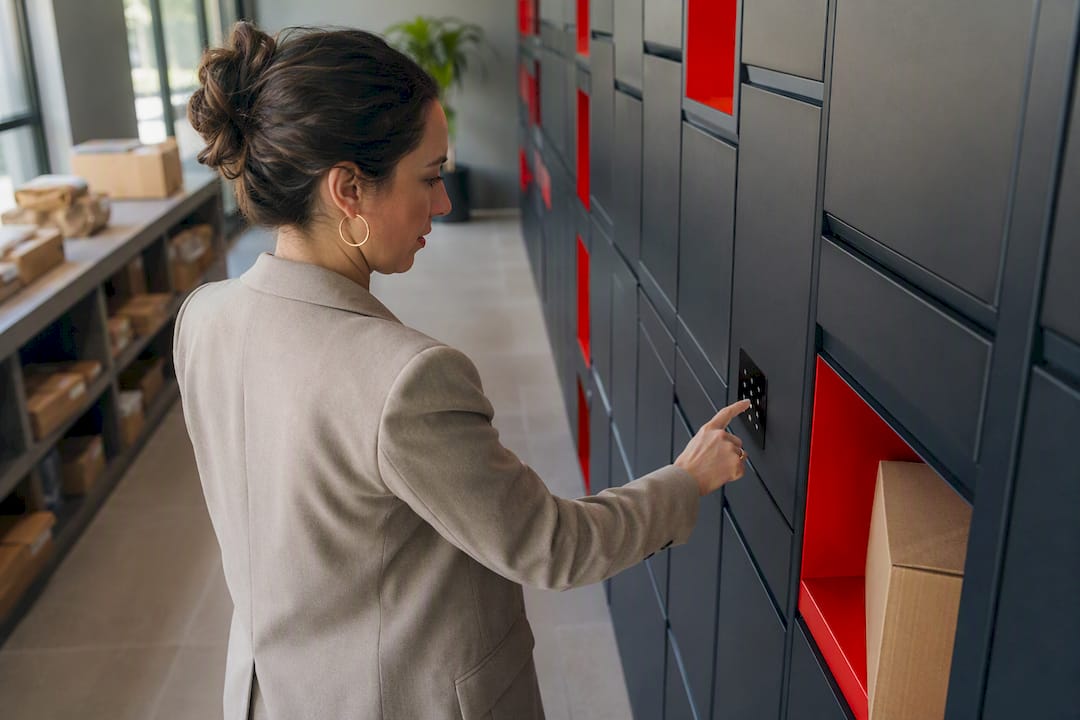
For most property and facility teams, a hybrid smart locker deployment paired with managed operational workflows is the fastest, lowest-risk way to stop package chaos. Fixed lockers handle routine volume securely, while daily oversight catches oversized parcels and carrier errors before they pile up. Postal Solutions can evaluate your site and build a turnkey plan around your unit count and delivery volume.
TL;DR:
- Fixed lockers are suitable for small properties with under 50 deliveries daily, but often require supplementing with overflow solutions during peak times.
- AI-powered package rooms offer significantly higher capacity and oversized parcel handling but depend on a strict intake process to avoid tracking issues.
- Hybrid systems, combining lockers for daily use with overflow shelving or scheduled visits, suit properties with irregular volume and oversized parcel needs.
- Entry-level locker systems cost between $6,000 and $20,000 for hardware and installation, with ongoing expenses for software, maintenance, and management.
- Carrier non-compliance remains the main cause of locker system failures, requiring standardized processes, carrier training, and regular audits to ensure proper package intake.
Table of Contents
- What Type of Business Package Lockers Does Your Property Actually Need?
- Fixed Lockers, AI Package Rooms, or Hybrid: What’s the Difference?
- How Much Do Business Package Lockers Cost?
- Why Do Carriers Skip the Locker System (and How Do You Stop It)?
- How Do You Implement a Business Package Locker System?
- What’s the Real ROI of a Business Package Locker System?
- Why Postal Solutions Has the Field Data to Back This Up
- Our Take: Hardware Is the Easy Part
- Get a Site Assessment From Postal Solutions
- Sources
- FAQ
What Type of Business Package Lockers Does Your Property Actually Need?
Before you talk to a single vendor, figure out what you’re solving for. Package volume varies wildly by property type, and buying hardware sized for the wrong problem is the single most expensive mistake facility teams make.
Start by pulling a week of real data, ideally during a normal (not holiday) stretch, and note a peak day separately, using insights from property management tips and tricks for leasing season to guide your peak period analysis. Track total packages received, the share that are oversized (think air fryers and mini fridges, not envelopes), your available square footage near the mailroom or lobby, and how your team currently handles pickup requests.
The math tends to sort properties into three rough categories:
- Small offices and retail locations: Under 50 daily deliveries usually fit a compact fixed locker bank with minimal oversized capacity needed.
- Mid-size multifamily communities: A 250-unit apartment community typically receives around 1,500 packages a month, which pushes most properties toward a mix of lockers and overflow shelving.
- Large student housing or high-turnover properties: Seasonal move-in spikes and a heavy oversized-parcel mix often justify a dedicated package room, not just lockers.
Once you know which bucket you’re in, vendor conversations get a lot shorter.
Fixed Lockers, AI Package Rooms, or Hybrid: What’s the Difference?
Every business package locker system on the market falls into one of three categories, and each comes with a real tradeoff. There’s no universally “best” option here, only the best fit for your volume and footprint.
- Fixed smart lockers. These offer the simplest pickup experience: a resident or employee gets a code, opens a door, takes their box. The catch is compartment size. Anything too big for the largest locker door has to go somewhere else, and during peak weeks (holidays, move-in season) overflow becomes a real problem. Seventy percent of operators already run at least one locker or unmanaged package-room system, which tells you how common this starting point is, and also why so many end up adding a second solution later.
- AI-powered package rooms. These use software-directed shelving instead of fixed compartments, and the space efficiency gain is significant. Deployed examples show AI rooms can triple storage capacity per square foot compared to fixed lockers, and they handle oversized parcels far better since there’s no rigid door size to work around. The tradeoff is that they depend more heavily on a clean intake process. If a driver skips the scan step, the software loses track of where a package actually sits.
- Hybrid systems. Lockers handle the steady daily flow, while an open-shelf overflow area or scheduled managed visits absorb peaks and oversized items. This is the practical middle ground for properties with irregular volume, and it’s what most sizable multifamily and student housing sites eventually land on.
Installation footprint, power and network access, and how carriers physically interact with the system all factor into which type fits your building. A retrofit into an existing mail room has different constraints than a ground-up new build.
How Much Do Business Package Lockers Cost?
Budget conversations go smoother when you separate hardware from ongoing costs, because vendors don’t always volunteer that breakdown upfront.
Entry-level installed smart locker systems commonly run $6,000 to $20,000, and that range typically covers hardware and installation only, not software licensing or maintenance. Larger AI package rooms and multi-bank locker walls sized for bigger properties run well above that floor.
For space planning, the standard rule of thumb is to allocate at least one square foot of dedicated storage per unit in new construction, with additional overflow capacity built in. Retrofits rarely hit that benchmark exactly, so plan for creative use of adjacent storage or a managed overflow process instead.
Ongoing costs to budget for include:
- Software subscription fees tied to the locker or package-room platform
- Routine hardware maintenance and part replacement
- Potential managed visit fees if you outsource daily organizing and audits
Statistic to know: entry-level smart locker installs run $6,000 to $20,000 before software and maintenance, and a mid-size community can expect roughly 1,500 packages a month flowing through whatever system you choose.
Why Do Carriers Skip the Locker System (and How Do You Stop It)?
Hardware rarely fails first. Process does. Carrier non-compliance, meaning drivers who skip the intake scan and leave packages on a counter or in a hallway, was flagged by a majority of surveyed operators cited it as their top operational frustration. A locker wall does nothing if the driver never uses it.
Fixing this is less about technology and more about repeatable process. Effective controls include:
- A laminated, pictorial SOP posted at the delivery entrance so drivers see the steps without reading dense instructions
- QR codes or PIN pads that make scanning faster than leaving a package on the floor
- A designated staging location for oversized items that won’t fit in a locker
- A carrier training packet shared with USPS, UPS, FedEx, and Amazon logistics teams at rollout
- A clear escalation path for repeat non-compliance, including who at the property calls the carrier’s local hub
Standardizing that carrier communication at rollout, rather than fixing it property by property, is what keeps large portfolios from seeing uneven results. When you’re evaluating vendors, ask for audit logs that show driver scan timestamps and documented non-participation, plus a remediation SLA for missed scans.
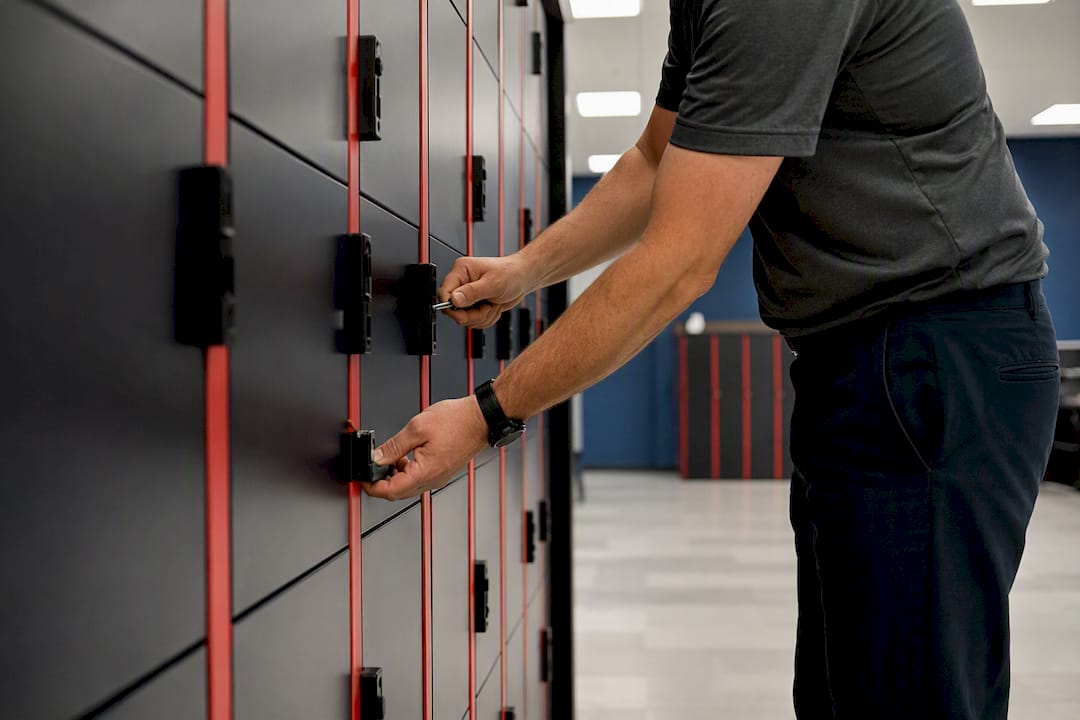
Pro Tip: A six-day-per-week managed visit paired with your lockers catches carrier errors within a day instead of a week, which stops small compliance slips from turning into a lobby full of misdelivered boxes.
How Do You Implement a Business Package Locker System?
Procurement moves faster when you sequence it instead of chasing every vendor conversation at once.
- Define your KPIs and technical requirements first. Know your daily volume, oversized parcel percentage, and any integration needs with existing access control or building management software before you request quotes.
- Send a tight RFP. Ask every vendor the same questions: How do they handle carrier workflows and non-compliance? What integrations do they support? What’s the warranty and maintenance SLA? Who owns the audit data?
- Prep the site. Confirm power and network drops, plan signage for the delivery area, coordinate with existing access control, and map out overflow storage before installation day.
- Commission in phases. Run a short pilot, train staff and carriers together, communicate the change to residents or employees, and schedule audits at 30, 60, and 90 days to catch drift early.
Treating this as a workflow rollout, not just an equipment delivery, is what separates smooth go-lives from months of complaints.
What’s the Real ROI of a Business Package Locker System?
Unmanaged package handling isn’t free. It just hides the cost in staff time. Properties without a system in place often absorb $40,000 to $70,000 annually in staff hours and lost productivity, and that figure climbs fast at higher-volume sites.
Lockers alone cut a chunk of that. Lockers plus managed visits cut more, since someone is actively organizing overflow and correcting carrier mistakes daily instead of letting them accumulate. AI package rooms add scalability for properties outgrowing fixed compartments.
Watch these KPIs after go-live:
- Touches per package (fewer is better)
- Average pickup time per resident or employee
- Complaint volume tied to missing or misdelivered packages
- Staff hours reclaimed monthly
Why Postal Solutions Has the Field Data to Back This Up
This footprint spans conventional multifamily, student housing, senior housing, and university partnerships, which means the carrier compliance and sizing guidance here comes from repeated, real deployments, not theory.
Where clients want more than hardware, Postal Solutions also configures hybrid systems and layers on daily package room management outsourcing, keeping rooms organized, audited weekly, and current without adding property staff.
Our Take: Hardware Is the Easy Part
Most package locker research online focuses on comparing brands and door sizes, which misses the actual failure point. Systems don’t break because the lockers are too small. They break because nobody enforced the carrier process, and within a few months a locker wall that cost thousands of dollars turns into an expensive shelf next to a pile of boxes that didn’t fit.
The 70% of operators layering multiple intake methods aren’t doing it by accident. They’re admitting that a single hardware purchase rarely survives contact with real-world delivery volume and driver behavior. That’s the gap conventional buying guides skip past.
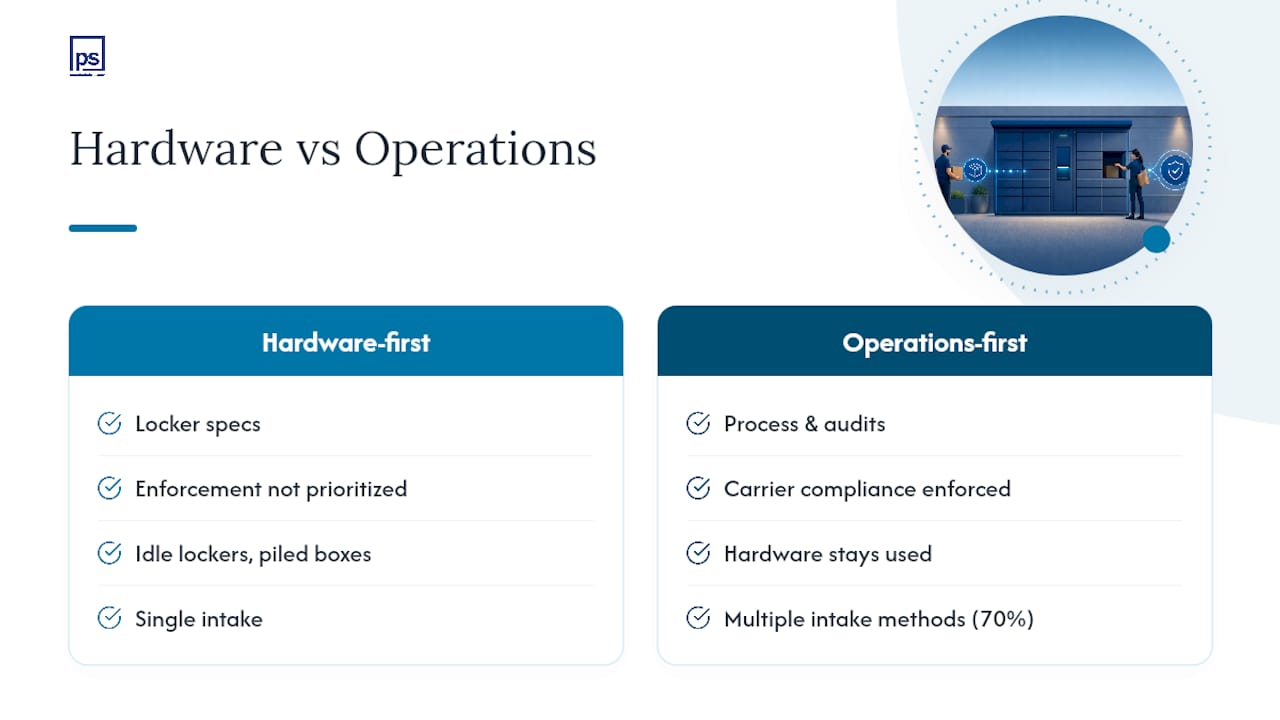
If you’re evaluating systems right now, prioritize the process questions before the spec sheet: who audits the room weekly, who retrains carriers when compliance slips, and who’s accountable when a scan gets skipped. A managed visit program paired with the right hardware answers all three. Buying lockers without answering them is how properties end up back at square one within a year, just with more expensive equipment sitting idle.
Facility teams that treat this as an operations problem first, and a purchasing decision second, get better outcomes with less hardware.
— Postal Solutions
Get a Site Assessment From Postal Solutions
Postal Solutions sells and installs Luxer One package room and locker systems, and manages the day-to-day work that keeps them running: daily package room organizing, address label audits, weekly reporting, and six-day-per-week managed visits where properties want a full-service solution. Unlike buying hardware alone, this means someone is accountable for carrier compliance and room organization from day one, not just the installation.
An initial site assessment typically covers your unit count, current delivery volume, footprint, and existing access control setup, and results in a sizing and cost recommendation within days, not weeks. If your team is losing hours to package chaos or fielding carrier complaints, contact Postal Solutions to schedule a site walkthrough and get a straight answer on what system fits your property.
Sources
- A Framework for Solving Multifamily’s Package Management Problem | Insights by Blueprint
- Package Management: Logistics Technology Prevents Apts From Getting Boxed In | NAA
FAQ
How Much Does a Business Package Locker Cost?
Entry-level smart locker installations typically run $6,000 to $20,000, covering hardware and installation but not ongoing software subscriptions or maintenance fees. Larger AI-powered package rooms sized for high-volume properties cost more.
Do I Get Paid for Hosting an Amazon Locker?
Business package lockers installed through providers like Postal Solutions are owned and managed by your property, not leased out as a public Amazon Locker hosting site, so this isn’t a revenue arrangement. Any compensation structure for hosting a third-party public locker is a separate, unrelated program from a private business or apartment locker system.
What Are Those Package Lockers Called?
Commercial parcel lockers, business office package lockers, and automated delivery locker systems are the common industry terms. Some properties also use “package rooms” to describe open-shelf AI-managed storage rather than fixed locker compartments.
How Do Package Lockers Work?
A carrier scans a package into a locker or package room using a barcode or QR code, which assigns it a compartment and notifies the recipient with a pickup code. The recipient enters that code at a kiosk or app to retrieve their package, and the system logs the transaction for audit purposes.
What’s the Difference Between a Package Locker and a Package Room?
A package locker uses fixed compartments sized to specific dimensions, while a package room uses open shelving, sometimes AI-directed, that adjusts to different parcel sizes without a rigid door limit. Many properties combine both to handle routine deliveries and oversized items in the same space.