Lower Property Operating Costs: A Practical Playbook
Lower Property Operating Costs: A Practical Playbook Three levers move the needle fastest on operating costs: utility efficiency, preventative maintenance, and centralizing vendor and package-room operations. Start with contract rebids and
Published

Three levers move the needle fastest on operating costs: utility efficiency, preventative maintenance, and centralizing vendor and package-room operations. Start with contract rebids and consolidation, which institutional operators use to cut expenses 5 to 15 percent without touching resident experience. Pair that with LED and HVAC controls for quick utility wins, a real preventative maintenance schedule (prevention routinely saves multiple dollars for every dollar spent versus reactive repairs), and outsourced package-room management like the model Postal Solutions runs alongside Luxer One lockers to cut payroll hours lost to parcel chaos.
- Utilities and energy retrofits: 10 to 30% reduction on lighting and HVAC line items within months
- Preventative maintenance: avoids the multiplier effect of emergency repairs
- Contract rebids and vendor consolidation: 5 to 15% savings, often within one renewal cycle
- Centralized admin and package-room outsourcing: recovers staff hours currently lost to parcel sorting and resident complaints
- Turnover and make-ready fixes: shortens vacancy days and protects net operating income (NOI)
Key Takeaways
Lowering property operating costs comes down to fixing controllable line items first: utilities, maintenance cadence, vendor contracts, and package-room labor, in that order of speed to impact.
| Point | Details |
|---|---|
| Start with contracts | Rebid your top vendor contracts first; competitive bidding typically saves 15 to 25% per contract. |
| Prevent, don’t react | Scheduled maintenance avoids the cost multiplier of emergency repairs on HVAC and roofing systems. |
| Benchmark quarterly | Track operating expense ratio and CAM per square foot every quarter, not once a year. |
| Fix package-room labor | Outsourced daily organization and Luxer One locker installs from Postal Solutions recover staff hours lost to parcel sorting. |
| Sequence by timeline | Tackle 30-day quick wins first, then 90-day contract and pilot work, then 180-day capex decisions. |
Table of Contents
- What Counts as Property Operating Costs?
- Where Do Hidden Operating Costs Come From?
- What Are the Highest-Impact Cost Reduction Strategies?
- How Does Package-Room Outsourcing Cut Labor Costs?
- How Should You Prioritize Projects for the Best ROI?
- What Should You Do in the First 30, 90, and 180 Days?
- How Do Regulations Affect Property Operating Costs?
- Do Green Certifications Lower Operating Costs?
- A Practical Next Step for Package-Room Costs
- Sources
- FAQ
What Counts as Property Operating Costs?
Operating costs cover every recurring expense required to run a property, separate from financing or capital improvements. Knowing which line items you actually control determines where your first dollar of effort goes.
- Utilities: electricity, gas, water, and waste removal
- Maintenance and repairs: routine upkeep, emergency fixes, and asset servicing
- Labor and staffing: on-site payroll, benefits, and overtime
- Contract services: landscaping, janitorial, security, and waste hauling
- Insurance and property taxes: largely market-driven, slower to change
- Administrative costs: office supplies, software licenses, and back-office labor
- CAM allocations: shared costs billed to tenants in commercial properties
- Turnover and make-ready costs: cleaning, repairs, and marketing between leases
Utilities, staffing models, and vendor contracts respond quickly to management decisions. Taxes and insurance move on a longer, market-driven timeline. Track your operating expense ratio and CAM per square foot from day one. Both numbers tell you fast whether your cost structure is drifting from portfolio norms.
Where Do Hidden Operating Costs Come From?
Most cost leakage hides in places nobody audits regularly. Sloppy general ledger and CAM coding lets ineligible expenses slip into tenant reconciliations unnoticed, and annual reviews catch these errors far too late to matter. Unreconciled vendor invoices, untracked overtime, and turnover costs (lost rent plus make-ready labor) quietly erode margins month after month. Unmanaged package-room labor is another common blind spot: staff time spent sorting parcels and fielding resident complaints rarely shows up as its own line item, but it adds up fast.
Benchmark these figures on a recurring basis:
- Operating expense ratio (total operating expenses divided by gross operating income)
- CAM per square foot, which typically runs $3.00 to $17.00 annually depending on property type and region
- Turnover cost per unit and average days-to-turn
- Utilities cost per unit or per square foot, tracked month over month
- Invoice exception rates, meaning how often billed amounts don’t match contract terms
Reconcile quarterly, not annually. A quarterly cadence catches CAM miscoding and vendor billing errors while they’re still cheap to fix.
What Are the Highest-Impact Cost Reduction Strategies?
Energy and utilities
LED retrofits pay back the fastest of any capital project, often within months on high-use common areas and parking structures. Smart HVAC controls and submetering take longer to install but deliver steady, compounding savings once tenants see their own consumption reflected in their bills. Low-flow fixtures and leak-detection sensors round out the water side, where waste is often invisible until a bill spikes.
Maintenance: prevention over reaction
Shifting from reactive repairs to scheduled, sensor-supported maintenance is one of the most reliable operations playbook strategies available to property teams. Preventative maintenance programs consistently outperform reactive spending, particularly on HVAC systems, roofing, and parking lot surfaces, where deferred repairs compound quickly into major capital expenses.
Vendor and procurement discipline
Rebid your top three or four contracts every renewal cycle. Competitive bidding with at least three quotes on any contract above a reasonable threshold typically saves 15 to 25 percent versus auto-renewing with the incumbent. Across a portfolio, consolidating vendors and standardizing scopes of work is where institutional operators find their easiest 5 to 15 percent in expense reduction.
Labor and centralization
Centralize leasing, renewals, and administrative work across a portfolio rather than duplicating it at every site. Flexible staffing models and selective insourcing of high-frequency services like pest control or valet trash can reduce costs while protecting service levels, especially when paired with centralized purchasing power.
Turnover and make-ready
Standardize renovation scopes so every unit turn follows the same checklist and materials list. Clear vendor service-level agreements (SLAs) shrink days-to-turn, and every day shaved off vacancy directly protects NOI.
Technology and automation
Property management software, automated renewal workflows, and work-order automation reduce administrative drag when they’re integrated rather than siloed. Sensor-driven building systems feed real-time data into software that converts it into actionable maintenance and energy decisions, which is the mechanism behind most of the utility and maintenance savings above.
Pro Tip: Track resident satisfaction scores alongside every cost-cutting initiative. A contract rebid that saves money but degrades service response times often costs more in turnover than it saves in vendor fees.
Contract restructuring alone routinely delivers 5 to 15 percent in operating expense reductions for institutional operators, according to Ivy Capital’s analysis of multifamily NOI growth.
How Does Package-Room Outsourcing Cut Labor Costs?
Package rooms generate hidden labor costs that rarely appear on a budget line. Staff spend hours sorting parcels, matching names to units, and fielding “where’s my package” calls, on top of the lost productivity when residents can’t retrieve items during office hours.
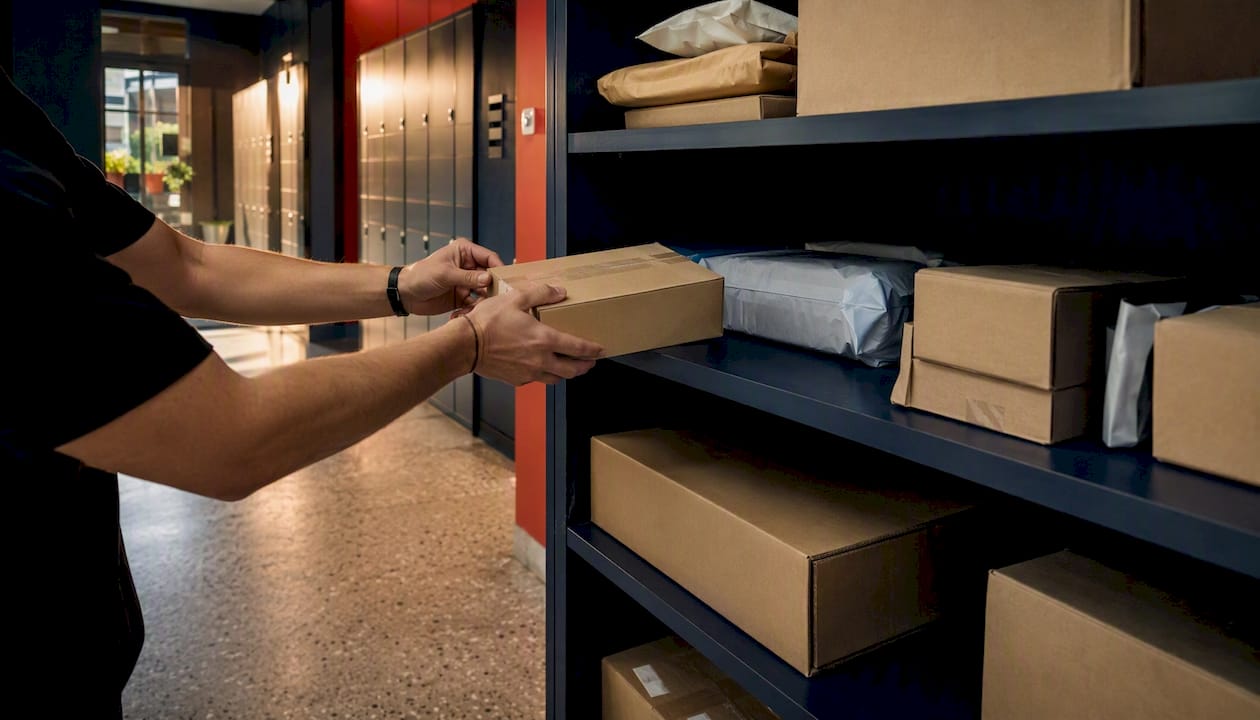
Consider a conservative, illustrative baseline: a 300-unit community with no locker system might see a leasing or maintenance staffer spend 8 to 10 hours weekly on package sorting and resident outreach. Installing a Luxer One locker system and adding daily managed visits (matching every package to the correct unit, running weekly audits) can cut that to 2 to 3 hours of oversight per week. That’s payroll time redirected to leasing and resident service instead of parcel triage.
Automated locker systems paired with managed daily organization also reduce lost packages and shorten resident pickup times, which lowers leasing friction and cuts down on the frustrated maintenance calls that eat into staff schedules.
When evaluating a locker or managed-service option, check for:
- Integration with your existing property management software
- Refrigerated compartment availability for grocery and meal-kit deliveries
- Parcel size flexibility for oversized items
- Clear vendor SLAs on daily visit frequency and audit reporting
Pro Tip: Run a 60-day pilot at your highest-volume building before rolling out portfolio-wide. Package volume varies enough between properties that a single pilot site rarely represents the whole portfolio.
How Should You Prioritize Projects for the Best ROI?
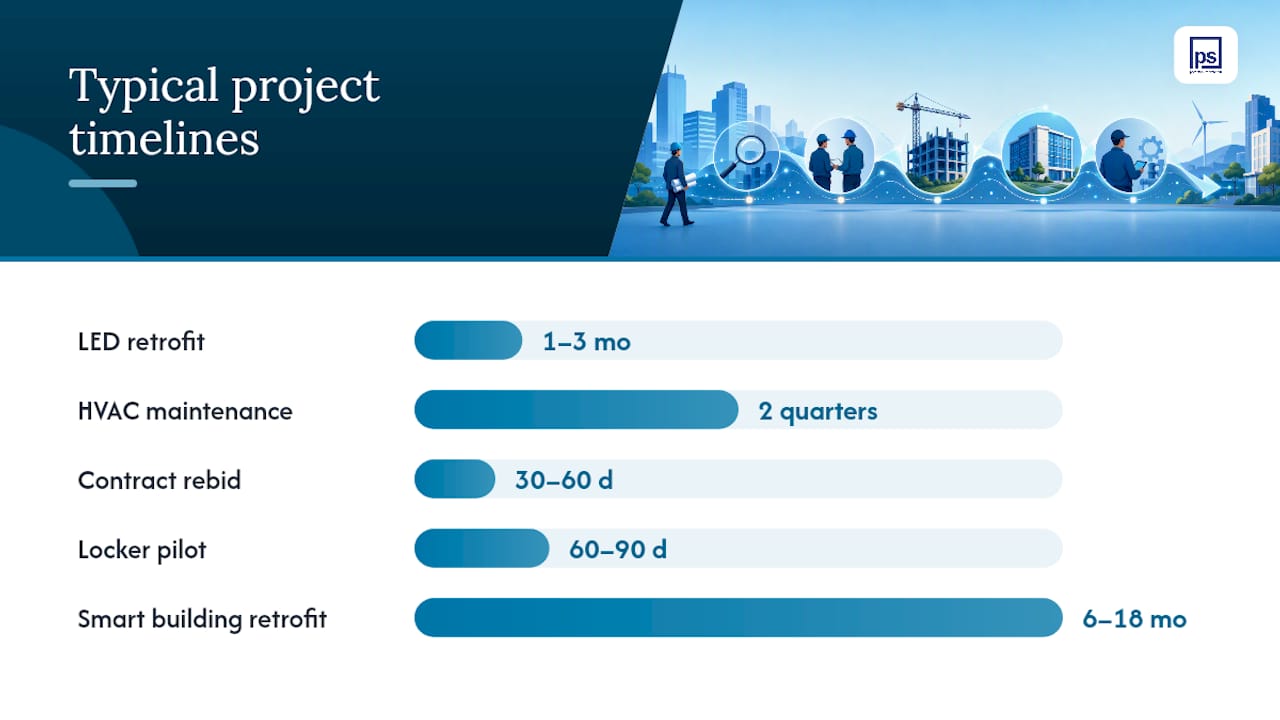
Rank projects by impact versus effort. Quick wins (LED swaps, contract rebids) need little capital and pay back fast. Mid-term projects (HVAC tune-ups, work-order automation) take a quarter or two to implement but compound over years. Long-term capital projects (smart building retrofits, full submetering rollouts) require larger budgets and board-level approval but deliver the deepest savings.
| Project | Typical Timeline | Expected Impact |
|---|---|---|
| LED retrofit | 1 to 3 months payback | Fast reduction in lighting spend |
| HVAC preventative maintenance | Ongoing, savings visible within 2 quarters | Fewer emergency repair calls |
| Contract rebid (top 3 vendors) | 30 to 60 days to execute | 15 to 25% savings per rebid contract |
| Package-room locker pilot | 60 to 90 days | Recovered staff hours, faster pickup |
| Full smart building retrofit | 6 to 18 months | Compounding utility and maintenance savings |
Loop in your regional manager or asset owner before committing capital, and request budget in phases tied to measured results rather than a single lump-sum ask.
What Should You Do in the First 30, 90, and 180 Days?
- Days 1 to 30: Audit your top three vendor contracts, begin LED replacement in the highest-traffic common areas, run a full utility bill audit, set basic work-order triage rules, and pilot managed package-room visits at one property.
- Days 31 to 90: Roll out submetering or tenant-level utility billing where feasible, launch a preventative maintenance schedule for HVAC and roofing, rebid or consolidate your two largest contracts, and formalize a Luxer One locker deployment or outsourced package-room agreement.
- Days 91 to 180: Finish remaining energy-control upgrades, integrate your work-order software with your property management system, automate resident communications for renewals and billing, and evaluate remaining capex projects for the next budget cycle.
Assign an owner and a due date to every item. A checklist without accountability rarely survives the first busy leasing season.
How Do Regulations Affect Property Operating Costs?
Compliance costs don’t show up as a single line item, but they touch almost every category above. Local energy benchmarking ordinances, now active in a growing number of U.S. cities, require buildings above a certain square footage to report annual energy use and, in some jurisdictions, meet performance thresholds or face fines. Fire and life-safety inspections, lead and asbestos disclosure rules, and habitability codes all carry compliance labor and, occasionally, retrofit costs when a property falls out of compliance.
The savings angle is real, though it’s indirect. Buildings that get ahead of energy benchmarking requirements, rather than scrambling to comply after a notice arrives, avoid the rushed capital spending that comes with a compliance deadline. Scheduling HVAC and building envelope upgrades on your own timeline, tied to your preventative maintenance calendar, costs less than an emergency retrofit forced by a fine or a failed inspection.
Fair housing and habitability compliance also intersect with maintenance response times. Slow work-order turnaround on health and safety issues creates legal exposure that dwarfs any short-term savings from deferred repairs. Build compliance deadlines into your maintenance and capital planning calendar rather than treating them as a separate function, and budget a small contingency line for regulatory-driven upgrades so a new local ordinance doesn’t blow up your annual operating budget.
Do Green Certifications Lower Operating Costs?
LEED and other green building certifications tend to pay for themselves through utility savings rather than through the certification badge itself. Certified buildings generally use less energy and water per square foot because certification requires the efficiency upgrades (better insulation, high-efficiency HVAC, water-saving fixtures) that drive the utility savings discussed earlier in this playbook.
The financial case varies by market and property type. Some municipalities offer property tax abatements, density bonuses, or expedited permitting for certified projects, which can offset certification costs on new construction or major renovations. Existing buildings pursuing certification retroactively, though, need to weigh the audit and documentation costs against the utility savings a certification-driven retrofit would deliver anyway.
Certification also carries a marketing benefit that shows up on the revenue side rather than the expense side: sustainability-minded tenants and residents increasingly factor certification into leasing decisions, particularly in commercial office and institutional multifamily segments. That demand can support slightly higher rents or lower vacancy, which isn’t a cost reduction in the strict sense but improves the same NOI equation from the other direction.
For most operators, the practical approach is to pursue the efficiency upgrades that certification requires (LED, HVAC controls, water fixtures) regardless of whether you formally certify, then decide on certification itself based on your specific market’s tenant demand and any local incentive programs.
A Note From the Field
Every managed package-room deployment we run confirms the same pattern: staff time buried in parcel sorting comes back the moment lockers and daily organization take over. Cost cuts only hold up long-term when resident experience improves alongside them, which is why Postal Solutions builds every program in partnership with the property team, not around them.
A Practical Next Step for Package-Room Costs
Contract rebids and energy retrofits take committees and budget cycles. Package-room costs are different: you can pilot a fix this quarter. Postal Solutions manages daily package-room organization, including labeling units, running weekly audits, and keeping parcels moving, and also sells and installs Luxer One locker and refrigerated locker systems for properties ready to automate pickup entirely.
The combination addresses the exact labor drain described above: staff time lost to sorting, resident complaints about missing packages, and leasing friction during peak delivery seasons. Property teams can request a package-room assessment to see where their current setup is losing hours, then decide whether a managed-visit program, a Luxer One installation, or both fits their portfolio. Visit Postal Solutions to request an assessment for your property.
Sources
- Reducing Operating Costs for Commercial Real Estate
- Inside the 2026 Operations Playbook | Multifamily Executive
- How Operational Improvements Drive NOI Growth in Multifamily Investments
- Common Area Maintenance (CAM): The Complete Guide for Property Managers and Landlords
- HOA Common Area Maintenance: Plan & Budget Guide
FAQ
What are some ways to reduce operating costs?
The fastest levers are utility efficiency upgrades, preventative maintenance schedules, vendor contract rebids, and centralizing admin or package-room labor. Institutional operators typically capture 5 to 15 percent savings through contract restructuring alone.
What is the 50% rule in real estate?
The 50% rule is a quick-estimate heuristic that assumes operating expenses, excluding mortgage payments, will run roughly half of gross rental income. It’s a planning shortcut for early underwriting, not a substitute for a detailed operating expense ratio calculation on an actual property.
What is a good operating expense ratio?
A lower operating expense ratio generally signals tighter cost control, though the “good” number varies by property type and market. Multifamily properties often target a ratio in the 40 to 60% range, while older or amenity-heavy properties tend to run higher.
What is a lower operational cost?
A lower operational cost means reducing the recurring expenses required to run a property, like utilities, maintenance, labor, and vendor contracts, without cutting into resident experience or deferring maintenance in ways that create bigger costs later. Package-room outsourcing through providers like Postal Solutions is one concrete example: it lowers labor cost per unit while improving resident pickup speed.
How much can package-room outsourcing save on labor?
Savings vary by property size and delivery volume, but properties that pair a Luxer One locker installation with daily managed organization commonly redirect several hours of staff time per week away from parcel sorting toward leasing and resident service.