Property Manager Package Solutions: Operations-Ready Guide
Property Manager Package Solutions: Operations-Ready Guide For most U.S. multifamily properties, the right property manager package solution is a managed, hardware-backed locker or secure package room paired with carrier-access controls and
Published
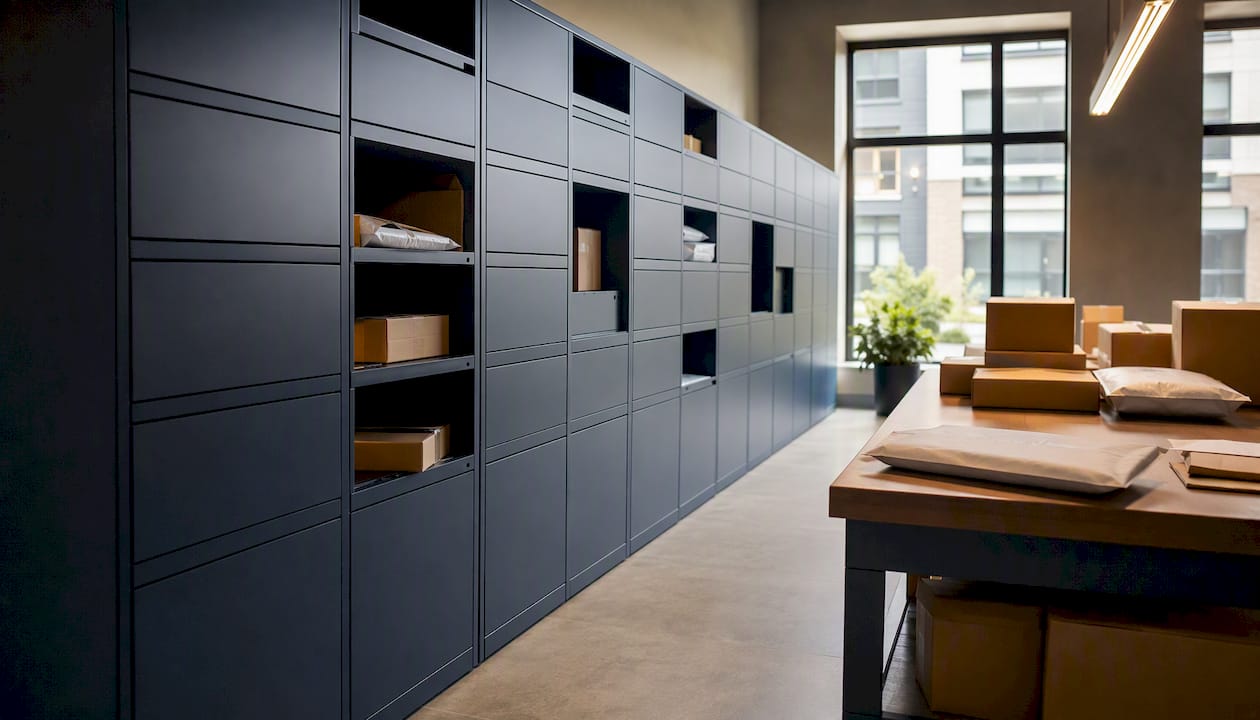
For most U.S. multifamily properties, the right property manager package solution is a managed, hardware-backed locker or secure package room paired with carrier-access controls and integration into your existing property management software. That combination consistently outperforms every alternative on the metrics that matter most to operations teams: staff hours recovered, resident satisfaction scores, and defensible audit trails when theft claims arise.
Here is what that approach delivers in practice:
- Reduced staff burden: Daily package organization and weekly audits shift off leasing-team plates entirely under a managed model.
- Lower theft risk: Controlled access and tamper-resistant hardware cut the exposure window that porch piracy depends on.
- Resident satisfaction: Automated pickup notifications and 24/7 locker access remove friction from the resident experience.
- Audit-ready records: Time-stamped carrier logs and access events give you documentation for claims without manual record-keeping.
- Scalability: Hardware and managed-service contracts can grow with your portfolio without rebuilding the program from scratch.
Pro Tip: Before committing to a full hardware purchase, run a 60-to-90-day pilot at one asset using a managed daily-organization service. You will collect real volume data, identify your peak-day patterns, and build the ROI case for ownership before any capital outlay.
Key Takeaways
A managed, hardware-backed package solution with daily operational oversight consistently outperforms every alternative on staff-time savings, resident satisfaction, and claims auditability for U.S. multifamily properties.
| Point | Details |
|---|---|
| Start with real volume data | Count daily and peak-day packages for two weeks before evaluating any hardware or service. |
| Require audit logs and carrier workflows | Every solution must capture time-stamped events and define how each carrier accesses the building. |
| Match contract model to ownership | Capex purchase suits long-term holders; opex-managed contracts suit short hold periods or portfolio operators. |
| Pilot before full commitment | A 60-to-90-day pilot at one asset produces the staff-hours and satisfaction data ownership needs to approve a rollout. |
| Postal Solutions manages the full program | Postal Solutions sells and installs Luxer One systems and manages daily package room organization, audits, and operational support. |
Table of Contents
- Why package management is a real operational problem for property managers
- What are the main package solution types property managers evaluate?
- How do you choose the right package management approach?
- What does implementation actually cost and how long does it take?
- What security features and audit capabilities should you require?
- Why a managed hardware approach works: Postal Solutions and Luxer One
- What is the recommended next step for your property?
- The operational trade-offs most guides skip
- Postal Solutions manages the full package program for you
- Sources
- FAQ
Why package management is a real operational problem for property managers
Package theft is not a nuisance-level issue. The USPS Office of Inspector General documents it as a widespread, fragmented problem affecting tens of millions of parcels annually, one that crosses carriers, retailers, and property stakeholders and demands coordinated, building-level responses rather than resident-by-resident fixes.
The financial scale is significant. SimplyInsurance estimates package theft costs U.S. consumers roughly $15 billion annually. Renters are particularly exposed: their insurance deductibles typically exceed the value of a stolen package, so individual recovery is rarely practical. That gap lands squarely on the property’s reputation.
Ecommerce’s growing share of retail sales means parcel volume into residential properties keeps rising. More deliveries per unit per week translates directly into more staff time, more exposure, and more resident complaints when something goes wrong.
The hidden labor cost is where many operators underestimate the problem. On a mid-size property, leasing staff can spend multiple hours per day sorting, logging, and fielding resident inquiries about packages. That time comes out of leasing activity, maintenance coordination, and resident retention work. It is a real drag on net operating income that rarely appears as a line item until someone calculates it.
| Metric | Scale |
|---|---|
| Estimated annual theft cost (U.S.) | ~$15 billion (SimplyInsurance) |
| Theft scope | Tens of millions of packages (USPS OIG) |
| Renters insurance deductible vs. package value | Deductible often exceeds loss (SimplyInsurance) |
| Ecommerce share of retail | Over 20% of worldwide retail sales (eMarketer) |
| Prevention adoption | Most households use at least one method (Porch Pirate Protection) |
What are the main package solution types property managers evaluate?
Understanding the options before you talk to vendors keeps you from buying the wrong category of solution. Each type fits a different operational profile.
Package lockers are banks of secure, individually assigned compartments. A carrier deposits a parcel, the system sends the resident an access code, and the resident retrieves it on their schedule. Lockers work well for properties with predictable volume and limited staff availability. They require adequate footprint and carrier onboarding, but once running, they are largely self-managing.
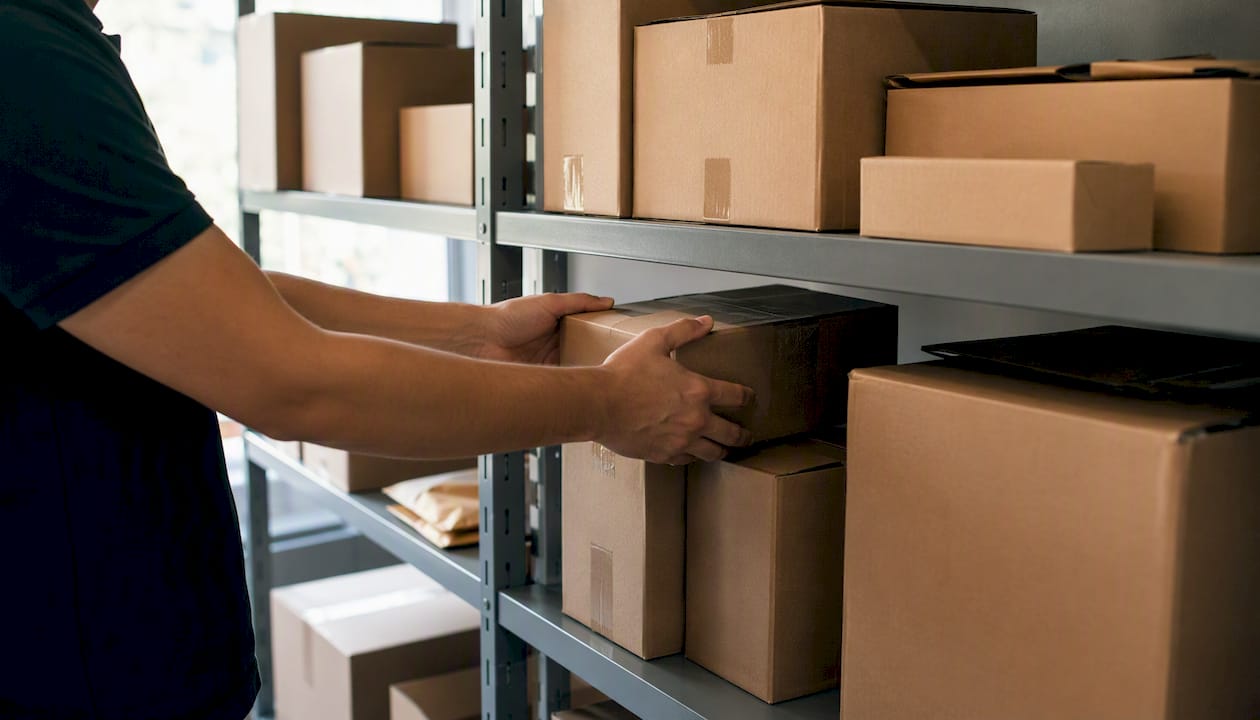
Package rooms range from a simple locked room with a manual log to a fully automated space with camera coverage, access control, and software integration. A staffed package room can handle irregular-size parcels that lockers cannot, but without daily organization, they become chaotic quickly. Residents cannot find their packages, staff get pulled in to help, and the room defeats its own purpose.
Smart package-room systems add computer vision, automated sorting, or conveyor-based intake to the package-room model. These fit large, high-volume properties where manual organization cannot keep pace. The capital cost is higher, and the integration requirements are more demanding.
Carrier-access control addresses the entry gap: how do UPS, FedEx, USPS, and Amazon actually get into the building? Intercom systems with carrier verification, key-fob access, and AI-enabled entry automation each solve part of this problem. Without a defined carrier workflow, even the best locker system gets bypassed when a driver leaves a parcel in the lobby.
Resident-level options include signature requirements, delivery redirects to access points, and personal lockboxes. Security and Porch Pirate Protection’s 2026 data both confirm that layered defenses outperform any single tactic. Resident-level fixes alone rarely hold at scale because they depend on individual behavior you cannot control.
- Lockers: best for consistent volume, limited staff, residents who value 24/7 access
- Package rooms: best for mixed parcel sizes, high volume, properties with some daily management capacity
- Smart systems: best for large urban properties with 300+ units and high daily intake
- Carrier-access control: necessary complement to any hardware solution
- Resident-level options: acceptable short-term or as a supplement, not a primary strategy
Pro Tip: Pair a locker bank with a defined carrier-access workflow from day one. Lockers that carriers cannot reliably access revert to lobby drops within weeks, and you lose the security benefit you paid for.
How do you choose the right package management approach?
Start with your property’s actual numbers, not a vendor’s feature sheet. Daily package volume, peak-day volume (typically Monday after a weekend and the holiday season), available square footage, your current staff model, and your resident profile all shape which solution category fits.
Once you have those numbers, apply this decision framework:
- Capacity and footprint: Can the hardware physically handle your peak-day volume? Undersized lockers create overflow that ends up in the lobby.
- Carrier compatibility: Does every carrier your residents use have a defined access and deposit workflow? Missing one carrier breaks the system for a meaningful share of deliveries.
- Software integration: Does the solution connect to your property management platform for automated notifications, work-order triggers, and resident communication? Manual notification workflows erode the time savings quickly.
- Security and auditability: Are access events time-stamped and tied to carrier ID or staff credentials? Can you pull a log for a specific package within five minutes of a resident complaint?
- Maintenance and service levels: What is the vendor’s SLA for hardware failures? A locker bank that is down during peak season is worse than no locker bank.
- Cost structure: Is this a capital purchase with a service contract, a lease with managed operations, or a subscription? Match the model to your ownership’s preference for capex versus opex.
- Scalability: Can the system expand as your portfolio grows without a full replacement?
Questions to ask every vendor before signing: What is your average installation timeline? Which property management platforms do you integrate with natively? How do you onboard each carrier? What does your audit log capture, and how long is it retained? Who handles maintenance calls, and what is your guaranteed response time? Can you provide references from properties of similar size and class?
Red flags to watch for: no audit log or vague answers about what it captures, unclear carrier-access policies, pricing that changes significantly after the initial quote, and vendors who cannot provide references from comparable properties.
Pro Tip: Score two approaches side by side using generic categories rather than brand names. Assign points for each criterion above based on your property’s priorities. The approach with the highest weighted score on your top three criteria is almost always the right starting point, regardless of which vendor presents it most attractively.
What does implementation actually cost and how long does it take?
Deployment has five phases: site survey and vendor selection, procurement and permitting, installation and integration, staff training and resident rollout, and steady-state operations. Each phase has its own timeline and cost drivers.
For a small property (under 100 units), a locker installation with software integration typically runs four to eight weeks from signed contract to go-live. Medium properties (100 to 300 units) with package rooms and carrier-access upgrades often take eight to twelve weeks, particularly when conduit or cabling work is required. Large properties or those adding refrigerated lockers for grocery and meal-kit deliveries can run twelve to twenty weeks, especially when permitting or custom site work is involved. Carrier operational surges around holidays are a real constraint: plan installations to complete before peak season, not during it.
Primary cost drivers to budget for:
- Hardware: Locker banks, package-room access control, cameras, and any refrigerated units
- Software and integration: Licensing, API connections to your property management platform, and notification setup
- Installation and site work: Electrical, conduit, anchoring, and any structural modifications
- Recurring service and maintenance: Hardware SLA coverage, software updates, and managed-operations visits if included
- Staffing changes: Reduced leasing-team hours on package handling, offset by any managed-service contract cost
On the ROI side, the math is straightforward. If leasing staff spend two hours per day on package-related tasks at a fully loaded cost of $25 per hour, that is roughly $18,000 per year in labor applied to a non-revenue activity. A managed daily-organization service typically costs a fraction of that, and it frees your team for leasing and retention work that directly affects NOI. For a deeper look at how secure package storage connects to NOI protection, the operational case is consistent across property classes.
What security features and audit capabilities should you require?
Security in a package management program is not just about physical hardware. It is about creating a documented chain of custody from carrier drop-off to resident pickup that you can reconstruct in under five minutes when a claim arrives.
Essential security features to require:
- Controlled access: No open-lobby package staging. Every deposit and retrieval requires a credential (carrier key, access code, or biometric).
- Tamper-resistant hardware: Locker compartments and package-room doors rated for forced-entry resistance.
- Camera coverage: Cameras positioned to capture carrier deposit events and resident retrieval events, with footage retained for at least 30 days.
- Time-stamped access logs: Every event tied to a carrier ID, staff credential, or resident account with a precise timestamp.
- Two-factor resident pickup verification: Access code plus a secondary confirmation (app confirmation, PIN, or biometric) reduces unauthorized retrieval.
Audit logs should capture: carrier name and ID at entry, package deposit time and compartment or location, resident notification timestamp, resident retrieval time and credential used, and any staff-override events. That sequence gives you a complete record for any claim.
For claims handling, train staff on a simple workflow: when a resident reports a missing package, pull the log for that unit’s expected delivery window, confirm whether a deposit event occurred, and cross-reference camera footage. If the log shows delivery and retrieval by an unrecognized credential, escalate to the carrier and, if warranted, law enforcement. Document every step with timestamps. Reducing apartment package theft at the building level depends on this kind of structured response, not ad hoc investigation.
Integration patterns that work: connect locker or package-room events to your property management platform so that resident notifications fire automatically, work orders trigger on hardware faults, and weekly audit reports land in your operations dashboard without manual export.
Why a managed hardware approach works: Postal Solutions and Luxer One
The managed hardware model aligns with how multifamily operations actually run. Property teams are not package logistics specialists, and they should not have to become one. A vendor that provides both the hardware and the daily operational management removes the execution gap that causes most package programs to underperform.
Postal Solutions has managed package room outsourcing since 2016, now in its 11th year of operations. As the largest Luxer One sales agency in the country, Postal Solutions has completed over 1,200 Luxer One sales and installations across more than 40% of U.S. states. That footprint covers on-campus universities, Public Private Partnership (P3) developments, conventional multifamily, student housing, senior housing, and municipalities.
The operational model Postal Solutions offers goes beyond hardware. For properties that want full-service coverage, Postal Solutions manages daily package room organization visits up to six days per week, with a package manager who marks unit numbers on boxes, organizes the room for easy resident retrieval, and completes weekly audits using the property’s existing package-room software or a Luxer One system Postal Solutions installs. The result is a room that residents can navigate without staff assistance, which is where the staff-time savings actually materialize.
A property that installs lockers or a package room without daily operational management is paying for hardware that residents cannot reliably use. The friction of a disorganized room pulls leasing staff back in, and the property ends up paying twice: once for the hardware and once in lost productivity. The managed model closes that gap by making organization a contracted deliverable, not an afterthought.
According to Postal Solutions’s managed package program guidance, properties that adopt a bundled service-plus-hardware model consistently recover staff hours, reduce resident friction at pickup, and generate fewer theft-related claims because the room stays current and auditable.
Operational benefits property managers typically see after switching to a managed program:
- Leasing staff time on package tasks drops significantly, freeing capacity for leasing and retention
- Resident pickup times decrease because packages are organized and labeled by unit number
- Weekly audits catch unclaimed packages before they create room congestion
- Theft claims decline because access is controlled and logs are current
- Ownership gets a documented operational program rather than an informal process
Pro Tip: Ask Postal Solutions for references from properties in your asset class and volume range before committing. A 150-unit conventional property and a 500-bed student housing community have different peak patterns, and the right reference will tell you what to expect in your specific context.
What is the recommended next step for your property?
The recommended approach is a managed, hardware-backed package room or locker system with carrier-access controls, daily operational management, and integration into your property management software. That combination delivers measurable outcomes on every metric ownership cares about.
Three prioritized next steps:
- Run a volume and footprint audit. Count your daily and peak-day package volume for at least two weeks. Measure your available space. Those two numbers determine which hardware category fits before you talk to a single vendor.
- Request proposals using the evaluation rubric above. Score each proposal on capacity, carrier compatibility, software integration, security/auditability, service levels, cost structure, and scalability. Require references from comparable properties.
- Pilot at one asset for 60 to 90 days. Use a managed daily-organization service during the pilot to establish baseline metrics. Track staff hours saved, resident satisfaction scores, and theft or missing-package incidents. Those numbers make the ownership presentation straightforward.
Success metrics to track during the pilot:
- Staff hours per week spent on package-related tasks (before and after)
- Resident satisfaction scores tied to package management (survey or app rating)
- Number of theft or missing-package claims filed
- Average time from delivery notification to resident pickup
- Package room audit pass rate (percentage of weekly audits with no unclaimed packages over 48 hours)
The operational trade-offs most guides skip
Most articles on this topic present package lockers as the obvious answer for any multifamily property. The reality is more nuanced, and getting the fit wrong is expensive.
For a property under 75 units with low daily volume, a full locker bank is often overkill. A well-managed package room with a defined carrier-access workflow and daily organization visits can deliver the same resident experience at a fraction of the capital cost. Resident-level approaches, such as redirecting deliveries to a staffed access point or requiring signature confirmation, are defensible short-term tactics when budget genuinely constrains hardware investment. They are not a long-term substitute, but they are not worthless either.
The capex-versus-opex question matters more than most operators acknowledge. Ownership groups with short hold periods often prefer an opex-managed model because it keeps capital off the balance sheet and makes the program easier to transfer at sale. Long-term holders frequently find that a capital purchase with a managed-service overlay produces better unit economics over five-plus years. Neither is universally correct. Match the contract model to your ownership’s actual financial preferences, not to what the vendor’s default proposal looks like.
The risk of half-measures is real and underappreciated. Lockers installed without carrier onboarding revert to lobby drops within weeks. Access control systems without integrated audit logs give you the appearance of security without the documentation that makes claims defensible. A package room without daily management becomes a storage room that residents avoid and staff dread. Each of these failures is avoidable, and each one costs more to fix after the fact than to prevent at the start. For mailroom operations guidance that covers integration points and daily workflows, the operational detail matters as much as the hardware choice.
Postal Solutions manages the full package program for you
Postal Solutions offers property managers a turnkey path from package chaos to a documented, auditable program. The service covers daily package room management outsourcing, Luxer One locker and package-room hardware sales and installation, and ongoing operational support that integrates with most major property management platforms. For properties that want hardware and management together, Postal Solutions installs the Luxer One system and manages daily organization visits up to six days per week, completing weekly audits and keeping the room current so residents and staff never have to guess.
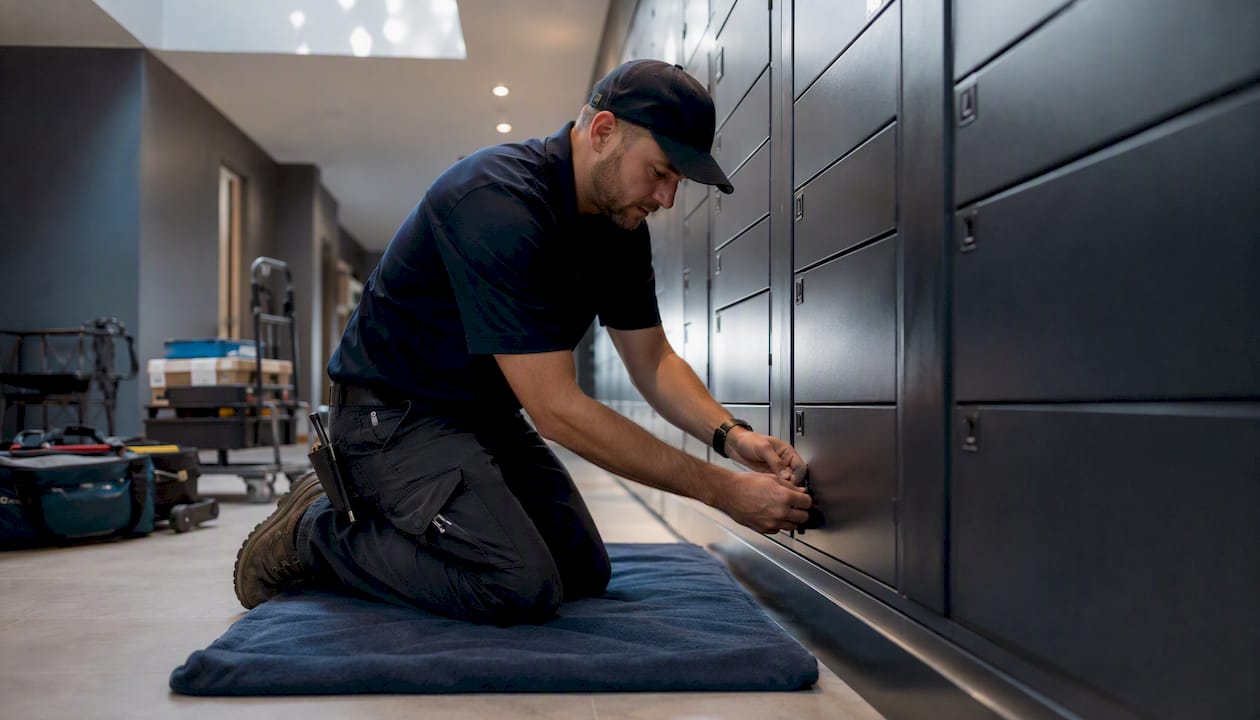
For multi-property operators building a portfolio-wide package strategy, Postal Solutions’s national footprint means consistent program standards across assets in different markets. The pilot path is straightforward: a site survey, a defined 60-to-90-day pilot with tracked metrics, and a daily management option from day one. Contact Postal Solutions at Postalsolutions to schedule a site survey and get a proposal built around your property’s actual volume and footprint.
Sources
FAQ
What is a property management package solution?
A property management package solution is a system, service, or combination of hardware and managed operations that handles parcel intake, organization, secure storage, and resident pickup at a multifamily property. It typically includes physical infrastructure such as lockers or a package room, carrier-access controls, and software integration for resident notifications and audit logging.
What should a property manager look for in package management software?
Look for native integration with your existing property management platform, automated resident notifications at delivery and pickup, time-stamped audit logs tied to carrier and resident credentials, and a maintenance SLA that covers hardware failures within 24 hours. Software that requires manual data export or separate resident communication workflows adds back the staff time the system is supposed to save.
How long does it take to install a package locker or package room system?
Small properties typically see installation complete in four to eight weeks from contract signing; mid-size properties with package rooms and carrier-access upgrades run eight to twelve weeks. Custom site work, refrigerated lockers, or permitting requirements can extend timelines to twenty weeks or more, so plan installations to finish before peak delivery seasons.
What is a property management solution?
A property management solution is any tool, platform, or service that helps operators manage the operational, financial, and resident-experience functions of a residential property. In the package management context, it refers specifically to the systems and services that handle parcel logistics from carrier delivery through resident pickup, including hardware, software, and managed daily operations.
How does Postal Solutions differ from a standard locker vendor?
Postal Solutions manages package room outsourcing and sells and installs Luxer One locker and package-room systems, but it also provides daily package room organization and weekly audits as an ongoing managed service. That operational layer is what separates a functioning program from hardware that residents cannot reliably navigate without staff help.
Recommended
- Multifamily Package Management Guide for Operators | Postal Solutions
- Managed Package Program Guide for Property Managers | Postal Solutions
- Apartment Package Management Services | Multifamily Package Room Operations | Postal Solutions
- Outsource Apartment Package Handling: A Property Manager’s Guide | Postal Solutions