A Human-Plus-Technology Package Solution for Property Teams
A Human-Plus-Technology Package Solution for Property Teams A human-plus-technology package solution pairs daily human package-room management with electronic locker or package-room technology, most commonly Luxer One hardware, to move parc
Published
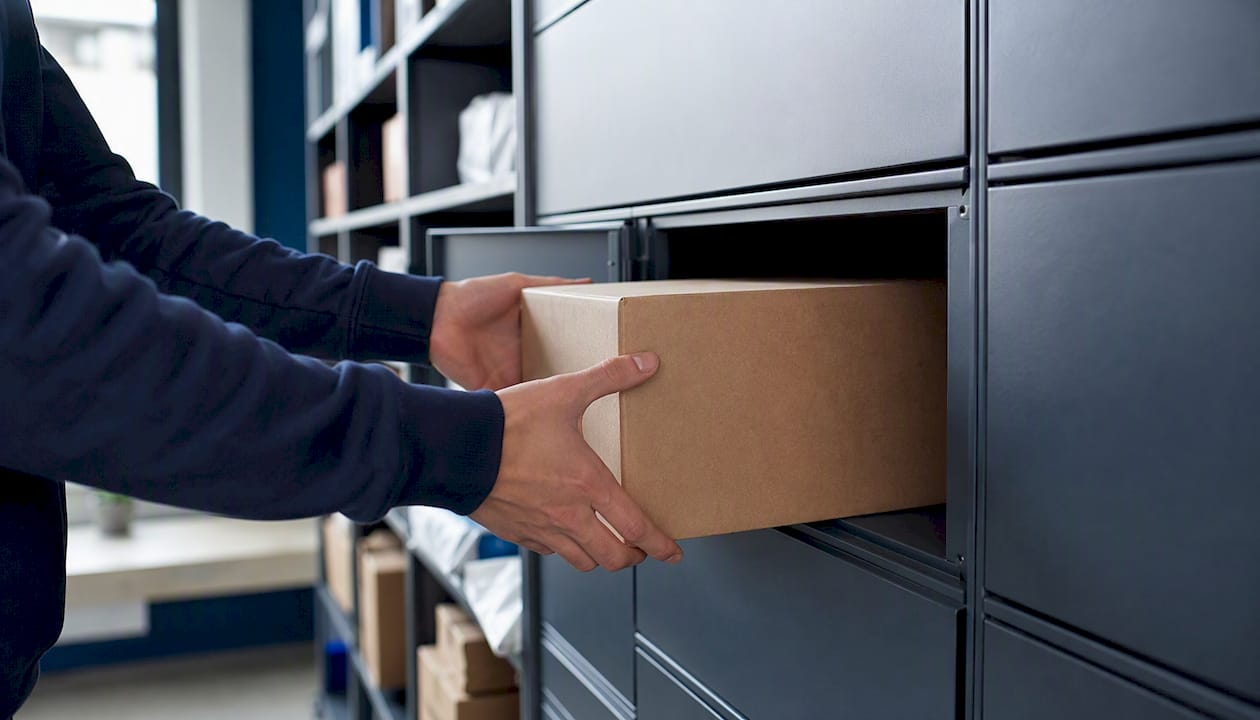
A human-plus-technology package solution pairs daily human package-room management with electronic locker or package-room technology, most commonly Luxer One hardware, to move parcels from carrier drop-off to resident pickup with less loss and less staff time. Postal Solutions, founded in 2016, builds these programs by combining Luxer One installations with six-day-per-week managed visits and weekly audits.
You need this hybrid model, not a locker bank alone and not a staff-only package room, when any of these three signals show up at your property:
- Daily parcel volume outpaces front-desk capacity — leasing staff are spending an hour or more per day sorting and fielding pickup questions instead of leasing.
- Packages go missing or pile up in unmanaged corners — residents complain, and staff cannot trace where a parcel sat between delivery and pickup.
- Residents expect 24/7, self-service access — a growing share of your renters, especially in student housing, want to grab a package at 11 p.m. without waiting on office hours.
Multifamily operators rarely rely on just one intake method. A recent Advisory Council survey found the average property uses 2.4 different package intake methods, and 70% use at least a smart locker or an unmanaged package room. That fragmentation is exactly why hybrid, human-plus-technology models tend to outperform single-method setups: they cover both the predictable volume and the exceptions.
Key Takeaways
A human-plus-technology package solution works because lockers absorb predictable 24/7 pickup volume while managed human visits handle exceptions, audits, and security oversight that hardware alone cannot cover.
| Point | Details |
|---|---|
| Run a volume audit first | Track daily package count, staff hours, and complaints for 30 days before signing a vendor. |
| Score vendors on seven dimensions | Compare scope, visit frequency, integration, security, cost, scalability, and reporting. |
| Plan for oversized parcels | Build overflow and oversized-item handling into the SOW, not as an afterthought. |
| Pilot before full rollout | Test the hybrid model in one high-volume building for 60 to 90 days first. |
| Postal Solutions as the model | Bundles Luxer One installs with six-day managed visits and weekly audits, with over 1,200 installations across more than 40% of U.S. states. |
Table of Contents
- What Does a Human-Plus-Technology Package Solution Include?
- What Are the Business Benefits of a Hybrid Package System?
- Which Properties Benefit Most From This Approach?
- How Do You Evaluate a Package Management Vendor?
- What Does Implementation Look Like Step by Step?
- What Drives Cost, and What KPIs Prove It’s Working?
- What Security and Privacy Safeguards Should Be in the Contract?
- How Does the Postal Solutions Operational Model Work?
- Do Operator Case Studies Back This Up?
- Where Does the Hybrid Model Fit Best, and How Should You Roll It Out?
- How Can Postal Solutions Help You Get Started?
- Where Can You Learn More?
- Sources
- FAQ
What Does a Human-Plus-Technology Package Solution Include?
Three layers make up a working system, and each one solves a different failure point.
Hardware. Electronic lockers, refrigerated compartments for perishables, and open package-room shelving for oversized items give residents a place to retrieve parcels without staff intervention. Luxer One’s own guidance stresses that modular, scalable locker configurations matter because delivery volume swings hard during peak seasons.
Human services. Lockers alone cannot absorb everything a carrier drops off. A managed visit, daily or six days a week, handles what the hardware cannot: an oversized box that will not fit a compartment, a mislabeled unit number, a locker bank that is jammed with expired holds. Weekly audits confirm every package logged actually has a corresponding pickup or an escalation path.
Software. Locker operating systems track chain of custody, trigger resident notifications by text or email, and increasingly integrate with the property management system already running your leasing office. This is the layer that turns a pile of boxes into a searchable, auditable record.
A typical handoff looks like this:
- Carrier arrives and scans or drops the parcel at the locker kiosk or package room.
- The system or the managed attendant logs placement and highlights or hand-writes the unit number on the label.
- The resident gets an automated notification.
- The resident retrieves the package via code, app, or staffed pickup.
- A weekly audit reconciles what came in against what went out, flagging anything unresolved.
Lockers give you the 24/7 convenience piece, but they are rigid on dimensions and tend to strain during delivery surges. The human visit is what keeps the system usable when volume spikes past what any fixed compartment count can hold.
What Are the Business Benefits of a Hybrid Package System?
The case for this model rests on five measurable benefits:
- Resident experience. Self-service pickup at any hour reduces the single most common maintenance-adjacent complaint in multifamily: “where is my package?”
- Staff time recovered. Leasing and maintenance staff stop functioning as unpaid package clerks.
- Fewer lost packages. Daily organizing and weekly audits close the gap where parcels disappear between drop-off and pickup.
- Improved security. Consolidating carrier access to one entry point and one logged process limits the number of people moving through common areas unsupervised.
- Revenue potential. Some properties add modest convenience fees for refrigerated or premium locker access, offsetting part of the ongoing service cost.
Here’s a simple ROI framing you can run with your own numbers: if front-desk staff currently spend 90 minutes a day on package handling at a loaded labor rate of $22 an hour, that is roughly $8,000 a year in recovered staff time alone, before counting reduced complaint volume or fewer liability incidents from lost high-value parcels. Weigh that recovered time against the annual managed-service fee to see whether the math clears.
Pro Tip: Track three numbers for 30 days before you sign anything: staff hours spent on packages, resident complaint volume, and average pickup time. That baseline is what proves ROI later.
Track these operator-facing metrics after launch: package-related complaints per month, average time from notification to pickup, and staff hours logged on package tasks. NMHC-referenced data cited by locker vendors notes that residents increasingly expect secure, self-service pickup as a baseline amenity, not a bonus.
Which Properties Benefit Most From This Approach?
Not every property needs the full hybrid build. These profiles consistently show the strongest fit:
- Student housing. High turnover, clustered move-in periods, and a strong preference for privacy over frequent office visits make consolidated carrier access valuable. Fewer outside visitors moving through buildings is a real security gain, not just a convenience one.
- High-density urban multifamily. Same-day delivery share is climbing, and lobby congestion during peak afternoon drop-off windows is a recurring complaint in dense urban buildings.
- Senior housing. Residents often need extra assistance retrieving items and benefit from a human check-in that a locker code alone cannot provide.
- Amenity-space conversions. Properties repurposing underused space into a package center get the most value when that space pairs with a managed visit rather than sitting unattended.
Lockers alone underperform anywhere oversized or perishable deliveries are common, since fixed compartments cannot flex. Staff-only models underperform anywhere volume exceeds what front-desk hours can absorb without cutting into leasing or maintenance work.
How Do You Evaluate a Package Management Vendor?
Score every proposal against these seven dimensions: scope of service, managed visit frequency and tasks, software and PMS integration, security features, cost structure, scalability, and reporting.
Bring these questions to every vendor conversation:
- How do you onboard new carriers, and can you restrict entry to a single controlled point?
- What is your defined process for oversized or irregular parcels that will not fit a locker?
- What does your SLA actually guarantee, in writing, for visit frequency and response time?
- How often are audits performed, and do we receive a written audit report?
- What are your tech support hours, and is support U.S.-based?
- Which PMS platforms do you already integrate with?
- What happens to a package if a resident does not pick it up within your retention window?
- How do you handle refrigerated or perishable deliveries?
- What is your installation timeline from signed contract to go-live?
- Can the system scale up if unit count or delivery volume grows?
- What training do you provide our staff during transition?
- What are the cancellation terms if the service does not meet expectations?
- How many installations have you completed, and can we speak with a comparable property?
- What data does the resident-facing notification system collect and retain?
Watch for these red flags: vendors who cannot produce a sample audit report, a rigid one-size-fits-all rollout that ignores your building’s layout, vague or unwritten cancellation terms, and limited integration options with the PMS you already run.
What Does Implementation Look Like Step by Step?
Rollout follows a predictable sequence once you select a vendor.
| Phase | Typical Duration | Key Activity |
|---|---|---|
| Discovery and site survey | 1–2 weeks | Assess space, delivery volume, carrier patterns |
| Contracting | 1–2 weeks | Finalize SLA, pricing, and cancellation terms |
| Hardware delivery and install | 2–4 weeks | Locker installation, refrigerated unit setup |
| Software integration and carrier onboarding | 1–2 weeks | Connect PMS, configure notifications, brief carriers |
| Staff training and pilot | 1–2 weeks | Train front desk, run pilot on one building |
| Full rollout | 1 week | Extend to remaining buildings or units |
Before install day, property teams should have dedicated space allocated and measured, a plan for how carriers will access that space, and resident communications drafted so nobody is surprised when the old package pile disappears in favor of a new pickup process. A step-by-step setup guide can help you map space requirements before your site survey.
What Drives Cost, and What KPIs Prove It’s Working?
Pricing moves on six levers: hardware size and customization, installation complexity, software license fees, PMS integration work, recurring managed-visit fees, and surge staffing during peak seasons like the fourth quarter.
| Cost Component | What Drives It |
|---|---|
| Hardware | Number of compartments, refrigerated units, footprint size |
| Installation | Site complexity, electrical and network access |
| Software licensing | Notification volume, PMS integration depth |
| Managed visits | Frequency (six-day vs. daily) and audit scope |
| Peak-season staffing | Delivery surge coverage during holidays |
Use this ROI formula to evaluate any proposal: annual labor savings plus avoided loss or liability, minus total annual fees. If that number is positive within the first year, the pilot has already paid for itself.

Track these KPIs post-launch: staff hours per 100 packages processed, average resident pickup time, the percentage of packages routed to lockers versus oversized handling, monthly complaint volume, and any shift in resident satisfaction scores tied to package handling. A high-volume delivery guide breaks down how surge periods specifically strain staff-only models.
What Security and Privacy Safeguards Should Be in the Contract?
Your statement of work should require these safeguards explicitly, not assume the vendor includes them by default:
- Encrypted resident notification flows for pickup codes and delivery alerts.
- Two-factor access controls for any staff-facing management portal.
- Audit logs recording every carrier entry and package placement.
- A documented offsite handling policy for returned or undeliverable parcels.
- Background checks for any attendant with physical access to the package area.
- A clear camera placement policy for common-area monitoring.
- Defined data retention limits for resident notification and pickup records.
Student housing carries an added layer: fewer external visitors and controlled carrier entry points matter more here than in conventional multifamily, since younger residents and their families weigh privacy heavily when choosing a property. A secure storage best-practices guide covers additional access-control specifics worth building into your SOW.
How Does the Postal Solutions Operational Model Work?
Postal Solutions structures its managed service around six-day-per-week visits, weekly audits, and a defined division of labor between property staff and the outsourced package team.
On a typical visit, a Postal Solutions attendant organizes the package room or locker bank, highlights or hand-writes unit numbers on labels, handles oversized parcels that will not fit locker compartments, and reconciles the system’s log against physical inventory. Weekly audits catch anything that slipped through daily handling before it becomes a resident complaint.
- Six-day managed visits covering organizing, labeling, and oversized-parcel workflows.
- Weekly audits reconciling software records against physical packages on hand.
- Software monitoring paired with resident notification support.
- Coordination with property staff on escalations, not full staff replacement.
Pro Tip: Ask any vendor how they split responsibilities during steady-state operations. Postal Solutions handles daily organizing and audits; your leasing team retains oversight of resident communication and escalations that require a human decision.
Since founding in 2016, Postal Solutions has sold and installed more than 1,200 Luxer One systems across more than 40% of U.S. states, working with student housing operators, conventional multifamily owners, senior housing communities, and public-private university partnerships. That footprint is a direct result of pairing hardware sales with the six-day managed visit model this article describes, and it’s what separates a hardware-only vendor from a full operational partner. A closer look at package-room management services breaks down exactly how the split works property by property.
Do Operator Case Studies Back This Up?
Operators managing large student housing portfolios have reported concrete gains after moving to a managed, third-party model.
Core Spaces leadership has noted that shifting to third-party managed systems reduces on-site handling time and improves security by consolidating carrier access into a single controlled point, a benefit they call especially important for student housing communities.
That kind of shift shows up in a consistent set of outcomes:
- Reduced front-desk time spent on package sorting and resident inquiries.
- Fewer theft and lost-package complaints tied to unmanaged access points.
- Faster average pickup speed once residents adapt to notification-driven retrieval.
- Cleaner audit trails that resolve disputes over “I never got that package” faster.
Where Does the Hybrid Model Fit Best, and How Should You Roll It Out?
The strongest fit for a human-plus-technology package solution is a resident-experience-focused property carrying real volume, not a small building where a locker bank alone would suffice. If your community sees daily deliveries in the dozens or hundreds, and residents already expect round-the-clock access, the hybrid model earns its cost quickly.
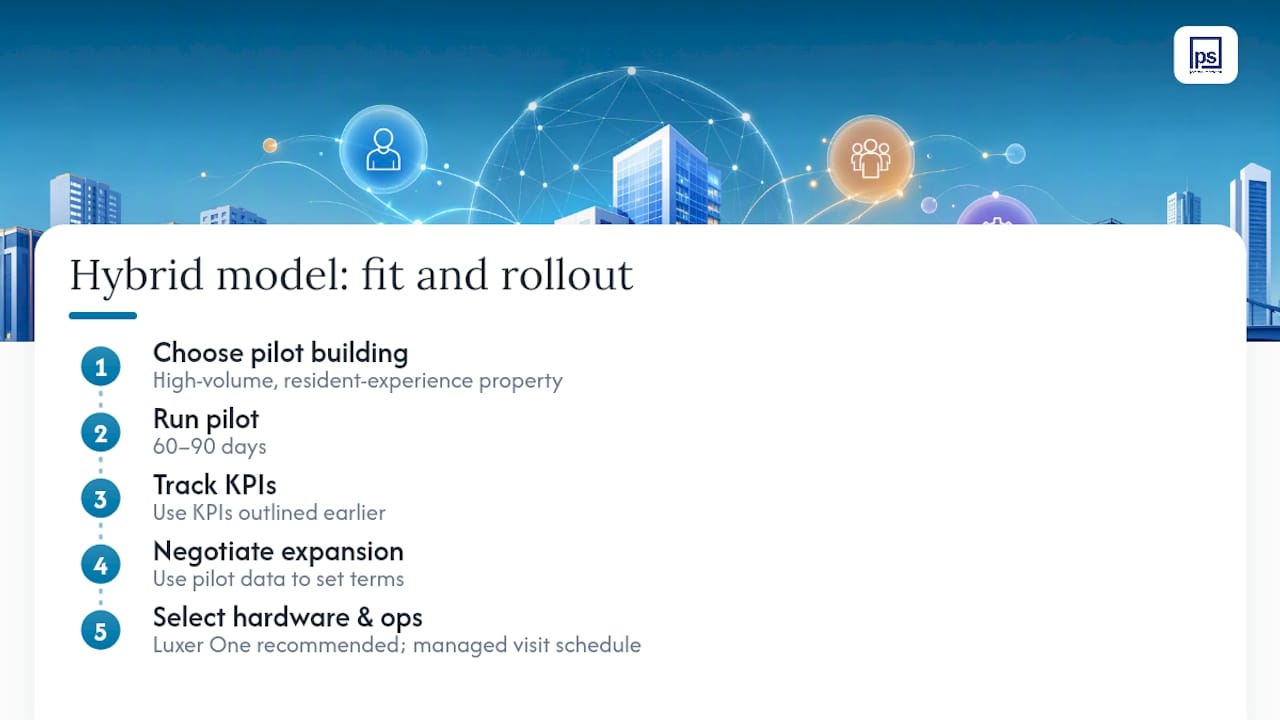
Pilot before you commit portfolio-wide. Run the combined model in your highest-volume building for 60 to 90 days, track the KPIs outlined earlier, and use that data to negotiate terms across additional properties. Full rollout without a pilot tends to expose integration gaps you could have caught early.
Luxer One remains the hardware Postal Solutions recommends most often, not because it’s the only option, but because its modular locker configurations and refrigerated unit options handle the widest range of parcel types without forcing a property into a single fixed layout. Pairing that hardware with a managed visit schedule, rather than deploying it standalone, is where the real resident-experience gains show up.
How Can Postal Solutions Help You Get Started?
Postal Solutions bundles Luxer One hardware sales and installation with six-day-per-week managed package-room visits, so you get one point of contact instead of coordinating a hardware vendor and a separate staffing solution. That combination is what lets a single-vendor relationship cover both the locker technology and the daily organizing, labeling, and audit work most properties end up needing anyway.
If you’re ready to see what this looks like for your property, request a site survey and have three things ready: your total unit count, your current daily package volume, and the space you can dedicate to a package room or locker bank. From there, Postal Solutions can scope a proposal matched to your building’s actual traffic instead of a generic package. Request a proposal to start that conversation.
Where Can You Learn More?
For deeper research on package management models and vendor selection, these sources are worth a closer read:
- The Advisory Council survey on how operators combine intake methods across their portfolios.
- The National Apartment Association’s coverage of operator experiences with managed package systems in student housing.
- Luxer One’s vendor-selection guidance on scalable locker configurations.
- Postal Solutions’ own breakdown of its bundled managed service model.
Property teams evaluating a full rollout can also request Postal Solutions case studies and proprietary survey data directly to support internal procurement conversations. For a broader view of how organized operational systems support service delivery across the property management industry, see this property management services overview.
Sources
- A Framework for Solving Multifamily’s Package Management Problem | Insights by Blueprint
- Navigating the Surge | National Apartment Association
- How to Choose a Package Management Vendor
FAQ
What is a human-plus-technology package solution?
It’s a managed package-room program combining electronic lockers or package-room hardware with scheduled human visits for organizing, auditing, and handling exceptions like oversized parcels.
How is this different from a locker-only system?
Lockers alone handle routine 24/7 pickup but struggle with oversized items and delivery surges; adding managed human visits closes that gap through daily organizing and weekly audits.
How much does a hybrid package system cost?
Cost depends on hardware size, installation complexity, software integration, and managed-visit frequency; run the ROI formula of labor savings plus avoided loss minus annual fees to judge a specific proposal.
Is this model suitable for student housing?
Yes, student housing often benefits most because consolidating carrier access to a single controlled point improves both privacy and security in a way residents and parents notice.
Does Postal Solutions install the locker hardware itself?
Postal Solutions sells and installs Luxer One systems and pairs that hardware with six-day managed visits and weekly audits as a bundled service.
How long does implementation take?
A typical rollout runs eight to thirteen weeks from discovery through full deployment, covering site survey, contracting, installation, integration, training, and pilot.
Recommended
- Property Manager Package Solutions: Operations-Ready Guide | Postal Solutions
- PackageLog for Property Managers: Software, Lockers, or Managed Service | Postal Solutions
- How to Manage High Volume Package Deliveries in Multifamily Housing | Postal Solutions
- Apartment Package Management Services | Multifamily Package Room Operations | Postal Solutions