Leasing Office Package Relief: A Property Manager's Guide
Leasing Office Package Relief: A Property Manager’s Guide The fastest path to leasing office package relief is a managed, hybrid approach: outsource daily package-room operations to a dedicated service and pair it with flexible hardware, wh
Published
The fastest path to leasing office package relief is a managed, hybrid approach: outsource daily package-room operations to a dedicated service and pair it with flexible hardware, whether Luxer One lockers, an open package room, or a combination of both. That single decision reclaims staff hours, reduces resident friction, and protects net operating income without requiring your leasing team to become logistics specialists.
Three steps to start now:
- Triage your backlog. Designate a temporary staging area, photograph unclaimed packages, and send a bulk resident notification to clear current congestion before any new system goes live.
- Run a quick vendor assessment. Measure your available package-room square footage, count your average daily inbound parcels for two weeks, and confirm which property management platform (Entrata, Yardi, or RealPage) you need a vendor to integrate with.
- Prep your space. Identify access points, confirm carrier delivery hours, and flag any oversized-item overflow zones. A clean site assessment cuts installation time significantly.
The payoff: leasing staff reclaim hours each day, residents pick up packages in seconds rather than waiting for staff assistance, and renewal rates reflect the improved experience.
Key Takeaways
Outsourced daily package-room management, paired with Luxer One hardware where needed, is the most direct way to reclaim staff hours and protect resident retention at multifamily and student-housing properties.
| Point | Details |
|---|---|
| Daily burden is measurable | A 370-unit community averaging 75 packages/day loses more than 6 staff hours daily to manual handling. |
| Labor cost is quantifiable | At $20/hr, package handling costs roughly $30,000/year per associate in direct wages alone. |
| Hardware needs operations | Lockers and package rooms fail without daily management, carrier training, and weekly audits. |
| KPI targets are achievable | Managed deployments typically reduce staff touches to under 2 per package and pickup time to seconds. |
| Postal Solutions manages it | Postal Solutions offers six-days-per-week managed visits, Luxer One installs, and audit support nationwide. |
Table of Contents
- What does leasing-office package congestion actually cost you?
- Which package management solution fits your property?
- How do you choose the right solution for your property?
- How Postal Solutions and Luxer One work together to relieve package burden
- How to calculate the ROI of outsourcing package management
- What does implementation actually look like?
- Which KPIs should you track after deployment?
- Why managed operations beat hardware-first thinking
- Ready to get leasing office package relief at your property?
- Sources
- FAQ
What does leasing-office package congestion actually cost you?
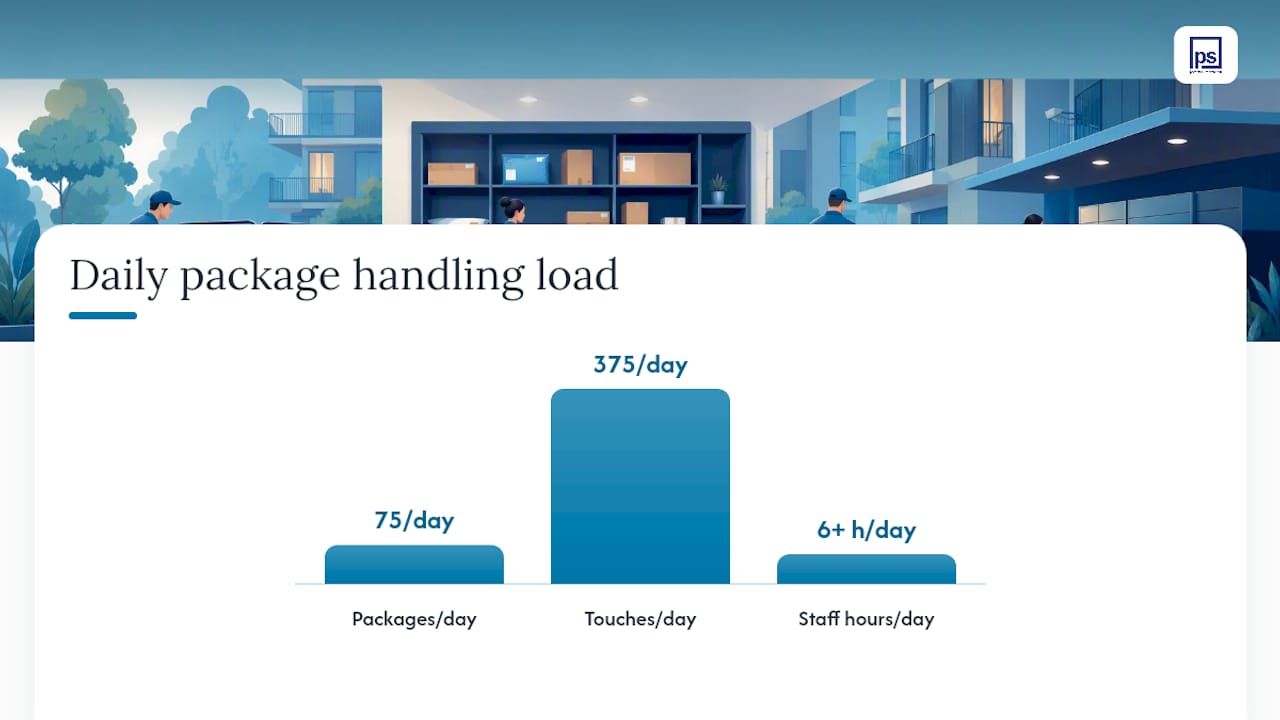
The numbers are more concrete than most operators realize. Among communities tracked by industry observers, the average property runs about 370 units and receives roughly 75 packages per day. Without an organized intake system, each package can require four to five staff touches: receiving, sorting, logging, notifying the resident, and retrieving the item when the resident needs help locating it. At 75 packages and five touches each, that is more than six staff hours consumed daily on package handling alone.
The financial translation is direct: at a $20/hour wage rate, six hours of daily package work costs roughly $2,500 per month, or about $30,000 per year, for one associate. That figure excludes the opportunity cost of leasing conversations that never happen, the negative reviews generated by lost or misplaced packages, and the turnover costs triggered when frustrated residents choose not to renew.
| Cost Category | Daily Impact | Annualized Estimate |
|---|---|---|
| Staff labor (package handling) | 6+ hours/day | ~$30,000/year per associate |
| Leasing opportunity cost | Lost prospect and renewal time | Not quantified here |
| Resident turnover (package friction) | Complaint-driven non-renewals | Varies by market |
| Package loss/theft incidents | Resident complaints, liability | Varies by property |
Security consequences compound the financial ones. Packages left in unsecured lobbies or hallways invite theft, and a single high-profile loss can generate multiple negative reviews that affect occupancy for months.
Which package management solution fits your property?
Operators typically use an average of 2.4 intake methods simultaneously, which signals that no single solution handles every scenario. The five main categories each carry distinct trade-offs.
Common failure modes to watch:
- Dimensional rigidity: Fixed-cell lockers reject oversized items, forcing staff back into the loop on the packages that need the most handling.
- Carrier noncompliance: Any system fails when drivers bypass the designated intake point. Carrier training and a pictorial SOP are non-negotiable.
- Space loss: Large locker banks can consume amenity square footage that generates more NOI as a fitness room or coworking space.
- Liability shift: Offsite consolidated delivery can reduce on-site courier visits by an estimated 35%, but it transfers operational control and may not satisfy residents expecting same-day access.
For high-volume properties, a managed outsourced service paired with electronic lockers or an open package room consistently outperforms any single hardware-only approach. The hardware handles storage; the managed service handles intake, organization, audits, and resident communication.
How do you choose the right solution for your property?
Match the solution to your property profile before you talk to any vendor. Score each criterion on a 1–3 scale and weight by importance to your operation.
Evaluation criteria:
- Daily package volume (weight: high) — properties above 75 packages/day need automated intake or managed support; below that threshold, a well-organized open room may suffice.
- Unit count and density (weight: high) — properties above 300 units benefit most from electronic lockers or AI-enabled open rooms.
- Available square footage (weight: medium) — measure before you spec; locker banks require contiguous wall space that open rooms do not.
- Resident demographics (weight: medium) — student housing residents expect 24/7 self-service access; senior communities may need simpler retrieval workflows.
- Surge profile (weight: high) — holiday peaks and move-in/move-out weeks can triple daily volume; confirm how each vendor handles overflow.
- PM platform integration (weight: high) — confirm native or API integration with Entrata, Yardi, or RealPage before signing.
Questions to ask every vendor:
- How do you train and document carrier compliance? Do you provide a pictorial SOP or QR/PIN access for high-frequency drivers?
- What is your overflow protocol when lockers are full or the package room reaches capacity?
- How is chain of custody maintained from carrier drop-off to resident pickup?
- What is your service-level agreement for daily visits, weekly audits, and incident response?
- Can you demonstrate integration with our existing property management system?
Red flags:
- No documented carrier compliance plan
- Fixed-cell lockers with no overflow solution for oversized items
- Audit trails that rely on manual spreadsheets rather than software
- No daily operational support, only hardware installation
How Postal Solutions and Luxer One work together to relieve package burden
Postal Solutions manages package-room outsourcing through a structured daily cadence: a package manager visits the property six days per week to organize the package room, mark unit numbers on incoming parcels, trigger resident notifications, and complete weekly audits using the community’s existing package-room software or a Luxer One system installed by Postal Solutions.

That depth of deployment experience spans on-campus universities, Public Private Partnerships (P3), conventional multifamily, student housing, senior housing, and municipalities.
What the managed service delivers:
- Six-days-per-week package-room organization visits
- Unit-number annotation on every inbound parcel
- Weekly audits via existing software or Luxer One’s platform
- Resident notification workflow management
- Carrier compliance support and chain-of-custody documentation
For properties that want a full turnkey solution, Postal Solutions sells and installs Luxer One locker systems, open package rooms, refrigerated lockers, or combination configurations, then layers managed daily visits on top. The result: package room efficiency improves measurably and leasing staff are removed from the intake loop entirely.
At a typical 370-unit community receiving 75 packages per day, residents using a properly managed Luxer One system retrieve packages in approximately 10 seconds. Staff touches drop from four to five per package to near zero for the vast majority of deliveries.
How to calculate the ROI of outsourcing package management
The arithmetic is straightforward. Use your own inputs and compare against the industry baseline.
| Input | Sample Value | Your Property |
|---|---|---|
| Daily packages | 75 | ___ |
| Staff touches per package | 5 | ___ |
| Minutes per touch | 1 min | ___ |
| Total staff minutes/day | 6 hours | ___ |
| Hourly wage (leasing associate) | $20/hr | ___ |
| Monthly labor cost (packages only) | ~$2,500 | ___ |
| Annualized labor cost | ~$30,000 | ___ |
Turnover avoidance adds a second layer. When package management directly supports resident retention, even one avoided non-renewal per year offsets a meaningful portion of a managed-service contract, given that apartment turnover costs typically include make-ready expenses, lost rent during vacancy, and leasing commissions.
Properties that size their solution for average volume routinely find themselves overwhelmed in November and December.*
What does implementation actually look like?
| Phase | Activity | Typical Duration |
|---|---|---|
| Site assessment | Space measurement, access review, PM platform check | 1–3 days |
| Space prep | Staging area setup, signage, access point configuration | 3–5 days |
| Hardware install (if applicable) | Luxer One locker or package-room installation | 1–3 days |
| Carrier communication | Notify USPS, UPS, FedEx, Amazon of new intake protocol | 1 week |
| Staff onboarding | Workflow training, software access, escalation procedures | 1 day |
| Go-live | Managed visits begin, resident notification sent | Day 1 |
| 30-day check | Audit results reviewed, carrier compliance confirmed | Day 30 |
| 30-day review | KPI baseline established, adjustments made | Day 30 |
Before your vendor arrives, complete this checklist:
- Confirm package-room square footage and ceiling height
- Identify all carrier access points and delivery hours
- Pull 30 days of package volume data from your current log
- Confirm PM platform (Entrata, Yardi, RealPage) login credentials for integration
- Designate a staff point of contact for daily vendor coordination
- Prepare resident communication announcing the new system
Postal Solutions manages package-room audits and chain-of-custody tracking from day one, so the operational record is clean before the 30-day review.
Which KPIs should you track after deployment?
The metrics that matter most are the ones that directly reflect staff time and resident experience.
Core KPIs to monitor:
- Average staff touches per package — target: under 2 (from a baseline of 4–5)
- Average resident pickup time — target: under 30 seconds
- Daily package volume — track weekly to catch surge trends early
- Carrier compliance incidents — target: zero missed intake-protocol violations per week
- Package-loss incidents — track monthly; any loss triggers an audit
- Resident satisfaction signals — complaint volume, online review sentiment, renewal rate
Integrate KPI reporting with your property management dashboard so leasing managers see package metrics alongside occupancy and maintenance data. Addressing resident package complaints proactively, before they reach review platforms, is one of the highest-leverage retention actions available to a leasing team.
Why managed operations beat hardware-first thinking
The property management industry defaults to hardware purchases when package volume becomes a problem. Buy lockers, install them, and assume the problem is solved. That logic misses the operational layer entirely.
Hardware without daily management degrades quickly. Lockers fill up and carriers stop using them. Package rooms become disorganized within weeks. Residents complain, staff get pulled back in, and the property ends up paying for hardware it cannot operate effectively.
Postal Solutions takes the opposite approach: operations first, hardware in support of operations. The six-days-per-week managed visit cadence, combined with weekly audits and carrier compliance documentation, is what keeps a Luxer One system or an open package room functioning at the level residents expect. The hardware is the infrastructure; the managed service is what makes it reliable.
Carrier compliance deserves particular attention. It is the most common failure mode across all solution types. Successful deployments document carrier training, produce a one-page pictorial SOP, and issue QR or PIN codes for high-frequency drivers. Without that discipline, even the best locker system becomes a workaround that staff have to manage manually.
For operators who want predictable operating expenses and a clear service-level agreement, outsourcing package management to Postal Solutions converts a variable, staff-intensive cost center into a defined monthly operating line, with measurable KPIs attached.
Ready to get leasing office package relief at your property?
Postal Solutions manages daily package-room organization, sells and installs Luxer One locker and package-room systems, conducts weekly audits, and supports carrier compliance from day one. Many properties have used this combination to reclaim staff hours, reduce resident friction, and protect NOI.
The concrete next step: request a site assessment. Postal Solutions will review your package volume, available space, and PM platform to recommend the right configuration, whether that is a managed open package room, a Luxer One locker system, or a full turnkey combination. Contact Postal Solutions to schedule your assessment and get a customized recommendation for your property.
Sources
The calculations, decision criteria, and operational benchmarks in this guide draw from the following sources. Procurement and operations teams can use these to validate figures and explore methodology in greater depth.
- What Package Wrangling Is Really Costing Your Team - Multifamily & Affordable Housing Business
- A Framework for Solving Multifamily’s Package Management Problem | Insights by Blueprint
- ‘I want it now’ – Understanding the logistics impacts of students’ online shopping habits in halls of residence and the opportunities for consolidated parcel delivery services
FAQ
What is leasing office package relief?
Leasing office package relief refers to outsourcing or automating daily parcel intake, organization, and resident notification so leasing staff are removed from package handling entirely. The goal is to reclaim staff hours and reduce resident friction.
How many staff hours can a managed package service save?
At a 370-unit community receiving 75 packages per day, manual handling consumes more than six staff hours daily. A managed service with proper hardware typically reduces staff touches to under two per package, recovering the majority of that time.
Does Postal Solutions install Luxer One lockers?
Yes. Postal Solutions manages both the hardware installation and ongoing daily package-room operations.
What is the biggest risk with package locker systems?
Carrier noncompliance is the most common failure mode. Without documented carrier training, a pictorial SOP, and QR or PIN access for frequent drivers, even well-installed lockers are bypassed and packages end up in unsecured areas.
How quickly can a managed package-room service go live?
A typical implementation runs two to three weeks from site assessment to go-live, covering space prep, hardware installation if applicable, carrier communication, and staff onboarding. The first 30-day audit confirms the system is operating as expected.
Recommended
- Front Desk Package Relief: 2026 Guide for Property Managers | Postal Solutions
- Managed Package Program Guide for Property Managers | Postal Solutions
- Outsource Apartment Package Handling: A Property Manager’s Guide | Postal Solutions
- Multifamily Package Management Guide for Operators | Postal Solutions