Mailroom Labor Reduction: A 2026 Guide for Property Managers
Discover effective mailroom labor reduction strategies for property managers. Cut costs, boost productivity, and streamline package management by 2026.
Published
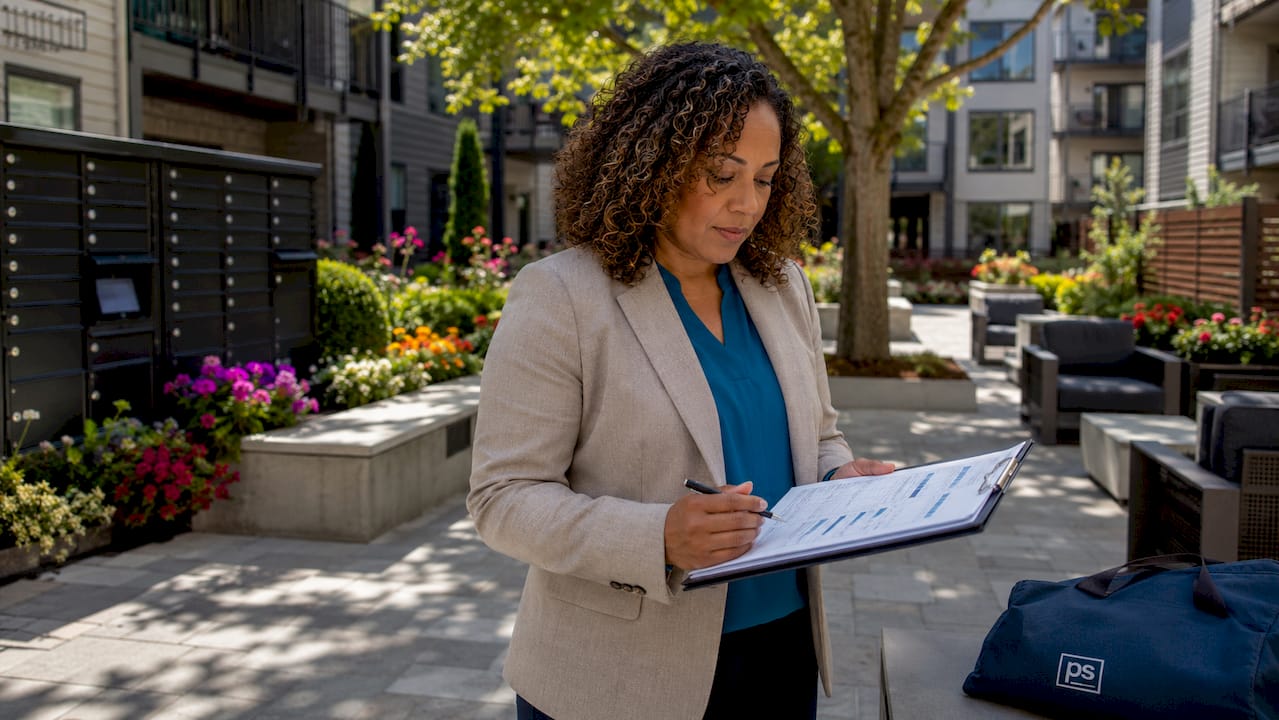
Mailroom labor reduction is defined as the systematic process of cutting staff time and payroll costs tied to package receiving, sorting, and resident notification in multifamily housing. At a property rate of $20 per hour, dedicating six hours daily to package tasks costs roughly $30,000 annually per property in diverted labor alone. That figure does not count lost productivity on leasing, maintenance, and resident services. For property managers and facility directors, the math is straightforward: unmanaged package volume is one of the fastest-growing operational costs in multifamily housing, and the properties that address it systematically outperform those that do not.
What mailroom tasks consume the most labor?
Package management breaks down into five core tasks: receiving deliveries, logging packages, sorting by unit, notifying residents, and managing retrieval. Each step adds time, and the cumulative load is significant. Manual package handling consumes over six hours of daily staff time at a 370-unit property. That translates to roughly 30 hours of weekly labor, which is nearly a full-time position dedicated to boxes.
The most time-intensive steps are sorting and resident notification. Sorting requires staff to physically handle every parcel, read labels, and place packages in the correct location. Notification, when done manually by phone or email, generates follow-up calls, missed pickups, and repeat trips to the package room. Both tasks are prime targets for automation.
Measuring your current labor cost starts with a simple time audit. Ask staff to log every minute spent on package-related tasks for two weeks. Track receiving time, sorting time, notification time, and any resident-assist trips to the package room. The total will likely surprise you.
- Receiving: Signing for deliveries and moving packages inside
- Logging: Recording package details by hand or in a spreadsheet
- Sorting: Organizing packages by unit number or resident name
- Notification: Calling, texting, or emailing residents about arrivals
- Retrieval support: Helping residents locate or access their packages
Pro Tip: Run your time audit during a peak delivery week, such as the first week of a semester for student housing or the week after a major retail holiday. That number reflects your true worst-case labor exposure, which is the figure that matters most for budgeting.
How do mailroom automation solutions reduce labor costs?
Automation cuts labor by removing manual steps from the package workflow. The two primary tools are automated notification systems and physical package management infrastructure, including open-shelving package rooms and electronic locker systems. Each addresses a different part of the labor problem.
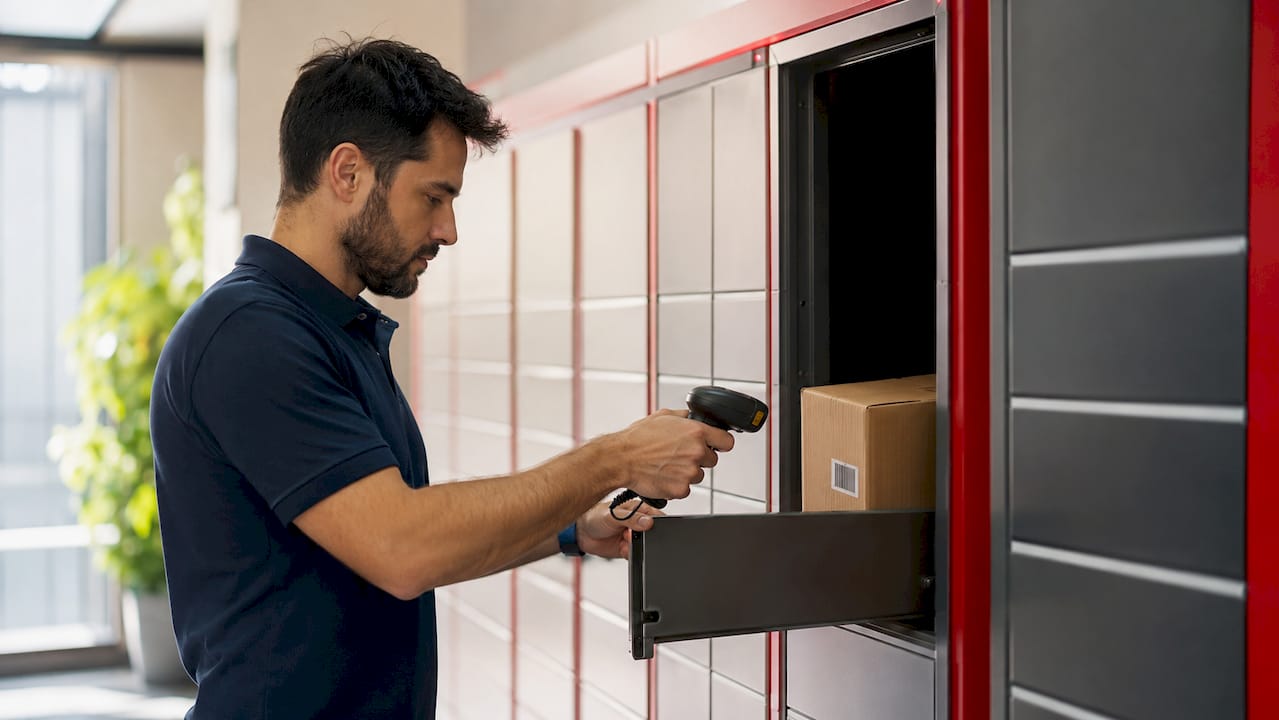
Automated resident notifications eliminate the single biggest source of staff interruption. Automated reminders at 48 hours and structured three-to-five-day collection windows reduce manual follow-ups and staff phone calls significantly. Residents pick up packages on their own schedule, and staff stop fielding “did my package arrive?” questions.
Physical infrastructure choices affect capacity and overflow labor. Open-shelving package rooms deliver two to three times higher package capacity per square foot compared to fixed locker systems. Higher capacity means fewer overflow situations, which are the scenarios that generate the most unplanned staff time. Electronic locker systems, by contrast, offer 24/7 self-service access and strong chain-of-custody tracking, which suits properties where security is the top priority.
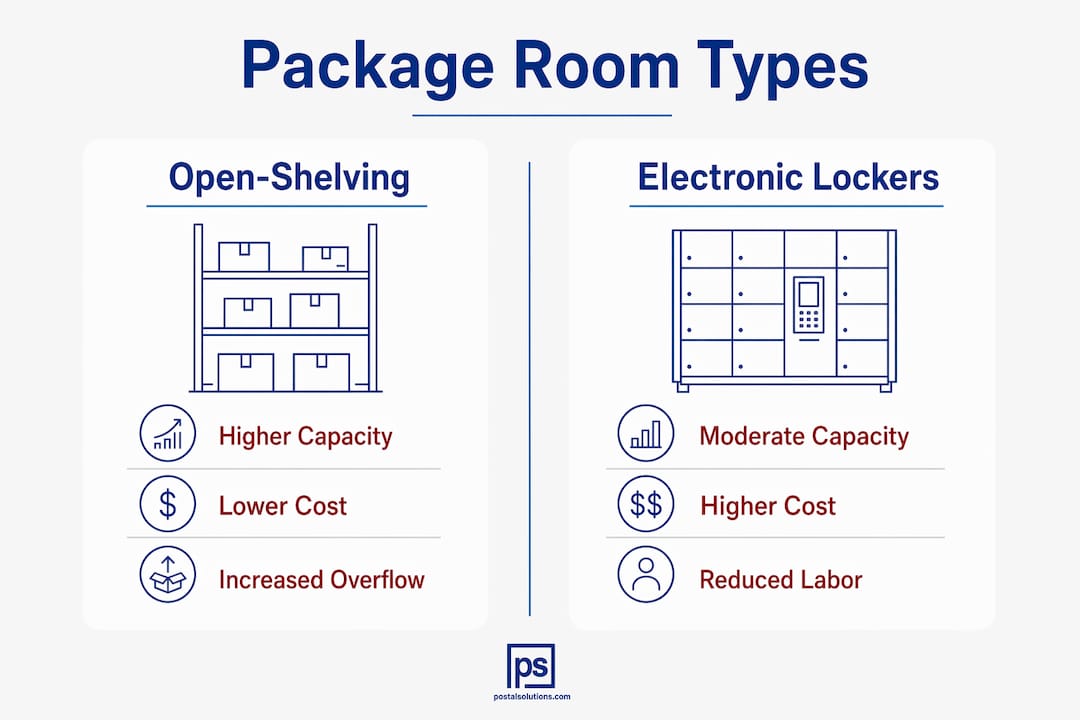
The table below compares feature categories across the two main infrastructure approaches.
| Feature category | Open-shelving package room | Electronic locker system |
|---|---|---|
| Package capacity per sq. ft. | High (2–3x lockers) | Lower, fixed by unit count |
| Resident self-service access | Requires staff or access code | Fully automated, 24/7 |
| Overflow handling | Flexible, manual reorganization | Limited without expansion |
| Audit and tracking | Software-dependent | Built-in, automated |
| Upfront cost | Lower | Higher |
| Best fit | High-volume, space-constrained properties | Security-focused or unstaffed sites |
The labor savings from automation are measurable. Properties that deploy digital package management reclaim 6+ hours daily previously lost to manual handling. That time shifts to leasing, maintenance coordination, and resident services. The operational benefit compounds quickly across a portfolio.
Labor-saving technologies also function as resident amenities. Reliable 24/7 package access improves resident retention by 7%–12%, which directly supports net operating income. Reduced turnover is one of the clearest financial returns on a package management investment.
How to implement mailroom labor reduction in multifamily properties
A phased approach produces better results than a full-portfolio rollout on day one. The five steps below give you a repeatable framework.
-
Audit your current mailroom labor and workflows. Pull two weeks of time logs from staff. Identify which tasks consume the most hours and where handoffs break down. This baseline tells you where automation will have the greatest impact.
-
Evaluate your space and package volume. Measure your package room square footage and count average daily deliveries. High-volume properties with limited space benefit most from open-shelving systems. Properties with security concerns or unstaffed hours benefit from electronic lockers or a combination of both.
-
Develop carrier compliance protocols. Carrier non-compliance is the top cause of package system failures and a major source of staff burden. Create written delivery instructions, post pictorial standard operating procedures at entry points, and issue driver QR codes or PIN codes for access. Compliance at intake prevents downstream chaos.
-
Train staff and carriers before go-live. Walk every team member through the new workflow before launch. Brief regular delivery drivers on access procedures. Standardizing carrier communication at deployment reduces operational disruptions during peak periods.
-
Deploy technology, automate notifications, and track KPIs. Go live with your chosen system, activate automated resident notifications, and set pickup window policies. Track weekly labor hours, resident pickup rates, and overflow incidents. Adjust notification timing and pickup windows based on what the data shows.
Pro Tip: Pilot your new workflow at one property before scaling across your portfolio. A single-site pilot surfaces carrier compliance gaps, resident behavior patterns, and software configuration issues before they become portfolio-wide problems.
Common challenges when reducing mailroom labor
Even well-planned rollouts hit friction. Knowing the most common failure points lets you address them before they erode your labor savings.
-
Carrier non-compliance: 70% of operators identify carrier non-compliance as their main frustration. Drivers leave packages in lobbies, skip access systems, or ignore delivery instructions. The fix is a combination of posted pictorial SOPs, driver-specific access credentials, and direct outreach to carrier district managers when violations repeat.
-
Seasonal volume surges: Holiday periods and move-in weeks overwhelm fixed-capacity systems. Plan for surge capacity by pre-clearing stale packages before peak periods. Set shorter pickup windows during high-volume weeks to keep the room current.
-
Resident access complaints: Residents who cannot find their packages generate staff calls, which defeats the purpose of automation. Weekly audits that verify package labeling and location accuracy prevent most access complaints before they start.
-
Measuring success after launch: Track three KPIs weekly: total staff hours spent on package tasks, resident pickup rate within 48 hours, and overflow incidents per week. These three numbers tell you whether your labor reduction is holding or slipping.
Facility operators increasingly prefer integrated workflows over expanding locker hardware. Consistent carrier compliance and standardized procedures deliver more durable labor savings than hardware alone. The process is the product.
Key takeaways
Mailroom labor reduction requires a combination of workflow audits, carrier compliance protocols, and automation technology to produce durable cost savings in multifamily housing.
| Point | Details |
|---|---|
| Labor cost is measurable | Six daily hours at $20/hour equals $30,000 annually per property in diverted staff time. |
| Automation targets the right tasks | Automated notifications and package rooms eliminate sorting and follow-up, the two biggest time drains. |
| Carrier compliance is non-negotiable | 70% of operators cite carrier non-compliance as the top system failure point; fix intake first. |
| Open shelving outperforms lockers on capacity | Open-shelving rooms hold 2–3x more packages per square foot, reducing overflow labor. |
| Process beats hardware | Workflow redesign and compliance standards produce more lasting savings than new equipment alone. |
What Postal Solutions has learned about mailroom labor
The properties that struggle most with package labor share one pattern: they added hardware without fixing the process underneath it. A locker system installed in a chaotic intake workflow is still a chaotic workflow. The lockers just look nicer.
What actually works is starting with the audit. When you know exactly how many staff hours go to packages each week, the conversation about investment becomes simple arithmetic. A property spending 30 weekly hours on manual package handling is spending the equivalent of a part-time employee on a task that automation handles in under five hours. That is not a technology argument. That is a budget argument.
The resident retention angle is also underappreciated. Package access reliability improves retention by 7%–12%, and retention is where multifamily NOI is won or lost. Operators who frame package management as a resident amenity rather than a back-office problem get faster internal buy-in and better outcomes.
The right solution looks different at a 120-unit senior community than at a 500-unit student housing property. Volume, resident behavior, and staffing models all vary. Postal Solutions has managed package room operations across conventional multifamily, student housing, and senior communities since 2016, and the consistent finding is this: tailored process beats generic hardware every time.
— Postal Solutions
Postal Solutions supports your mailroom efficiency goals
Postal Solutions manages daily package room operations for multifamily communities across the country, including conventional apartments, student housing, and senior communities. The service covers daily package organization, unit-number labeling, and weekly audits using your existing package room software or a Luxer One system that Postal Solutions sells and installs. As the largest Luxer One sales agency in the United States, with over 1,200 installations across more than 40% of U.S. states, Postal Solutions brings direct experience to every property type and volume level. If your team is spending hours each week on packages, outsourced mailroom management is worth a closer look. You can also explore the full range of apartment package management services to find the right fit for your property.
FAQ
What is mailroom labor reduction in multifamily housing?
Mailroom labor reduction is the process of cutting staff hours and payroll costs tied to package receiving, sorting, and resident notification. It combines workflow redesign, automation technology, and carrier compliance protocols to free staff for higher-value tasks.
How many hours can automation save in a package room?
Automation reduces weekly package labor from 30+ hours to under five hours at properties with roughly 300–370 units. That savings equals the equivalent of a part-time staff position redirected to leasing and resident services.
What is the biggest cause of package system failures?
Carrier non-compliance is the top cause, cited by 70% of multifamily operators. Drivers who bypass access systems or ignore delivery instructions create downstream sorting and retrieval problems that fall on property staff.
Do open-shelving rooms or lockers save more labor?
Open-shelving package rooms hold two to three times more packages per square foot than fixed locker systems, which reduces overflow incidents and the labor that comes with them. Lockers offer stronger self-service access and tracking, making them better suited for unstaffed or security-focused properties.
How does package management affect resident retention?
Reliable package access improves resident retention by 7%–12%, according to 2026 operational data. Higher retention directly supports net operating income by reducing turnover costs and vacancy periods.