Package Room SLA: 4 Guarantees Property Managers Should Require
Package Room SLA: 4 Guarantees Property Managers Should Require An effective package room SLA guarantees four things: packages get logged within a defined window (usually same-day), residents get notified within hours, a maximum dwell or pi
Published
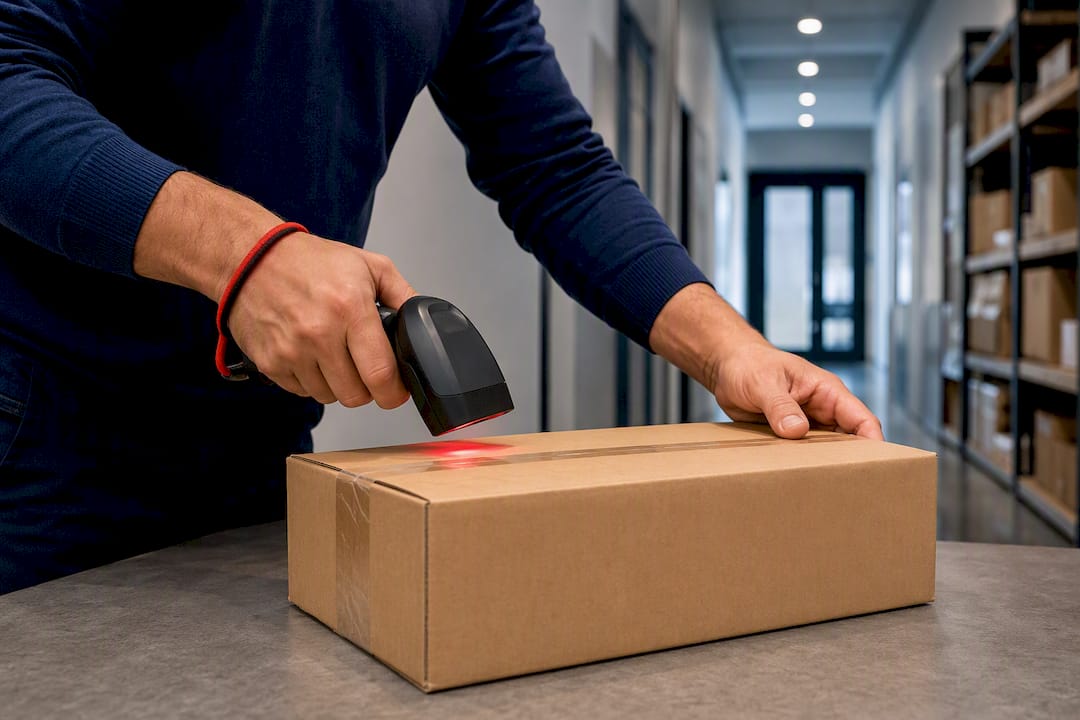
An effective package room SLA guarantees four things: packages get logged within a defined window (usually same-day), residents get notified within hours, a maximum dwell or pick-up window is enforced before escalation, and every access point produces an audit trail. Carriers own accurate scanning at drop-off, property staff own notification and escalation, and an outsourced manager (if one is used) owns daily organizing and weekly audits. Sample clauses and a checklist follow below.
TL;DR:
- Carriers must log packages promptly at drop-off, with tracking verified against delivery timestamps, especially during peak holiday volumes.
- Resident notifications should be automated and sent within 30 minutes of logging, with reminders at days 5 and 14 to prevent complaints.
- Oversized and perishable packages require dedicated staging, refrigerated storage, and shorter pick-up windows, typically one to two days.
- Access control must use user-specific, revocable credentials, with cameras covering intake points and detailed audit logs for all entries.
- Weekly physical audits and daily management visits are essential to catch logging errors and verify KPI compliance, reducing resident disputes.
Table of Contents
- What Should a Package Room SLA Actually Require?
- Who Owns What in a Package Room SLA?
- How Does the Intake Process Meet SLA Targets?
- How Should Notification and Pick-up Policies Work?
- What Security and Audit Standards Belong in the SLA?
- How Should the SLA Handle Peak Season and Overflow?
- What KPIs and Audits Should the SLA Require?
- What Should a Package Room SLA Template Include?
- Why Daily Management and Audits Improve SLA Performance
- Three SLA Mistakes Property Managers Keep Making
- How Postal Solutions Operationalizes Your SLA
- Sources
- FAQ
What Should a Package Room SLA Actually Require?
A package room SLA is only as good as the metrics inside it. Vague language like “packages will be processed promptly” creates disputes, not accountability. The fix is a checklist of measurable commitments, each with a target number and a way to verify it.
Here’s what belongs in every contract, whether you’re negotiating with a vendor or writing internal policy for staff:
- Intake logging time: Packages should be scanned or logged into the system promptly during staffed hours, and by the start of the next business day for after-hours deliveries. Measure this against carrier delivery timestamps versus system log timestamps.
- Resident notification timing: Automated notification should fire soon after logging, ideally using at least two channels (email plus SMS or app push). Manual logging environments should target same-day notification.
- Dwell/pick-up window: Most communities set a 7 to 14 day pick-up window before escalation begins, mirroring the 14-day standard used in university housing agreements.
- Oversize and perishable handling: Define a separate staging area and, where perishable deliveries are common, require refrigerated storage with a temperature log.
- Access-control and audit-log minimums: Every credential use should generate a timestamped, user-identified log entry, not a generic “door opened” record.
- Overflow response time: The SLA should require a documented overflow response, such as temporary storage or a surge visit, within a suitable short timeframe after the room reaches defined capacity.
The National Apartment Association’s package management guidance points to a pattern worth building into any SLA: holiday peaks account for a disproportionate share of annual package volume, which means your notification and dwell-time targets need to hold up under a surge, not just on an average Tuesday in March.
Who Owns What in a Package Room SLA?
Package rooms fail most often at the handoff points, not inside any single task. A package sits unlogged because the carrier scanned it wrong, or a resident never got notified because staff assumed the system handled it automatically. Assigning ownership by task closes those gaps.
- Carriers are responsible for accurate credential entry at access points, scanning packages against the correct unit, and staging oversized items in the designated area rather than blocking walkways or stacking on unrelated shelves.
- Property staff are responsible for maintaining secure storage conditions, validating that notification systems actually fired (not just assuming they did), and escalating packages that cross the dwell-time threshold.
- Vendors or outsourced managers, when contracted, are responsible for daily organizing visits, weekly physical audits against the software log, and any integration work needed to keep hardware and property management systems talking to each other.
- Exception handling needs its own owner. Misdelivered packages, disputed “I never got this” claims, and suspected tampering should route to a named role, usually the property manager or the vendor’s account lead, with a documented response time.
Carrier noncompliance is consistently flagged as the single greatest failure point in package operations, which is exactly why carrier obligations need to be spelled out in the contract rather than assumed. An SLA that only governs the property’s internal process, and says nothing about carrier behavior, is missing its biggest risk factor.
How Does the Intake Process Meet SLA Targets?
The intake workflow is where SLA targets either get hit or get quietly missed. A clean, repeatable sequence removes the guesswork.
- Carrier arrives and gains access, either through a staffed desk, a temporary PIN, or a monitored kiosk.
- Package is placed in the designated intake zone, separated by size or handling type (standard, oversized, perishable).
- Package is logged or scanned into the tracking system, with the timestamp becoming the official start of the SLA clock.
- Initial resident notification is triggered, ideally automated and immediate.
- Package is shelved or bin-sorted by unit number, with oversized items segregated to avoid crowding standard shelving.
Staffed intake and unmanned intake carry different measurement burdens. In a staffed room, an employee can verify scans in real time. In an unmanned or hybrid room using smart locker or self-service access, the system itself has to generate the timestamp, which makes camera coverage and scan-receipt logs the only real audit trail.
Pro Tip: Require carriers to photograph or scan at the point of placement, not at the door. A scan logged at the door but a package placed on the wrong shelf still counts as “delivered” in the system while the resident search time balloons.
A short SOP checklist works better than a lengthy policy document taped to a wall. Property teams that adopt one page covering arrival, placement, scan, and notification see fewer carrier errors than teams relying on verbal training alone, largely because a one-page reference survives staff turnover better than institutional memory does.
How Should Notification and Pick-up Policies Work?
Notification cadence is where most resident complaints originate, and it’s also the easiest part of the SLA to get precise about. A resident who never got a text has a legitimate grievance; a resident who ignored three reminders does not.
- Initial notification: Send promptly after logging, through at least two channels.
- Reminder cadence: A second reminder at day 3 to 5, and a final notice at day 7 to 10, depending on your pick-up window.
- Pick-up window: 7 days works for high-turnover student housing; 14 days is more common in conventional multifamily and matches common parcel locker agreement language.
- Perishables and controlled items: Require prompt notification and a shortened pick-up window of about one to two days before disposal or donation, given spoilage risk.
- Oversized goods: Notify promptly and require in-person coordination rather than self-service pickup, since these items often can’t fit through a locker door or standard shelving.
Sample SLA phrasing that holds up in practice: “Resident will be notified via email and SMS within 30 minutes of package logging. A reminder notice will be sent on day 5 if the package remains unclaimed. Packages unclaimed after 14 days are subject to the community’s unclaimed-property policy.” That kind of specificity heads off the ambiguity that drives resident complaints about missing or delayed packages.
What Security and Audit Standards Belong in the SLA?
Security language in a package room SLA isn’t decoration. It’s the difference between resolving a dispute in five minutes with a log printout and spending a week trying to reconstruct what happened from memory.
- Per-user, revocable credentials: Static keys or shared PINs are a known vulnerability. The minimum acceptable standard is access control integrated with the property management system, with credentials tied to individual users and instantly revocable at move-out.
- Time-limited carrier PINs: Carrier access codes should expire regularly, such as daily or per shift, to maintain security.
- Camera coverage: Cameras should cover intake points and shelving areas, with a minimum 30-day retention window tied directly into the SLA.
- Audit-log format: Every entry needs a timestamp, user ID, and package ID at minimum, not just a generic access event.
- Emergency-access procedures: Document who can override the system, under what circumstances, and require that overrides generate their own audit entry.
Communities relying on shared keys or unmanaged access points report far higher rates of unresolved “missing package” disputes, simply because there’s no record to check. An SLA that doesn’t specify audit-log format is an SLA that can’t actually prove compliance either way.
How Should the SLA Handle Peak Season and Overflow?
Peak season is predictable, which means an SLA that doesn’t plan for it is choosing to fail on schedule every November. The NAA’s own guidance flags holiday volume as a recurring, outsized share of annual deliveries, and smart locker systems can see delivery volume jump sharply the week after Black Friday, according to Swiftlane’s operational data.
- Size storage for the surge, not the average day: Reserve capacity for at least 2 to 3 days of peak-level delivery volume, since a single missed pickup day during peak can cascade into a backlog.
- Overflow commitments: Define what happens when the room hits capacity, including notification to residents, temporary off-site storage, and whether surcharges apply for extended holds.
- Vendor-provided surge support: Specify when the outsourced manager is contractually required to add visits or temporary labor versus when that falls on property staff.
- Refrigerated storage clauses: If perishable deliveries are common (meal kits, grocery delivery), the SLA should require temperature-controlled storage with defined temperature logging, not an ad-hoc fix improvised in December.
Combining a locker bank for daily volume with a package room for oversized items and overflow keeps costs manageable while preserving the measurability that makes the SLA enforceable in the first place.
What KPIs and Audits Should the SLA Require?
An SLA without measurement is just a wish list. The KPIs below turn commitments into numbers you can actually check monthly.
| KPI | Definition | Suggested target |
|---|---|---|
| Logging compliance | % of packages logged within the intake window | near 100% |
| Intake-to-notify time | Minutes from scan to resident notification | Under 30 minutes |
| Average dwell time | Average days from logging to pickup | Under 5 days |
| Carrier compliance rate | % of carrier drop-offs correctly scanned and staged | 90% or higher |
- Weekly physical audits should cross-check shelved packages against the software log, catching packages that were placed but never scanned.
- The audit checklist NAA recommends includes a physical count, a log comparison, and a note of any discrepancies, which is a useful floor even for communities running fully automated systems.
- Monthly KPI reports should come from the vendor or system dashboard, not a manually compiled spreadsheet, since manual reporting is where SLA compliance quietly erodes.
- Remediation language should specify what happens when a KPI is missed twice in a rolling 90-day period, whether that’s a corrective action plan, a service credit, or an escalation call.
Carrier compliance rate deserves particular attention here. Vendors should document specifically how they detect and remediate carrier noncompliance, not just report a number with no explanation of what happens when it dips.
What Should a Package Room SLA Template Include?
Contract language doesn’t need to be complicated, but it does need to be precise enough that nobody can argue about what “logged” or “notified” actually means.
- Definitions block: Spell out “logged” (scanned into the system with timestamp and unit assignment), “notified” (automated message sent through at least two channels), “dwell time” (days between logging and pickup), and “carrier compliance” (percentage of drop-offs correctly scanned at point of delivery).
- Measurement and reporting clauses: State exact windows, such as “packages will be logged within two hours of drop-off during staffed hours” rather than “promptly.”
- Remedy language: Include service credits for missed KPIs, a defined cure period (commonly 30 days), and termination triggers if performance doesn’t improve after two consecutive corrective action periods.
- Force majeure and carrier exceptions: Carve out delays caused by carrier-side failures outside the property’s or vendor’s control, but require documentation of the exception rather than a blanket excuse.
The DHL Logistics of Things guidance on parcel locker deployment makes a point worth repeating in any SLA negotiation:
Establishing service level agreements that clearly define the roles, responsibilities, and performance expectations of every stakeholder, logistics partners, property managers, and end users alike, is what prevents a package system from becoming a source of disputes rather than a source of resident satisfaction.
That’s the whole point of putting any of this in writing. A definitions block without teeth is just a memo.
Why Daily Management and Audits Improve SLA Performance
Contract language sets the target. Daily execution is what actually hits it, and that’s where most package room SLAs quietly fall apart.
Luxer One package room and locker systems have been sold and installed since 2016, including in conventional multifamily communities, student housing, senior housing, and university partnerships. That footprint comes from a simple operational pattern: hardware alone doesn’t hit SLA targets, daily management does.
- Daily organizing visits, where a manager highlights or handwrites unit numbers on package labels, cut resident search time dramatically compared to unsorted shelving.
- Weekly audits against the property’s existing package room software catch the logging gaps that create disputes before residents ever notice them.
- Documented SLA language, paired with a consistent audit trail, gives both the property and residents a clear reference point when a “where’s my package” question comes up, reducing the friction that drives resident complaints.
- Without daily management, properties effectively pay twice: once in staff payroll, and again in the lost productivity of staff pulled away from other duties to search for missing packages.
Three SLA Mistakes Property Managers Keep Making
The gap between a well-written SLA and one that actually works usually comes down to three recurring mistakes.
The first is vague timing windows. “Packages will be logged promptly” isn’t enforceable, because nobody can measure “promptly.” Every timing commitment needs an actual clock: hours, not adjectives.
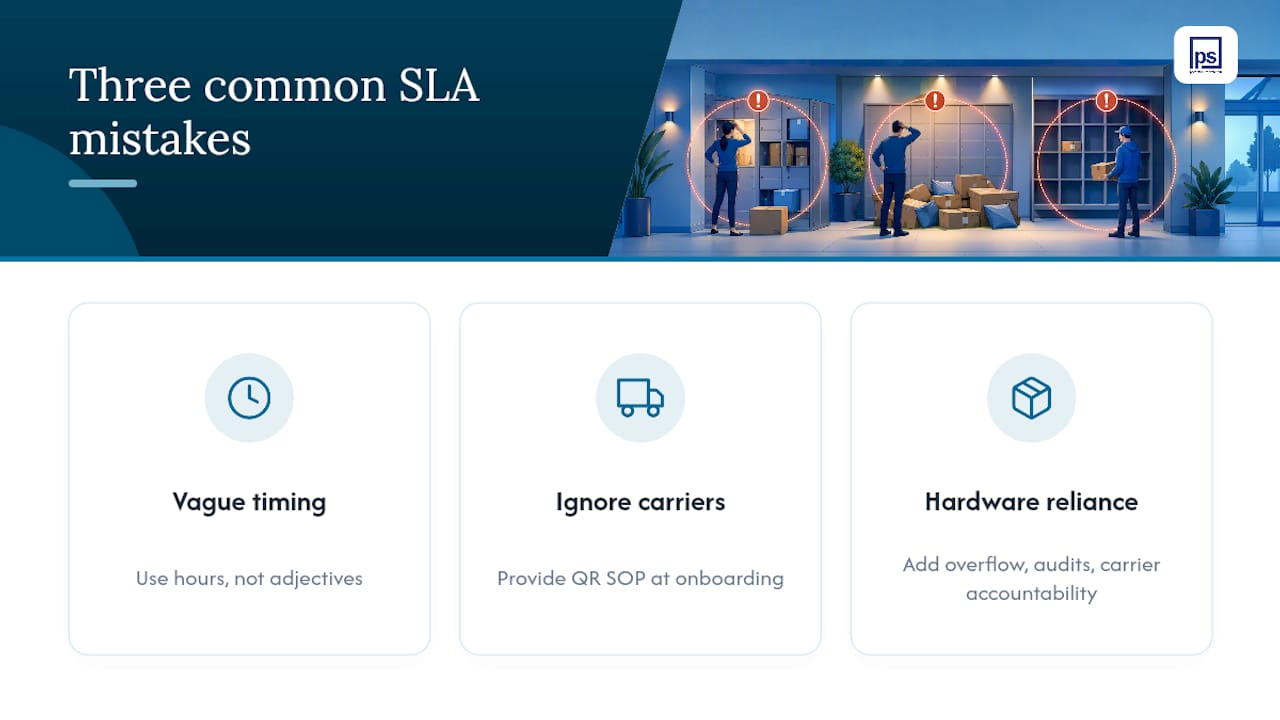
The second is ignoring carrier behavior. Property-side SLAs often govern only what staff or vendors do, leaving the carrier’s scanning accuracy as an unmanaged variable, even though it’s frequently the biggest source of failure. A one-page QR-coded SOP for carriers, distributed at onboarding, closes more gaps than another round of staff training ever will.
The third is treating hardware as the whole solution. A locker wall or a monitored room reduces friction, but it doesn’t replace overflow planning, audit cadence, or carrier accountability. Those need their own clauses.
— Postal Solutions
How Postal Solutions Operationalizes Your SLA
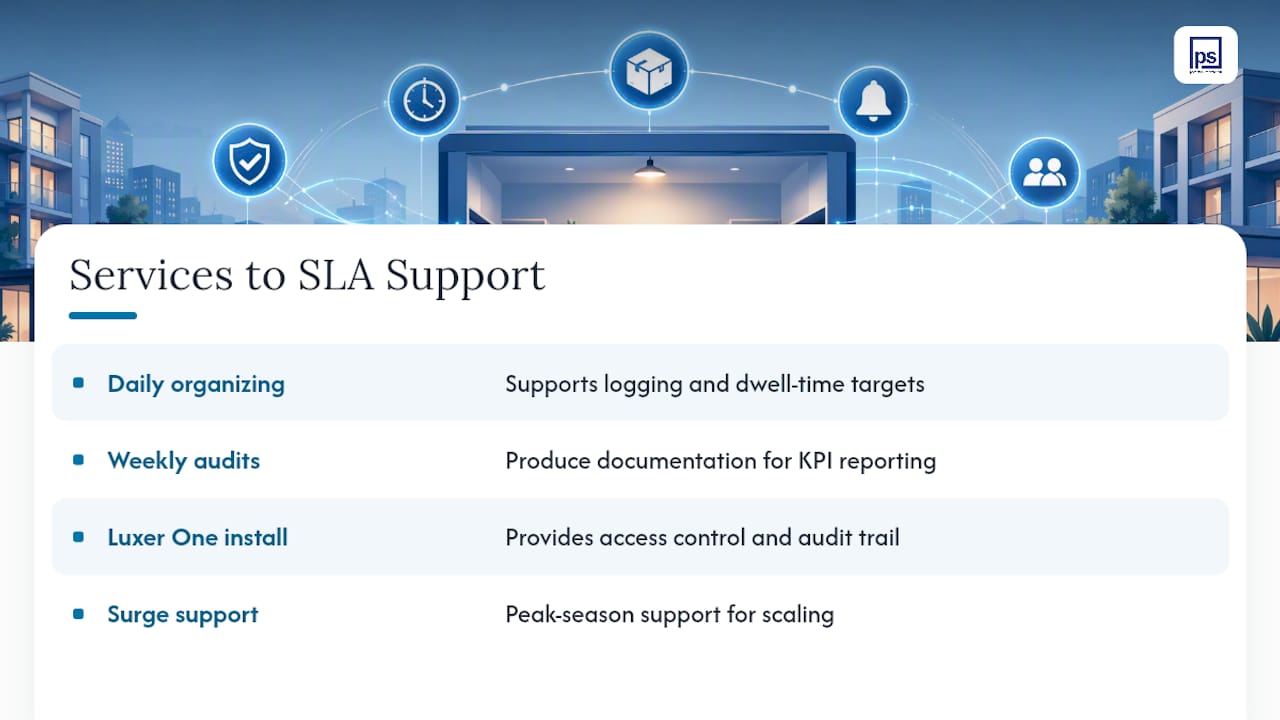
Writing a strong SLA is only half the job. Executing it daily, every day, is what separates a contract that works from one that becomes a source of resident complaints. Services that make SLA compliance real include daily package room organizing, weekly physical audits against your existing software, and the sale and installation of Luxer One package room and locker systems, including refrigerated options for perishable deliveries.
Those services map directly onto the SLA items covered above. Daily organizing supports your logging and dwell-time targets. Weekly audits generate the documentation your KPI reporting needs. Luxer One installation gives you the access-control and audit-trail backbone that a modern SLA requires. If your community is scaling into student housing, senior housing, or a multifamily portfolio and needs surge support during peak season, that’s a conversation worth having before the holiday rush, not during it.
Visit Postal Solutions to request a proposal or a system demo tailored to your property’s package volume.
Sources
- How to Effectively Manage Package Acceptance (NAAHQ)
- How To Set Up A Package Room In 2026 | Swiftlane
- 10 questions to ask before setting up a parcel locker network | DHL Logistics of Things
- Apartment access control systems (Prodatakey)
FAQ
What Is a Package Room?
A package room is a secure, designated space, either staffed or self-service, where carriers deliver parcels for later resident pickup, typically featuring shelving organized by unit number, access control, and camera coverage.
How Does Package Receiving Work at a University or Large Residential Campus?
Large residential campuses typically route carrier deliveries to a central receiving or distribution point, where staff or automated systems log each package by unit before residents pick it up during posted hours or through a locker system, following the same logging and notification pattern outlined in this article’s intake workflow.
Where Should Packages Be Sent for On-Campus or Managed Housing?
Packages should be addressed exactly as specified by the housing office or property, usually to a designated receiving address with the resident’s unit or room number included, since misaddressed packages are a leading cause of delayed logging and notification.
What Determines the Hours of Operation for a Package Pick-up Station?
Pick-up hours are set by the property or housing operator based on staffing and security needs, and a well-written SLA should specify these hours explicitly along with what happens to notification timing outside of them.
How Long Can a Package Sit Unclaimed Before Action Is Taken?
Most SLAs set a 7 to 14 day pick-up window before escalation, following patterns seen in university housing parcel agreements, after which unclaimed-property or disposal policies typically apply.