Self-Service Parcel Retrieval for Apartment Managers
Discover how self-service parcel retrieval can save apartment managers time and enhance resident satisfaction with secure, 24/7 access.
Published
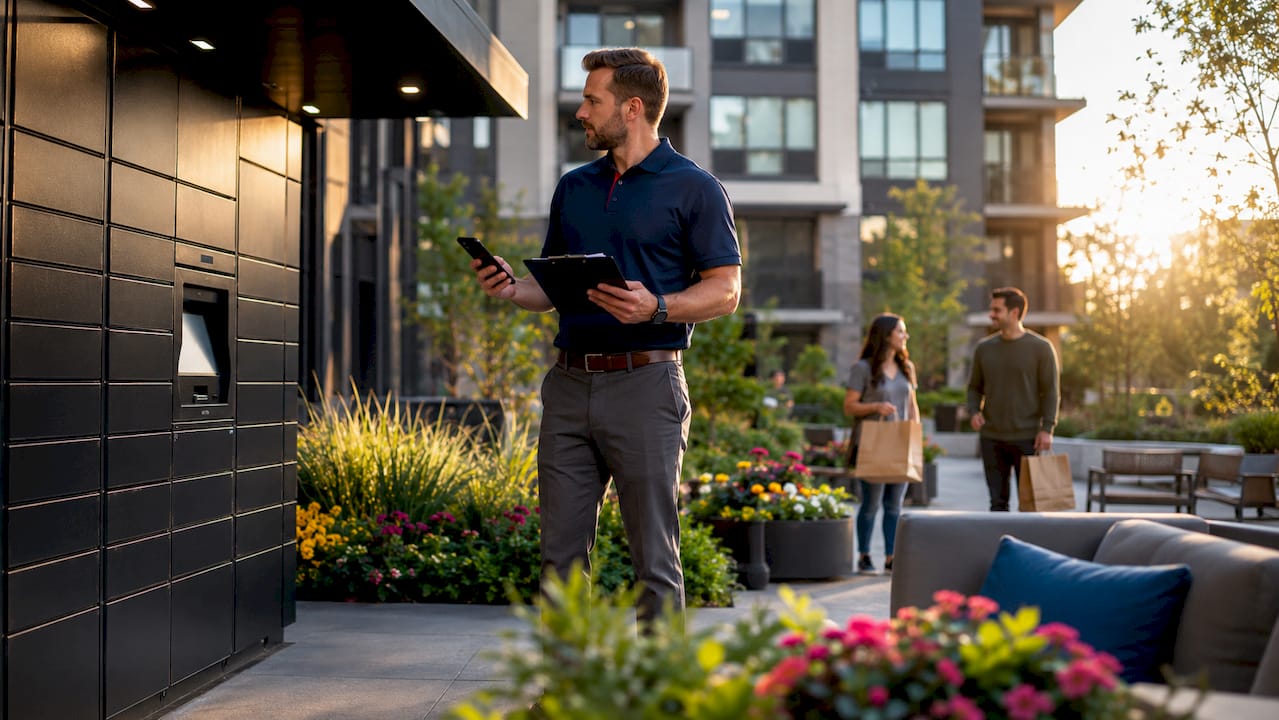
Self-service parcel retrieval is an automated system that lets residents collect packages securely, on their own schedule, without any staff involvement. The industry term for the broader category is automated parcel pickup, and it covers everything from smart locker banks to access-controlled package rooms. Property managers who deploy these systems report saving 5–15 hours of staff time per week. That figure alone explains why multifamily operators across every housing class are moving away from front-desk package handling. With 67% of residents expecting secure, contactless, 24/7 package pickup options, the pressure to act is real and growing.
What infrastructure does self-service parcel retrieval require?
The right hardware and software combination determines whether a self-service package collection system works or fails. Property managers need to evaluate three core technology types before committing to a solution.
Smart parcel locker systems
Smart lockers are the most widely deployed form of automated parcel pickup. Carriers deposit packages into individual compartments, and residents receive a unique PIN code, QR code, or mobile app notification to retrieve their parcel. Smart lockers log every transaction automatically, which creates an audit trail that protects both the property and the resident. The 24/7 access benefit removes scheduling friction entirely.
AI-powered package rooms
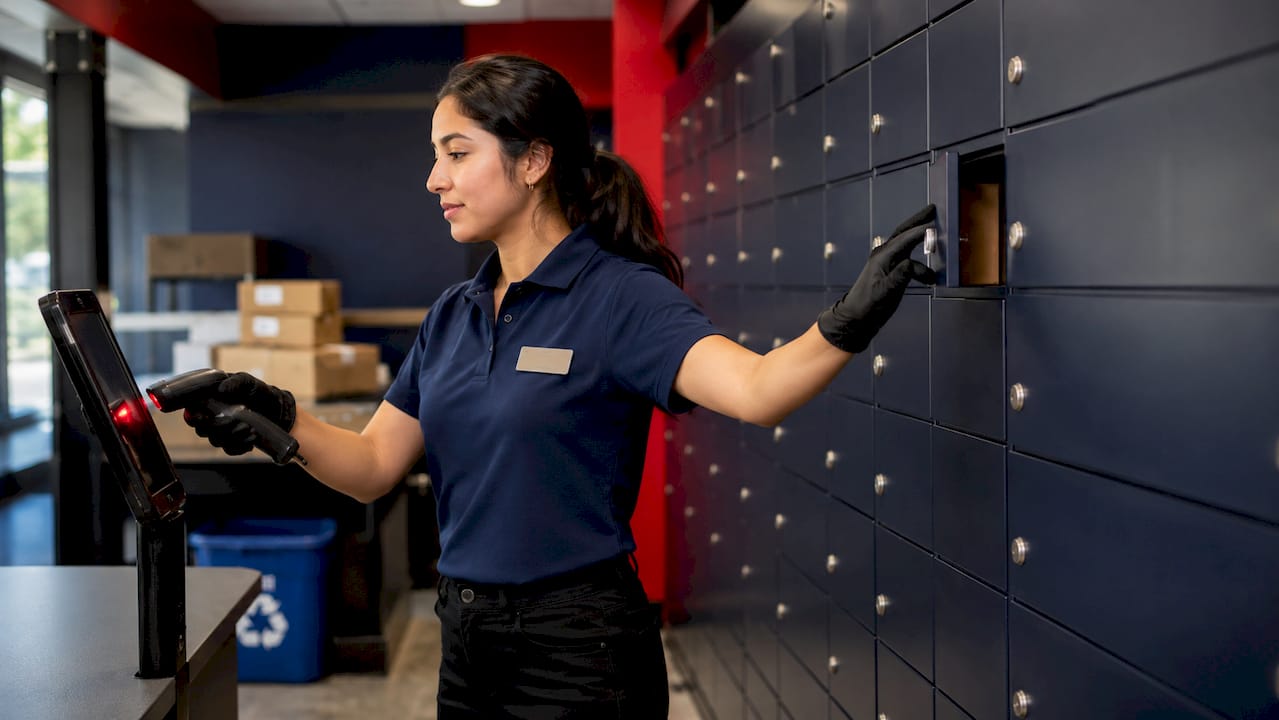
AI-powered package rooms use computer vision and open shelving instead of individual compartments. This approach triples storage capacity compared to traditional locker banks and reduces resident retrieval time from 30 minutes to seconds. Large buildings that previously required 12 staff members to manage packages can operate with as few as 2. For high-density properties, this technology changes the math on labor costs significantly.
Key infrastructure requirements
Before selecting a system, confirm your property can support these components:
- Access control integration: PIN codes, QR codes, or a mobile app tied to your resident management platform
- Carrier workflow compatibility: The system must accept deliveries from USPS, UPS, FedEx, and Amazon without requiring special carrier equipment
- Resident notification system: Automated SMS or email alerts sent immediately upon package deposit
- Software reporting: Usage logs, package aging reports, and audit tools accessible to your management team
- Physical space: Adequate square footage near a building entrance with reliable power and network connectivity
Cost context: Standard locker implementation for a 200-unit property ranges from $12,000 to $36,000, with a typical payback period of 12–18 months. That payback accelerates when you factor in reduced staff overtime and lower package theft claims.
How to implement a parcel retrieval system step by step
A successful deployment follows a defined sequence. Skipping steps creates gaps that carriers and residents will expose quickly.
-
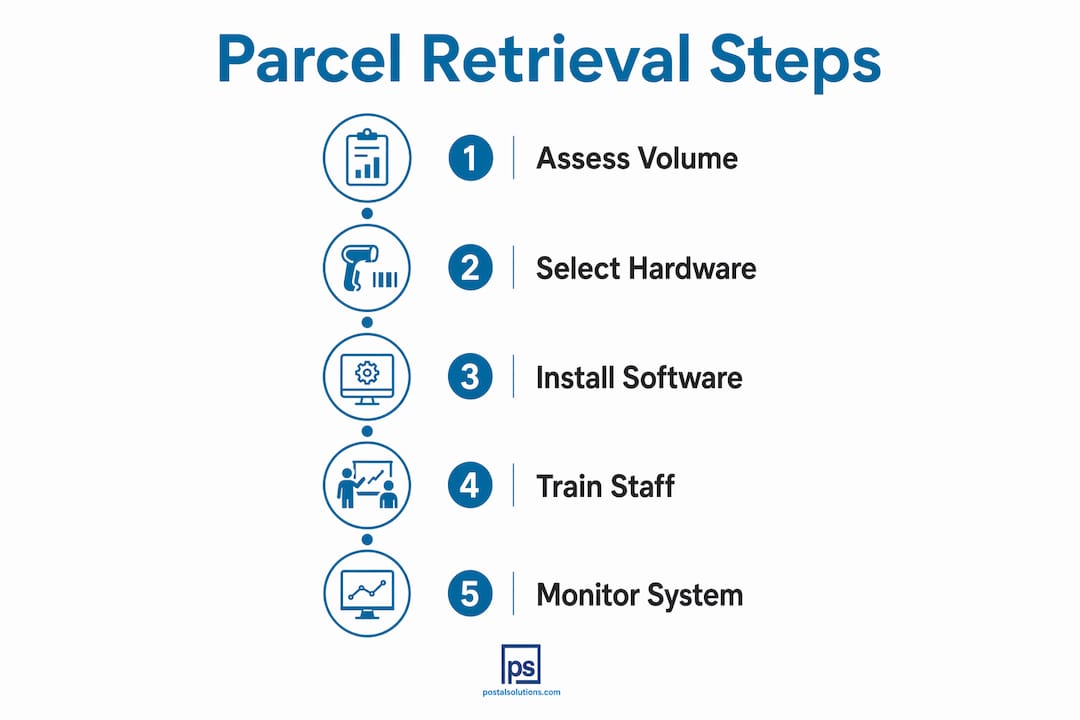
Assess your package volume and space. A 200-unit community typically receives 75–100 packages daily, doubling during peak seasons. Count your current daily intake for 30 days before sizing any system. Undersized systems create overflow problems immediately.
-
Match the solution type to your property. Locker banks work well for properties with defined entry points and moderate volume. AI-powered package rooms suit high-density buildings where space efficiency matters most. Offsite third-party delivery removes packages from the property entirely, which eliminates space needs but shifts liability and adds cost per package. Hybrid models convert unused amenity space into access-controlled package centers with minimal labor overhead.
-
Train carriers before go-live. Provide every carrier with a simple pictorial standard operating procedure. Post QR codes and PIN instructions at the delivery entrance. Standardizing carrier communication upfront prevents the majority of intake failures before they start.
-
Define staff roles clearly. Even a fully automated system needs a designated person to handle exceptions: oversized packages, carrier errors, and system alerts. Assign this responsibility explicitly rather than leaving it to whoever is available.
-
Onboard residents before the system goes live. Send a written guide with step-by-step pickup instructions. Host a brief walkthrough session in the lobby. Residents who understand the system on day one generate far fewer support requests in week one.
Pro Tip: Post laminated quick-reference cards at the locker or package room entrance for the first 90 days. Residents who forget their PIN or app login will self-serve instead of calling the leasing office.
What operational practices keep the system running well?
Deploying the hardware is the beginning, not the end. Ongoing management determines whether residents trust the system or abandon it.
-
Enforce carrier compliance consistently. Carrier non-compliance is the most frequent cause of system failure in parcel management. Drivers who bypass intake protocols leave packages unsecured, which undermines the entire technology investment. Document every violation and escalate repeat offenders to the carrier’s local depot manager.
-
Monitor package aging daily. Any package uncollected for more than 3 days signals a notification failure or a resident access problem. Catching these early prevents locker congestion and resident frustration.
-
Maintain 24/7 access without exception. Residents who work non-standard hours depend on after-hours pickup. Restricting access defeats the core value of contactless parcel retrieval and drives complaints.
-
Create a clear protocol for oversized packages. Not every delivery fits a standard locker compartment. Designate a secure overflow area and notify residents immediately with specific pickup instructions.
-
Audit the system weekly. Review transaction logs, check for stuck packages, and confirm notification delivery rates. Weekly audits catch problems before they become resident complaints.
Pro Tip: Ask your locker or package room software vendor for a weekly summary report delivered automatically to your email. Reviewing one report takes five minutes and replaces hours of manual checking.
For properties that want professional support with daily package room management, Postal Solutions provides organized, audit-driven visits that keep systems current without adding to your onsite payroll.
How do you troubleshoot common parcel retrieval failures?
Even well-designed systems encounter predictable problems. Knowing the failure patterns in advance lets you respond before residents escalate.
Carrier non-compliance is the primary cause of parcel system failures. Success requires active detection and on-site labor backup for intake process failures. Technology alone does not fix a driver who ignores the intake workflow.
The most common failure points and their fixes:
-
Carrier non-compliance: Install signage at every delivery entrance. Log violations by carrier and date. Contact the carrier’s local operations manager with documented evidence. Packages must be scanned and correctly placed for tracking systems to work. Driver adoption is not optional.
-
System malfunctions: Maintain a written contingency plan that designates a temporary secure holding area. Notify residents of the outage immediately and provide an estimated resolution time. Never leave residents without a pickup path.
-
Resident access difficulties: Keep a support contact visible at the locker or package room entrance. Offer a reset option for PINs or app credentials that residents can trigger themselves without calling the office.
-
Peak-period overflow: Forecast volume spikes using the previous year’s data. During november and december, add temporary overflow capacity or increase pickup reminder frequency to accelerate turnover.
-
Multi-property consistency: Properties in a portfolio should use the same system, the same carrier SOPs, and the same resident communication templates. Consistency reduces training time and makes audits comparable across locations.
Key Takeaways
Automated parcel pickup works when technology, carrier compliance, and resident communication operate together as a system, not as separate parts.
| Point | Details |
|---|---|
| Size the system to actual volume | Count daily packages for 30 days before selecting locker count or room size. |
| Carrier training prevents most failures | Pictorial SOPs and posted PIN codes at delivery entrances reduce intake errors significantly. |
| Staff time savings are measurable | Property managers save 5–15 hours per week after implementing smart locker systems. |
| Weekly audits protect system health | Reviewing transaction logs and package aging reports weekly catches problems before residents notice. |
| 24/7 access is non-negotiable | Restricting pickup hours eliminates the core benefit of self-service package collection for residents. |
What Postal Solutions has learned after 1,200+ Luxer One installations
The conventional wisdom in multifamily package management says that buying the right technology solves the problem. After more than a decade of managing Luxer One installations across over 40% of U.S. states, Postal Solutions has found that technology is necessary but not sufficient. The real differentiator is what happens after installation.
Properties that treat a locker or package room as a set-and-forget amenity consistently underperform. Carriers drift back to old habits. Packages accumulate in corners. Residents lose confidence in the system and start calling the leasing office again. The property ends up paying twice: once for the hardware and once in staff time recovering from the chaos the hardware was supposed to prevent.
The properties that get the most value from automated parcel pickup are the ones that pair the technology with a service layer. That means someone visiting the property regularly to organize the package room, mark unit numbers on boxes, complete audits, and keep the system current. Postal Solutions manages that service layer for properties across conventional multifamily, student housing, and senior housing. The result is a system that actually works the way the brochure says it will.
Resident expectations around package access have also shifted faster than most operators anticipated. Contactless parcel retrieval is no longer a differentiator. It is a baseline expectation. Properties that cannot offer it are losing prospective residents to those that can. The question is no longer whether to invest in self-service package collection. The question is how to make the investment perform.
— Postal Solutions
Postal Solutions manages parcel retrieval for multifamily properties nationwide
Postal Solutions has spent nearly a decade helping property managers move from package chaos to organized, resident-friendly pickup systems. As the largest Luxer One sales agency in the country, with over 1,200 installations completed, Postal Solutions sells and installs Luxer One locker and package room systems for conventional multifamily, student housing, senior housing, and university properties. Beyond hardware, Postal Solutions offers daily package room management outsourcing, with organized visits six days per week to sort packages, mark unit numbers, and complete weekly audits. Property managers who want a complete solution without adding to their payroll can contact Postal Solutions for a consultation tailored to their property’s volume, layout, and resident profile.
FAQ
What is self-service parcel retrieval?
Self-service parcel retrieval is an automated system that lets residents pick up packages securely at any hour without staff assistance. It typically uses smart lockers or access-controlled package rooms paired with PIN, QR, or app-based entry.
How many packages does a typical apartment community receive daily?
A 200-unit apartment community typically receives 75–100 packages per day, with volume doubling during peak seasons like november and december.
What is the biggest cause of parcel locker system failure?
Carrier non-compliance is the most frequent cause of system failure. Drivers who bypass intake protocols leave packages unsecured and outside the tracking system, which breaks the entire resident experience.
How much does a smart locker system cost for a 200-unit property?
Implementation costs for a 200-unit property typically range from $12,000 to $36,000, with a payback period of 12–18 months driven by staff time savings and reduced package theft.
Do residents actually use self-service package collection systems?
Yes. Research shows 67% of residents expect secure, contactless, 24/7 package pickup options. Properties that offer this capability align directly with what residents already expect when they sign a lease.
Recommended
- Apartment Package Management Services | Multifamily Package Room Operations | Postal Solutions
- Apartment Mail & Package Resources — Guides, Comparisons, Use Cases | Postal Solutions
- Managed Package Room Visits: Top Strategies for Property Managers | Postal Solutions
- Package Room Management | Daily Services for Apartments & Student Housing | Postal Solutions