Package Room Weekly Audits: A 2026 Guide for Property Managers
Discover the importance of package room weekly audits for property managers. Learn efficient strategies to improve package handling and enhance resident...
Published

Package room weekly audits are systematic, recurring inspections that verify every package in a multifamily housing delivery area is logged, labeled, and accessible to the correct resident. Properties that skip these reviews accumulate unclaimed parcels, miss carrier compliance failures, and generate resident complaints that erode retention. Postal Solutions manages daily package room organization for conventional multifamily, student housing, and senior housing communities, and the data from those managed visits confirms one consistent truth: a structured weekly audit catches problems before residents ever notice them.
What do package room weekly audits actually require?
Effective weekly package room inspections start with the right tools and clear role assignments. Without both, the audit produces inconsistent results that are hard to act on.
Essential tools and documents for every audit:
- A printed or digital package room audit checklist covering package count, label accuracy, locker or shelf utilization, and notification status
- An inventory log that records each parcel’s carrier, arrival date, unit number, and pickup status
- Access to the property’s package management software or locker system dashboard for real-time data comparison
- A camera or mobile device to document overflow conditions, damaged parcels, or carrier placement errors
- Carrier compliance notes from the previous week to track repeat violations
Staff roles and training requirements:
The audit works best when one designated person owns the process each week. That person should understand how to read the property’s package management software, recognize carrier labeling errors, and escalate unclaimed packages past the collection window. Training takes less than an hour when the checklist is clear and the software is already in use.
Software and notification integration:
Your package management software should feed directly into the audit. Pull the current package log before you walk the room. Cross-reference what the system shows as “delivered” against what is physically present. Automated resident notifications reduce dwell time and improve package turnover, which means your audit log should reflect active movement, not a static pile of unclaimed boxes.
| Audit Tool | Primary Function |
|---|---|
| Package audit checklist | Tracks label accuracy, unit numbers, and pickup status |
| Inventory log | Records carrier, arrival date, and collection window status |
| Package management software | Provides real-time delivery and notification data |
| Carrier compliance notes | Documents repeat delivery errors for follow-up |
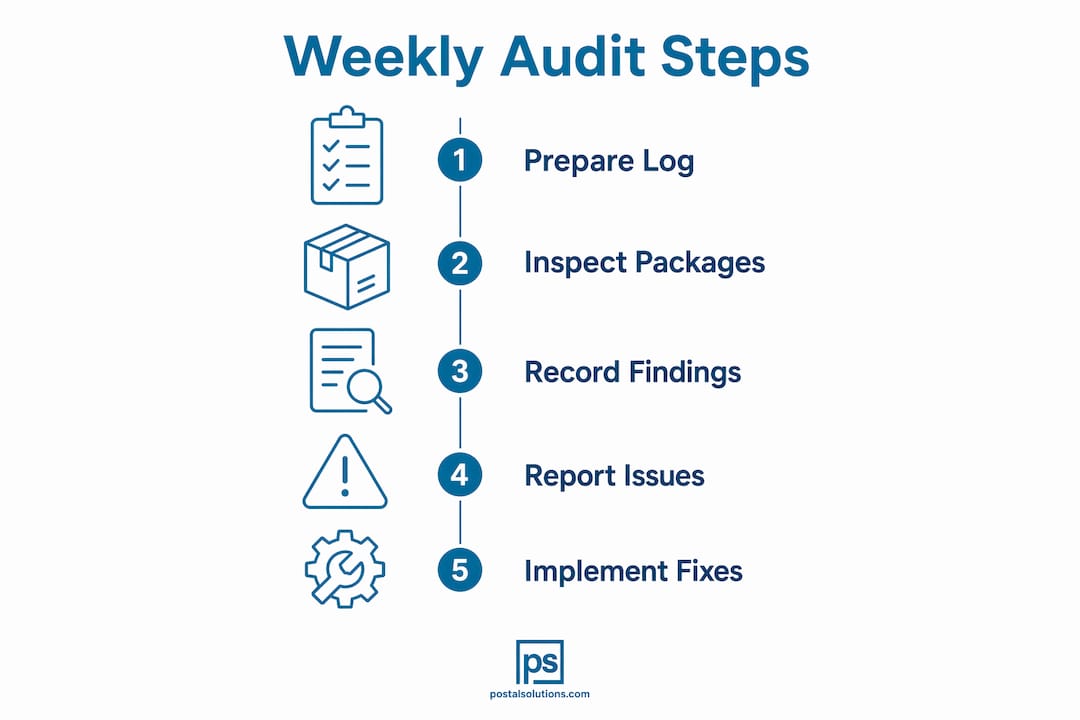
How to conduct a thorough weekly package room audit
A consistent, step-by-step process produces results you can compare week over week. Follow this sequence every time.
-
Pull the software report first. Before touching a single box, generate a current package log from your management software or locker dashboard. Note every parcel marked as delivered but not yet picked up.
-
Physically count and match packages. Walk the room and count every parcel. Match each one to the software log. Any package present but not logged is a carrier compliance failure. Any package logged but missing requires immediate investigation.
-
Check label accuracy and unit numbers. Confirm that each box has a legible unit number either printed on the carrier label or written clearly by staff. Mislabeled packages are the leading cause of residents searching the room and leaving without their parcel.
-
Assess locker and shelf utilization. Note which lockers or shelves are at capacity and which sit empty. Uneven distribution signals a configuration problem, not just a volume problem. Auditing package lockers regularly prevents overflow and missed notifications by identifying bottlenecks early.
-
Review the collection window status. Best practice sets a 3–5 day pickup window with automated reminders sent to residents at 48 and 96 hours post-delivery. Flag every package that has exceeded the window and trigger a final notice or escalation.
-
Verify notification delivery. Confirm that every package logged in the system generated a resident notification. Silent deliveries, where a package arrives but no alert goes out, are a common source of dwell time problems.
-
Document carrier compliance. Note any packages placed in the wrong location, left outside the secure area, or delivered without proper logging. Carrier non-compliance is the top frustration for 70% of multifamily operators. That figure reflects how often the problem originates outside the property’s control.
-
Record your findings and set follow-up tasks. Log overflow counts, notification failures, and carrier errors in a weekly summary. Assign a resolution owner for each issue before you leave the room.
Pro Tip: Schedule the weekly audit on the same day and time each week. Consistency makes it easier to spot trends, such as a carrier that repeatedly misplaces packages on Mondays or a notification system that fails after large delivery batches.
What common problems do weekly audits uncover?

Weekly package room inspections surface four recurring issues. Knowing them in advance lets you address them faster.
Overflow and capacity strain during peak periods. A room designed for average daily volume fails during holiday surges and back-to-school periods. Seasonal delivery surges stress package room capacity and staffing in ways that daily observation alone does not capture. The audit gives you a documented count that proves when you have outgrown your current setup.
Carrier non-compliance and delivery errors. Packages left in hallways, placed in the wrong locker bank, or delivered without system logging all show up during a physical audit. Post-audit actions include training carriers on compliance, adjusting locker distribution, and refining resident notification processes. Carrier training is not a one-time event. It requires documented follow-up tied directly to audit findings.
Notification delays and low pickup rates. When residents do not receive timely alerts, packages sit. Automated notifications reduce dwell time and improve turnover rates. If your audit consistently shows packages past the 48-hour mark without a second reminder, your notification workflow needs adjustment.
Staff time consumption and process gaps. Properties without a managed audit process often discover that leasing staff spend significant time helping residents locate packages. That time has a real cost.
“Smart package room systems reduced package management staff at a large property from twelve full-time associates to two by automating tracking and notifications. The audit process is what surfaces the data needed to justify that kind of infrastructure investment.”
When your audit log shows the same problems repeating week after week, the solution is rarely more staff hours. It is a process or infrastructure change backed by audit data.
How do you turn audit results into lasting improvements?
A single audit is a snapshot. A series of audits is a performance record. The goal is to use that record to make decisions that hold up over time.
Schedule capacity audits before peak seasons. Running a capacity audit every september lets multifamily properties adjust shelving and staffing before holiday volume arrives. That one annual review, layered on top of weekly inspections, prevents the reactive scramble that damages resident satisfaction during the busiest months.
Use audit metrics as performance benchmarks. Track package dwell time, pickup rate within the collection window, notification success rate, and carrier compliance rate as weekly KPIs. When one metric drops, the audit log tells you exactly when it started and what changed.
Pro Tip: Build a simple monthly summary from your weekly audit logs. Four weeks of data reveal patterns that a single inspection never could, such as a carrier that is consistently non-compliant on specific days or a locker bank that fills faster than others.
Incorporate findings into staff training. Audit results are the most credible training material available. When staff see that a specific labeling error caused 12 packages to sit unclaimed for five days, the correction sticks. Generic training does not produce the same result.
Plan for scalable infrastructure. Audit data justifies infrastructure decisions. If your weekly logs show consistent overflow in a specific zone, that is the evidence you need to request additional lockers or reconfigure shelving. Managing high-volume deliveries in multifamily housing requires infrastructure that matches actual usage patterns, not projected averages.
| Improvement Area | Audit Metric to Track | Action Trigger |
|---|---|---|
| Resident pickup behavior | Dwell time past 48 hours | Adjust notification frequency |
| Carrier compliance | Weekly error count per carrier | Initiate carrier training session |
| Room capacity | Overflow incidents per week | Request shelving or locker expansion |
| Staff efficiency | Time spent on resident package inquiries | Evaluate managed service or automation |
The audit frequency question is settled. The execution question is not.
After working with multifamily properties across the country since 2016, Postal Solutions has seen the full range of package room management approaches. The properties that struggle most are not the ones with the worst infrastructure. They are the ones that treat audits as optional.
Weekly audits reveal something that daily observation misses: the pattern. A single day of overflow looks like a bad Tuesday. Four weeks of overflow data on the same day of the week points to a carrier scheduling problem or a notification gap that is entirely fixable. The difference between those two outcomes is documentation.
The other thing audits expose is the hidden cost of inaction. Properties often calculate package management costs in terms of locker purchase price or software subscription fees. They rarely calculate the cost of a leasing agent spending 20 minutes per day helping residents find packages. Multiply that by five days a week and 50 weeks a year, and the number is significant. Audit data makes that cost visible and defensible.
Carrier cooperation is the variable that most property managers underestimate. Carrier compliance protocols established early prevent many operational failures and reduce staff time spent on manual interventions. The audit is the mechanism that holds carriers accountable, because it produces a written record of every compliance failure.
The properties that get the most value from weekly audits are the ones that treat the findings as operational data, not paperwork. They adjust collection windows, retrain carriers, reconfigure locker banks, and update notification schedules based on what the audit tells them. That is the difference between a property that manages packages and one that manages the experience around packages.
— Postal Solutions
How Postal Solutions supports weekly package room audits
Postal Solutions manages daily package room organization for multifamily communities, including conventional apartments, student housing, and senior housing. As part of that managed service, a package manager visits the property up to six days per week to organize the room, mark unit numbers on packages, and complete weekly audits using the community’s existing package management software. For properties that want a full-service setup, Postal Solutions sells and installs Luxer One locker systems and combines that hardware with ongoing managed visits. Properties that want to build their own audit process can start with the package room setup checklist available on the Postal Solutions website. Contact Postal Solutions to discuss a managed audit approach built around your property’s volume and layout.
FAQ
What is a package room weekly audit?
A package room weekly audit is a structured inspection that verifies every parcel in a multifamily delivery area is logged, labeled, and within its collection window. It identifies overflow, notification failures, and carrier compliance issues before they affect residents.
How often should package room audits be conducted?
Weekly audits are the standard for active multifamily properties. A separate capacity audit conducted each september prepares the property for peak holiday delivery volume.
What is the recommended package collection window?
Best practice sets a 3–5 day collection window with automated reminders sent at 48 and 96 hours after delivery. Packages that exceed the window should trigger a final escalation notice.
What problems do package room audits most commonly find?
The most common findings are carrier non-compliance, unclaimed packages past the collection window, notification system failures, and uneven locker or shelf utilization.
Can audit data justify infrastructure upgrades?
Audit data is the most direct evidence for infrastructure decisions. Weekly overflow counts, dwell time trends, and carrier error logs give property managers the documentation needed to request locker expansions or managed service support.
Key takeaways
Weekly package room audits are the most reliable method for catching operational failures before they reach residents, and properties that run them consistently outperform those that rely on reactive fixes.
| Point | Details |
|---|---|
| Audit frequency matters | Weekly inspections catch patterns that daily observation misses. |
| Collection windows need enforcement | A 3–5 day pickup window with 48 and 96-hour reminders reduces unclaimed package buildup. |
| Carrier compliance requires documentation | Written audit records hold carriers accountable and support corrective action. |
| Seasonal capacity audits prevent overflow | A september capacity review prepares properties for holiday and back-to-school surges. |
| Audit data justifies investment | Dwell time and overflow metrics provide the evidence needed to upgrade infrastructure or add managed services. |