Package Overflow Management: A Workflow-First Guide
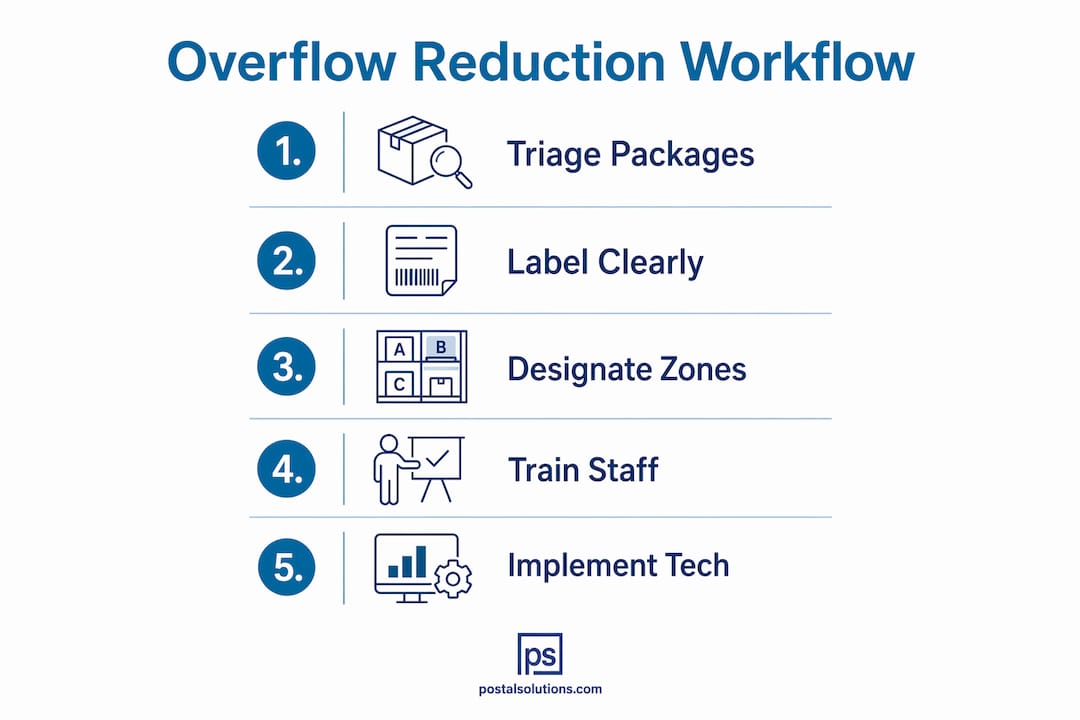
Package Overflow Management: A Workflow-First Guide Stop package-room overflow by combining immediate triage, a documented standard operating procedure, and the right technology or managed service. Those three elements work together. Withou
Published

Stop package-room overflow by combining immediate triage, a documented standard operating procedure, and the right technology or managed service. Those three elements work together. Without all three, you are solving one layer of the problem while the other two keep producing chaos.
Your next-hour checklist:
- Designate a temporary overflow staging area (a corner, a cart, a labeled zone) separate from the main intake shelf
- Post a single-page pictorial SOP at the package room entrance for carriers arriving today
- Send residents a pickup-window reminder via text or email
- Label every package already in the room with the unit number, in marker if needed
- Identify any packages held longer than 72 hours and flag them for escalation
The core principle: Hardware alone does not fix overflow. Documented workflows and carrier compliance are the foundation. Technology and managed services amplify a process that already works.
Table of Contents
- Why does package overflow keep happening in multifamily communities?
- What can your team do today to reduce overflow without new hardware?
- How do you build a standardized package-room SOP that survives staff turnover?
- Which technology options actually reduce package overflow?
- What does a managed package-room service actually do each day?
- What does implementation actually cost, and how long does it take?
- How do you measure package-room performance and protect it after staff changes?
- Key Takeaways
- The case for workflow-first package management
- Postal Solutions manages package overflow so your team does not have to
- FAQ
Why does package overflow keep happening in multifamily communities?
Package overflow is the uncontrolled accumulation of parcels beyond a room’s organized capacity, producing missed deliveries, resident complaints, and safety hazards in corridors and lobbies. The failure is almost never about space alone.
Carrier non-compliance tops the frustration list for 70% of operators surveyed, with staff time consumed by package handling and resident complaints each cited by roughly 50% of respondents. Overflow and insufficient storage ranked fourth at 40%. The order matters: fixing the room before fixing carrier behavior is working backward.
| Failure Mode | Operator Impact |
|---|---|
| Carrier non-compliance | Packages dumped in wrong locations; staff must re-sort |
| Ad-hoc, undocumented workflows | Performance collapses after any staff change |
| Fixed-size storage (lockers) | Oversized items overflow regardless of locker count |
| Holiday and move-in surges | Average volume jumps ~80% per week |
Stat to act on: Communities where SOPs are not documented see immediate performance degradation after staff turnover, according to industry advisory findings. The SOP is not optional.
What can your team do today to reduce overflow without new hardware?
Fast interventions cost almost nothing and can stabilize a package room within hours. Start with staging and labeling, then address carriers and residents in parallel.
Staging and labeling rules to set right now:
- Oversized items go on the floor along the back wall, never blocking the main aisle
- Refrigerated or prescription items get a red label and move to a designated priority shelf
- Any package held more than 72 hours gets a hold-notice sticker and triggers a resident notification
- Surge days (Black Friday week, move-in weekends) get a pre-designated external staging cart or secondary room
Carrier-facing tactics that cost nothing but a printer: issue QR or PIN codes to regular drivers so they can access the room without staff involvement, and post a single-page pictorial SOP at the entrance. Best practices recommend a standardized carrier communication package for multi-site rollouts. Visible signage for staging zones reduces misplaced parcels from substitute drivers.
For residents, a short email or text with a clear subject line (“Your package is waiting — please pick up by [date]”) moves pickups faster than a generic notification. Add a late-notice policy reminder and a returns-assistance offer to reduce the volume of unclaimed parcels sitting in the room.
Stat to act on: Leasing and concierge teams spend an average of four to six hours per week handling packages. Faster resident pickup is the single fastest way to reclaim that time.
How do you build a standardized package-room SOP that survives staff turnover?
A documented SOP is the difference between a package room that runs well and one that collapses every time a team member leaves. Build it in two layers: daily intake and storage, then shift handoff, and audits.
Daily intake workflow:
- Log each arriving package immediately (scan or manual entry) into your package-room software before placing it anywhere.
- Write or highlight the unit number on the label in large marker.
- Place the package in the correct zone: small items on labeled shelves by floor or building, oversized items in the designated floor zone, priority items on the priority shelf.
- Trigger the resident notification through your software or a manual text/email template.
- Record the carrier name and delivery time for compliance tracking.
Storage and pickup workflow:
- Allocate shelf space by unit range, not by arrival order. This cuts search time for both staff and residents.
- Apply a 72-hour hold sticker on day one. Escalate to a second notice at 72 hours and a final notice at five days.
- Log pickups with a timestamp and the resident’s unit number.
Shift handoff and weekly audit tasks:
- Outgoing staff note any packages flagged for escalation and any carrier compliance issues observed that day.
- Weekly: run a full inventory audit against your software log, reconcile discrepancies, and document the count.
Training: New hires get a one-page quick-start checklist on day one. Store the full SOP in a shared digital folder accessible to all site staff. Refresh training every 90 days or after any carrier-compliance incident.
Pro Tip: Photograph the package room at the start and end of each shift. The timestamp creates an audit trail that resolves carrier disputes in minutes and gives you compliance data without any additional software.

Which technology options actually reduce package overflow?
Technology reduces overflow when it fits the property’s volume, space, and staffing model. Matching the solution to those three variables matters more than picking the most sophisticated product.
Fixed-size locker banks are the most common installation. They provide security and automated resident notifications, but each compartment occupies the same floor space regardless of package size. Oversized items, which now make up a large share of volume as residents order boxed furniture online, overflow lockers consistently. Lockers work well for mid-size suburban communities with moderate daily volume and residents who value self-service access.
Open smart rooms with computer vision use AI-assisted shelving and camera-based tracking to maximize spatial efficiency. One reported case saw resident wait time drop from 30 minutes to seconds after deployment, with dedicated staff managing packages reduced from 12 to two. The trade-off: carrier adoption requires more training, and substitute drivers create recurring compliance gaps.
Must-ask vendor questions before procurement:
- How does the system detect and log carrier non-compliance?
- What is the driver workflow, and how long does it take a first-time driver to complete a delivery?
- Does the system integrate with your existing property management software?
- How does the system handle oversized items that exceed compartment dimensions?
Luxer One is a monitored electronic package room and locker system used across conventional multifamily, student housing, universities, and Public Private Partnerships nationwide. Key overflow-relevant features to confirm during procurement include 24/7 resident access, carrier-facing guided workflows, software integration with major property management platforms, and audit reporting. Match the Luxer One configuration (locker bank, open room, or combo) to your unit count, daily volume, and available square footage using the criteria above.
Stat to act on: Solution-to-property matching using unit count, daily volume, available space, staffing model, and resident demographics is the framework operators use to avoid buying hardware that creates new overflow problems within 12–24 months.
What does a managed package-room service actually do each day?
A managed service sends a trained package manager to your property on a set schedule to handle the tasks your on-site team currently absorbs. The day-to-day work includes organizing the package room, writing or highlighting unit numbers on labels, logging packages into your existing software, completing weekly audits, and flagging carrier compliance issues.
Service model signals to request from any managed provider:
- Six-day-per-week visit frequency (the standard for high-volume properties)
- Written weekly audit reports with package counts and discrepancy logs
- Staff training support for your on-site team
- Integration with your current package-room software or the ability to supply one
Expected outcomes after onboarding a managed service: staff handling time drops substantially, resident complaints decrease, and pickup times improve. One community reported an 80% drop in staff handling time and the elimination of package complaints within the first month of deploying a managed solution. For managed package room visits, the measurable gains show up fastest in staff hours reclaimed and resident satisfaction scores.
Managed vs. self-managed evaluation checklist:
- Does your current staff have documented, audited SOPs in place?
- Are carrier compliance incidents tracked and escalated consistently?
- Is package-room performance stable across staff changes?
- Is your team spending more than four hours per week on package tasks?
If three or more of those answers are “no,” a managed service typically delivers faster ROI than additional hardware.
What does implementation actually cost, and how long does it take?
| Phase | Timeline | Expected Outcome | Cost Shape |
|---|---|---|---|
| Immediate triage | — | Overflow stabilized; labeling and staging in place | Staff time only |
| SOP rollout and training | 1–4 weeks | Documented workflow; new-hire ready | Staff time; minimal print costs |
| Managed-service onboarding | 2–6 weeks | Daily organizing; weekly audits running | Recurring service fee |
| Luxer One procurement and install | 4–12+ weeks | Automated access; carrier-guided workflow | Hardware plus installation |
ROI math for operators: if your team spends five hours per week on package tasks at a fully loaded labor rate, that is over 260 hours per year pulled from leasing and resident services. A managed service that reclaims even half of that time pays for itself in productivity before you count lease-renewal impact. One-third of communities report spending more than four hours weekly on packages, confirming this is a widespread cost, not an edge case.
Stat to act on: Properties that expand hardware without fixing workflows return within 12–24 months needing a second solution. Process-first deployments avoid that cycle.
How do you measure package-room performance and protect it after staff changes?
Primary KPIs to track monthly:
- Packages processed per staff-hour
- Average time-to-pickup (from delivery log to resident pickup timestamp)
- Percentage of packages logged on first touch
- Carrier compliance rate (deliveries placed correctly without staff intervention)
- Overflow incidents per month (packages found outside designated zones)
Audit cadence:
- Daily quick-check: confirm all packages are labeled and staged correctly before end of shift
- Weekly inventory audit: reconcile software log against physical count; document discrepancies
- Monthly trend review: compare KPIs month-over-month; flag any metric moving in the wrong direction
Governance to protect performance across staff turnover: Store all SOPs in a versioned shared folder (Google Drive, SharePoint, or your property management platform). Require role-based training sign-off for every new hire before they handle packages independently. Cross-train at least two staff members on every package-room task so no single departure creates a gap. Set audit pass/fail thresholds (for example, a carrier compliance rate below 80% triggers an immediate carrier communication and retraining cycle).
Stat to act on: Industry advisory groups identify inconsistent procedures and staff turnover as the primary causes of overflow. Governance is the fix.
Key Takeaways
Effective package overflow management requires documented SOPs, carrier compliance protocols, and the right technology or managed service working together from day one.
| Point | Details |
|---|---|
| Triage first, hardware second | Stabilize staging and labeling within 24 hours before evaluating any technology purchase. |
| Document every workflow | Versioned SOPs and role-based training prevent performance drops after staff turnover. |
| Carrier compliance is the root cause | 70% of operators cite carrier non-compliance as their top frustration; address it directly with pictorial SOPs and PIN/QR access. |
| Match solution to property profile | Unit count, daily volume, and staffing model determine whether lockers, a smart room, or a managed service fits best. |
| Postal Solutions manages the full stack | Postal Solutions offers six-day managed visits, weekly audits, and Luxer One sales and installation in a large portion of U.S. states. |
The case for workflow-first package management
The operators who get this right are not the ones who bought the most hardware. They are the ones who fixed their processes first and then chose technology that fit those processes. Postal Solutions has seen this pattern consistently since 2016, across more than 1,200 Luxer One sales and installations in over 40% of U.S. states, spanning conventional multifamily, student housing, senior communities, and university P3 partnerships.
The most common mistake: a property invests in a locker bank or smart room, skips the SOP work, and watches the same overflow problems reappear within a year because carriers still dump packages in the wrong place and staff still have no documented escalation path. The hardware did not fail. The process did.
A workflow-first approach means the technology you add amplifies a system that already functions. Six-day managed visits, weekly audits, and carrier compliance protocols are not add-ons to a Luxer One installation. They are what make the installation hold its value over time.
Postal Solutions manages package overflow so your team does not have to
Properties dealing with chronic overflow usually need two things at once: an immediate operational fix and a durable system that holds up after staff changes. Postal Solutions delivers both. The managed service sends a package manager to your property up to six days per week to organize the room, mark unit numbers on labels, run weekly software audits, and keep the space current. For properties ready to add technology, Postal Solutions is the largest Luxer One sales agency in the country, with installations across conventional multifamily, student housing, senior housing, universities, and municipalities.
An initial engagement starts with a site assessment, a recommended SOP tailored to your volume and layout, and a cost estimate with pilot options. Your team stops absorbing package tasks. Residents find their parcels without friction. Staff hours go back to leasing and service.
Request a site assessment to get a recommended SOP and cost estimate for your property.
FAQ
What is the fastest way to stop package room overflow today?
Designate a temporary overflow staging zone, label every package with the unit number, and send residents a pickup-window reminder. These three steps stabilize a package room within hours at no hardware cost.
How often should a managed package service visit the property?
Six days per week is the standard for high-volume multifamily and student housing communities. Postal Solutions offers this frequency along with weekly audits and software integration.
Why do package overflow problems return after installing lockers?
Lockers are fixed in compartment size and cannot accommodate oversized items, so volume growth and large parcels create overflow regardless of locker count. Carrier non-compliance compounds the problem when drivers bypass the system entirely.
What KPIs should property managers track for package room efficiency?
Track packages processed per staff-hour, average time-to-pickup, percentage of packages logged on first touch, carrier compliance rate, and overflow incidents per month. Review these monthly and audit weekly.
How does staff turnover cause package room overflow?
When SOPs are not documented, each new hire rebuilds the workflow from scratch, creating inconsistency that carriers and residents both notice. Industry advisory groups identify undocumented procedures and staff turnover as the primary causes of overflow.
Recommended
- The Real Cost of Free Package Management | White Paper | Postal Solutions
- Package Room Setup Checklist for Multifamily Properties | Postal Solutions
- Apartment Package Management Services | Multifamily Package Room Operations | Postal Solutions
- How to Manage High Volume Package Deliveries in Multifamily Housing | Postal Solutions