Daily Package Pickup for Multifamily Properties
Daily Package Pickup for Multifamily Properties Run a daily, low-touch package pickup program that standardizes intake, labels parcels by unit number, and automates resident notification — managed in-house or through Postal Solutions — to e
Published
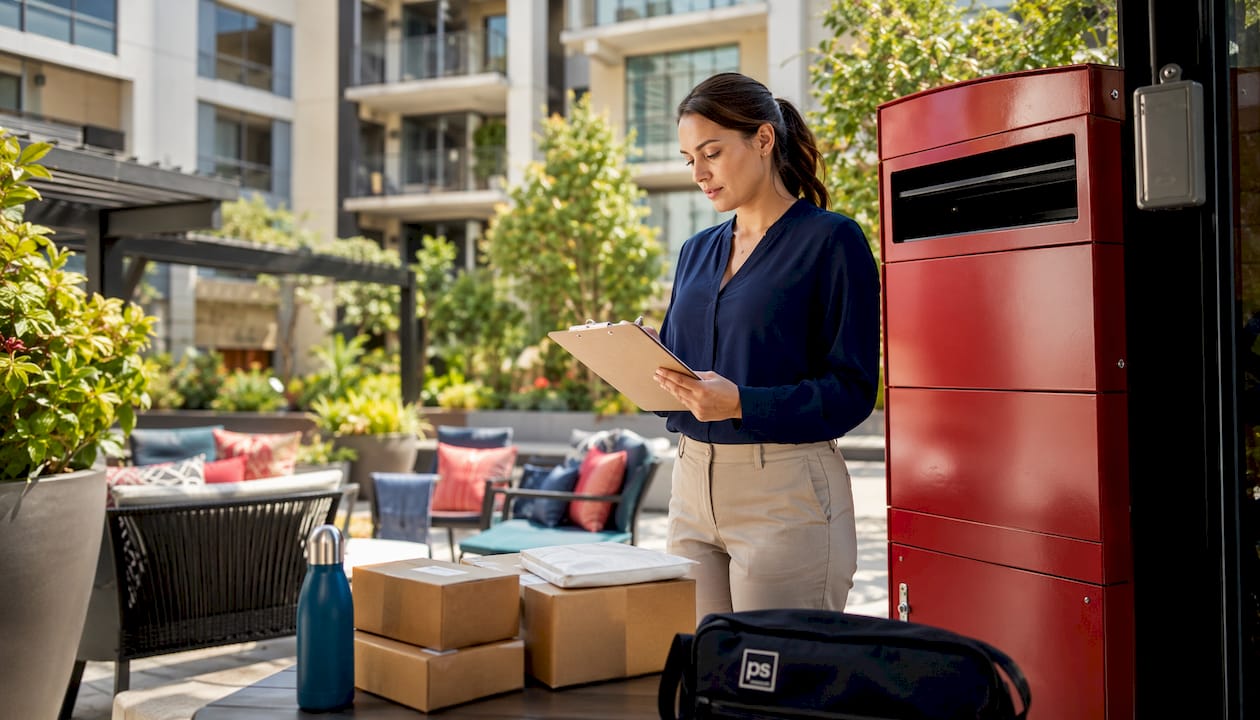
Run a daily, low-touch package pickup program that standardizes intake, labels parcels by unit number, and automates resident notification — managed in-house or through Postal Solutions — to eliminate backlog and cut leasing-team handling time. A 400-unit urban building receives roughly 187 packages per day on a typical day, with holiday volume climbing to about 208 per day in some reports. That volume demands a repeatable daily process, not a reactive one. The immediate first step: set a fixed daily intake window, assign someone to label and organize every parcel by unit number, and push automated resident notifications the same day.
Table of Contents
- What does a daily package pickup program actually include?
- How to run daily package pickups: a step-by-step checklist
- Written policies and exception workflows your property needs
- Which tools make daily parcel collection scalable?
- Should you manage daily pickups in-house or outsource?
- KPIs, weekly audits, and measuring ROI
- Sample 30–60 day rollout plan
- Key takeaways
- Why a daily operational model beats a hardware-first approach
- Postal Solutions manages daily package pickup for multifamily teams
- Useful sources and further reading
- FAQ
What does a daily package pickup program actually include?
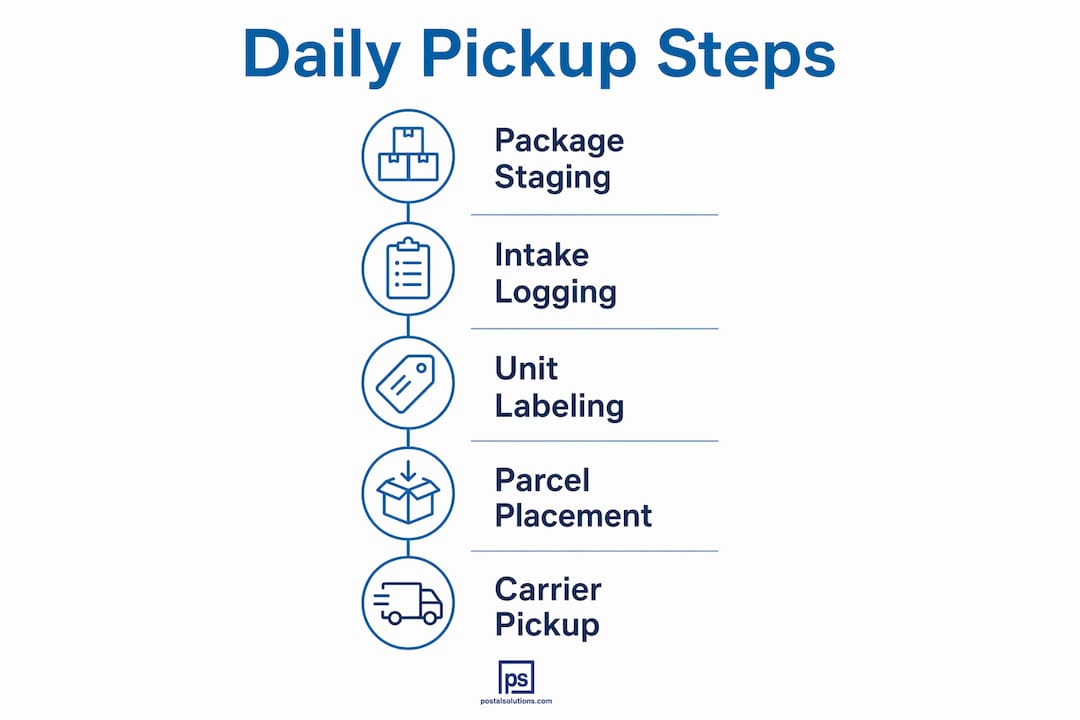
A daily package pickup program is a structured, repeatable operational system — not a locker installation or a policy memo. Its five core components are a fixed daily intake window, a secure holding area, a unit-number labeling standard, an automated resident notification workflow, and a documented exception process for items that fall outside normal handling.
The flow runs in one direction: carrier arrives and stages parcels → staff or a managed organizer logs intake and labels each box with the unit number → parcels are shelved or placed in lockers → residents receive an SMS or email notification → residents pick up within the hold window, or the exception workflow activates. Automated notifications and self-service access have reduced average pickup times to seconds in reported deployments, which means fewer resident calls to the leasing desk.
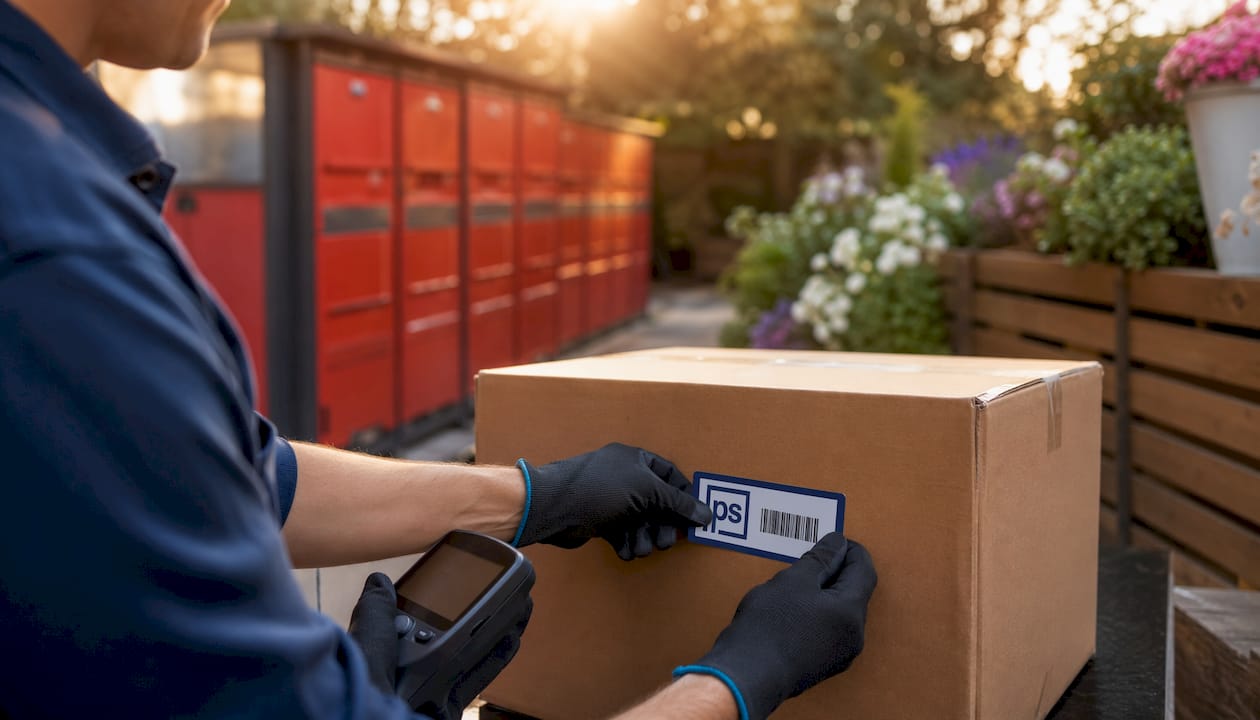
This model differs from ad hoc handling, where staff sort packages whenever time allows, and from locker-only setups that have no daily organizing visit. The program can sit at the leasing desk, with a dedicated concierge, or with an outsourced daily organizer. The key is that someone touches every parcel once per day on a fixed schedule.
How to run daily package pickups: a step-by-step checklist
Consistency is what separates a functioning program from a chronic backlog. Follow this sequence every operating day.
- Set the intake window. Accept carrier deliveries during a defined window (example: 9 AM–12 PM). Post the window at the receiving entrance and on carrier instruction cards.
- Log every parcel at intake. Scan or manually enter each package into your package-room software. Record carrier code, tracking number, and arrival time.
- Label by unit number. Highlight the unit number on the address label in bold marker, or handwrite it directly on the box. Use a consistent format: Unit / Carrier Code / Intake Time (example: “204 / UPS / 10:15”).
- Place oversized and perishable items separately. Oversized parcels go to a designated overflow zone; perishables go to refrigerated storage immediately. Flag both in the software.
- Send resident notification. Push an SMS or email with the carrier name and a photo of the label within 30 minutes of intake. Photo notifications reduce resident confusion and speed pickup.
- Close the daily log. Confirm all parcels are logged, labeled, and shelved before end of shift. Note any exceptions in the exception log.
- Run the weekly audit on day seven. Trace a random sample of parcels, check labeling compliance, review the exception log, and confirm carrier staging compliance.
Pro Tip: Target no more than two property touches per parcel — intake log and placement. Every additional touch adds labor cost and increases misplacement risk.
Properties without a structured system can see four to five staff touches per parcel; at 75 packages per day, this exceeds six hours of daily staff time, as explained in this property management guide.
Written policies and exception workflows your property needs
Reactive decisions made at the front desk cost more than a written policy ever will. The National Apartment Association advises properties to maintain written policies for oversized, perishable, and long-term hold items and to establish exception workflows before problems arise.
Publish these items to residents in your lease addendum or welcome packet:
- Acceptable delivery types: standard parcels, oversized freight, perishables (with refrigerated storage available), and dry cleaning. Exclude hazardous materials.
- Pickup window and hold limit: specify the days and hours residents may retrieve packages and the maximum hold period (commonly 5–7 business days) before return-to-sender.
- Liability statement: clarify that the property accepts packages as a courtesy and is not liable for carrier damage or theft after the hold period.
- Return-to-sender rules: state the trigger (hold period exceeded) and the process (carrier pickup scheduled by staff).
Exception workflows to document separately:
- Oversized items: photograph on arrival, notify resident immediately, flag for pickup within 48 hours, move to overflow after 48 hours.
- Perishables: refrigerate on arrival, notify resident for same-day pickup, dispose after 24 hours if unclaimed.
- Misdelivered or lost parcels: log the discrepancy, notify the resident, file a carrier claim within 24 hours. Review the apartment package handling guide for theft-reduction protocols.
- Carrier non-compliance: issue a pictorial SOP and QR/PIN codes to regular-route drivers. Operators who issue pictorial SOPs to drivers create a compliance audit trail that reduces intake errors during peak periods.
Which tools make daily parcel collection scalable?
Technology reduces manual work, but only when it sits on top of a daily operational process. Must-have features in any package-room software or locker system:
- Carrier intake logging with timestamp and photo capture
- Automated resident notifications via SMS and email
- Unit-labeling and search capability by unit number
- Oversized and perishable tagging with separate hold-status tracking
- Property management system (PMS) integration to push status into the resident portal
Luxer One is one of the most widely deployed locker and package-room platforms in U.S. multifamily. Postal Solutions is the largest Luxer One sales agency in the country, with over 1,200 Luxer One installations across more than 40% of U.S. states. Locker systems provide secure, 24/7 resident access, though fixed compartment limits can create overflow when oversized items arrive. Shelving-based smart package rooms can triple storage capacity for the same footprint, making them a strong option for high-volume properties.
At Stuyvesant Town, an AI-powered smart package room reduced resident wait times from 30 minutes to seconds and cut daily logistics staff from 12 to two. That result came from software plus process, not hardware alone.
When evaluating vendors, require a written answer to: how does your system detect carrier non-compliance, and what is your driver-management workflow? Carrier non-compliance is the most common cause of package system failures.
Should you manage daily pickups in-house or outsource?
The right model depends on four variables: unit count, average daily volume, available staff, and resident expectations.
- In-house works well when daily volume is low (under 30 parcels), staff have consistent availability, and the property has a dedicated package room with software already in place.
- Outsourcing makes sense when volume exceeds staff capacity, leasing teams are spending 4–6 hours per week on package tasks, or the property wants predictable labor costs and a standardized labeling process without adding headcount.
When issuing a statement of work for outsourced services, require these deliverables:
- Daily visit frequency and arrival time window
- Labeling standard (unit number format, marker or printed label)
- Resident notification SLA (within X minutes of intake)
- Carrier training and pictorial SOP distribution
- Weekly audit report with exception log and labeling compliance rate
Ask every vendor candidate to explain their carrier compliance approach. A vendor without a documented driver-management process is a liability at high-volume properties.
KPIs, weekly audits, and measuring ROI
| KPI | What to measure | Target |
|---|---|---|
| Parcels handled per day | Total intake logged daily | Matches expected volume ± 5% |
| Staff hours on package tasks | Time logged per week | Under 2 hours/week with outsourcing |
| Resident pickup rate within 48 hours | % of parcels retrieved in 48 hrs | — |
| Lost or misplaced incidents | Incidents per month | Zero; escalate any occurrence |
| Labeling compliance | % of parcels correctly labeled | — |
Weekly audit checklist: trace three to five random parcels from intake log to shelf, check labeling format on 10% of current inventory, verify carrier staging area is clear, review the exception log for unresolved items, and confirm resident notifications were sent within the SLA window.
ROI calculation: multiply staff hours saved per week by the hourly wage, then annualize. At 4 hours saved per week at $20/hour, that is $4,160 per year in recovered labor. Add complaint resolution time and the amenity value: residents rank package management near on-site gyms in importance, making the program a retention driver, not just an operational fix.
Sample 30–60 day rollout plan
| Week | Activities | Owner | Deliverable |
|---|---|---|---|
| 1–2 | Volume audit, policy draft, space assessment | Property manager | Baseline KPI report, draft policy |
| 3 | Carrier SOP creation, staff training | Leasing team or vendor | Pictorial SOP, training sign-off |
| 4 | Pilot daily intake, resident announcement | All staff | Live intake log, resident email sent |
| 5–6 | Full rollout, daily organizing visits begin | Staff or outsourced organizer | Daily logs, first weekly audit |
| 7 | Audit review, carrier compliance check | Manager or vendor | Audit report, exception log review |
Primary cost drivers: hardware (Luxer One locker or package room), software setup and integration fees, daily labor or outsourced service contract, and ongoing software subscription. For properties pursuing a managed solution, Postal Solutions offers managed package room visits up to six days per week, covering daily organizing, labeling, and weekly audits.
Key takeaways
A daily, low-touch package pickup program built on fixed intake windows, unit-number labeling, automated notifications, and weekly audits is the most reliable way to reduce staff handling time and resident complaints in multifamily housing.
| Point | Details |
|---|---|
| Fix the daily intake window | A defined daily window standardizes carrier staging and limits staff interruptions throughout the day. |
| Label every parcel by unit number | Highlighting or handwriting the unit number at intake is the single highest-impact step for reducing resident confusion. |
| Publish written exception workflows | Document oversized, perishable, and long-hold procedures before problems arise, per NAA best-practice guidance. |
| Measure KPIs from day one | Track parcels per day, pickup rate within 48 hours, and staff hours weekly to build the ROI case. |
| Postal Solutions manages the full program | Postal Solutions offers daily package-room organizing, unit-number labeling, weekly audits, and Luxer One sales and installation across the U.S. |
Why a daily operational model beats a hardware-first approach
The most common mistake property teams make is treating a locker installation as the solution. Hardware is a tool; the program is the solution. Properties that install lockers or package rooms without a daily organizing visit and a labeling standard end up with the same backlog, just in a more expensive box.
What actually produces measurable results is operational discipline: someone arrives daily, labels every parcel by unit, logs exceptions, and runs a weekly audit. That cadence is what keeps residents from calling the leasing desk, what keeps carriers from dumping parcels in the wrong zone, and what gives leadership a defensible ROI number at budget time. Technology accelerates a good process. It cannot replace one.
Postal Solutions has seen this pattern across portfolios of every size, from small conventional communities to large student housing developments. The properties that reduce resident friction and staff overtime are the ones that treat daily organizing as a non-negotiable operational standard, not an add-on.
Postal Solutions manages daily package pickup for multifamily teams
Properties that want a turn-key solution without adding headcount can work directly with Postal Solutions. The managed offering covers daily package-room organizing, unit-number labeling, carrier SOP distribution, and weekly audit reporting — up to six days per week. For properties that need hardware, Postal Solutions sells and installs Luxer One locker systems, package rooms, and refrigerated locker units nationwide, backed by more than 1,200 installations in over 40% of U.S. states.
The practical result: leasing teams stop spending hours per week sorting parcels, residents find their packages faster, and property leadership gets a weekly audit report they can actually use. Schedule a discovery call to get an operations checklist and a managed-service proposal tailored to your property’s volume and layout.
Useful sources and further reading
- National Apartment Association: Package Management Best Practices — written exception workflows, policy templates, and amenity-value research for multifamily operators.
- NAA: How to Effectively Manage Package Acceptance (PDF) — detailed guidance on access-control systems, locker scalability, and resident notification standards.
- Insights by Blueprint: A Framework for Solving Multifamily’s Package Management Problem — volume benchmarks, carrier non-compliance analysis, and locker vs. package-room tradeoffs.
- Multifamily & Affordable Housing Business: What Package Wrangling Is Really Costing Your Team — staff-touch data, Stuyvesant Town case study, and smart package-room ROI.
- MRI Software: Multifamily Data Research on Package Delivery Pain Points — resident amenity rankings and satisfaction data.
- Postal Solutions: Founded in 2016, Postal Solutions is the largest Luxer One sales agency in the U.S., with over 1,200 installations across more than 40% of U.S. states, offering daily package-room management outsourcing for conventional multifamily, student housing, and senior housing communities.
FAQ
How many packages does a typical apartment community receive daily?
A 400-unit urban building receives roughly 187 packages per day on a typical day, with holiday volume climbing to about 208 per day in some reports. Volume scales with unit count, so larger communities need a structured daily intake process from day one.
What is the fastest way to reduce staff time spent on packages?
Limit each parcel to two property touches — intake log and placement — and push automated resident notifications immediately. Properties without a structured system can see four to five staff touches per parcel, which at 75 packages per day exceeds six hours of daily staff time.
When should a property outsource daily package room management?
Outsourcing makes sense when leasing teams are spending more than a few hours per week on package tasks, volume exceeds in-house capacity, or the property wants standardized labeling and weekly audits without adding a full-time staff role. Postal Solutions manages daily package-room organizing and audits for multifamily communities of all sizes.
What should a weekly package room audit include?
Trace a random sample of parcels from the intake log to the shelf, check labeling compliance on a portion of current inventory, verify the carrier staging area is clear, review the exception log for unresolved items, and confirm resident notifications were sent within the agreed SLA window.
Does hardware alone solve the package management problem?
No. Locker and package-room hardware reduces friction for residents, but without a daily organizing visit, a unit-number labeling standard, and a documented exception workflow, backlog and misplacement persist. The operational program is what produces measurable results; hardware supports it.
Recommended
- Apartment Package Management Services | Multifamily Package Room Operations | Postal Solutions
- Package Lockers for Multifamily Properties in 2026 | Postal Solutions
- Apartment Package Handling Guide | Postal Solutions
- Apartment Mail & Package Resources — Guides, Comparisons, Use Cases | Postal Solutions