Holiday Package Surge Management for Property Managers
Holiday Package Surge Management for Property Managers Three actions will stop holiday package chaos in the next 72 hours: designate overflow space today, enforce a 48-hour resident pickup window with automated notifications, and assign a d
Published
Three actions will stop holiday package chaos in the next 72 hours: designate overflow space today, enforce a 48-hour resident pickup window with automated notifications, and assign a dedicated daily package manager, whether in-house or outsourced. U.S. carriers handle more than 2.3 billion packages during the holiday season, with year-over-year growth near 5%. That volume lands hardest on multifamily package rooms in November and December, which consistently account for nearly 20% of annual delivery volume.
TL;DR — Your next 72 hours:
- Designate overflow space. Identify a secondary staging area (unused amenity room, conference space) before volume peaks. Expected outcome: no lobby overflow, no fire-code violations.
- Set and enforce a 48-hour pickup window. Send automated arrival notices and a 24-hour reminder. Expected outcome: faster turnover, fewer packages sitting idle.
- Assign a daily package manager. One person owns intake, labeling, and audits every day. Expected outcome: staff time protected, resident disputes reduced.
Postal Solutions has managed package-room operations since 2016 and has sold and installed more than 1,200 Luxer One systems across more than 40% of U.S. states. The plan below is built from that field experience.
Table of Contents
- What does your 8-week pre-holiday checklist look like?
- Should you outsource daily package-room management or keep it in-house?
- Which technology actually prevents package-room overload?
- What SOPs keep your package room functional during a surge?
- How do you communicate pickup expectations to residents before chaos starts?
- How do you reduce theft and limit liability during peak volume?
- Sample 8-week implementation timeline you can copy
- Key Takeaways
- A note from the field: Postal Solutions’ operational view
- Postal Solutions is ready for your next holiday peak
- Useful sources and further reading
- FAQ
What does your 8-week pre-holiday checklist look like?
Start planning 6–8 weeks before peak. Work backward from Thanksgiving week and assign each task an owner.
Weeks 7–8 (now):
- Pull last year’s delivery logs; identify your peak days and highest-volume carriers.
- Audit current locker or package-room capacity. If utilization already exceeds 80%, activate temporary expansion planning immediately.
- Confirm overflow space and document its location for all staff.
Weeks 5–6:
- Contact carriers (UPS, FedEx, USPS, Amazon Logistics) to share your intake workflow and confirm compliance expectations.
- Order any temporary locker banks or modular shelving needed for overflow.
- Draft resident communication templates (arrival notice, 48-hour reminder, oversized-item alert).
Weeks 3–4:
- Run end-to-end delivery tests: carrier test deliveries, notification triggers, access credential checks. Fix failures now, not during a surge.
- Schedule surge-week staff shifts or confirm outsourced managed-visit coverage.
- Post lobby signage and send residents a holiday package policy notice.
Weeks 1–2:
- Confirm temporary staffing is onboarded and briefed on SOPs.
- Activate overflow space and verify all locker or room access credentials work.
- Brief every team member on escalation rules for unclaimed or oversized items.
Pro Tip: Rotating package duties among leasing staff during peak weeks costs more in lost productivity than hiring a dedicated daily package manager. One person who owns the room every day is faster and more consistent than three people sharing the task.

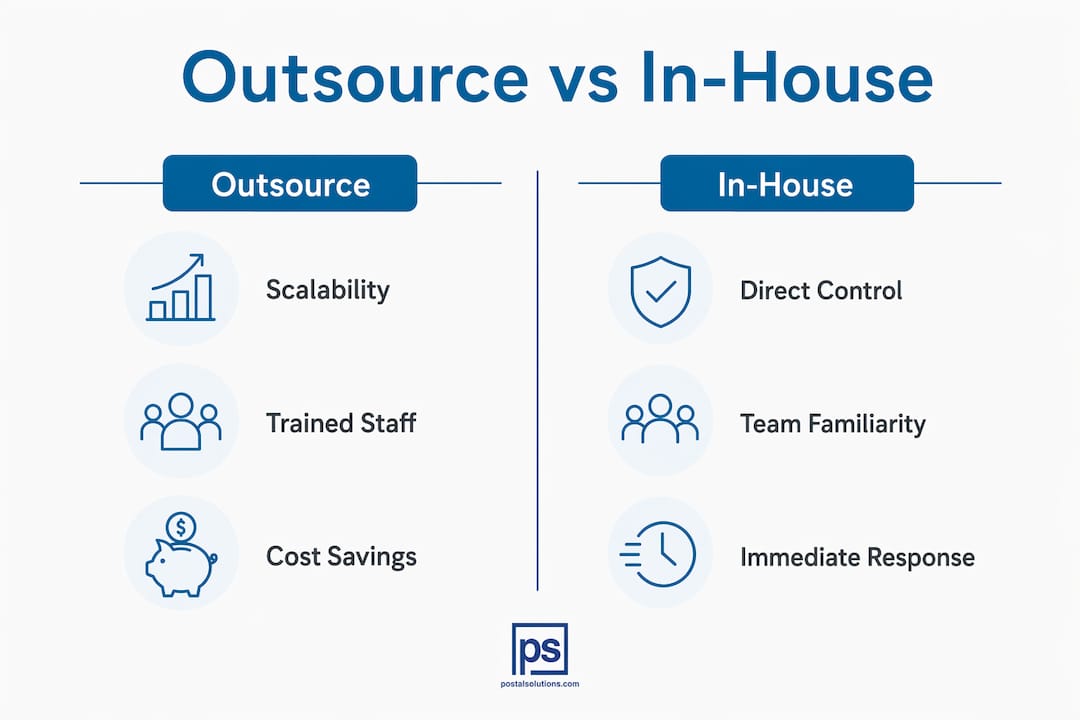
Should you outsource daily package-room management or keep it in-house?
The decision comes down to unit count, daily volume, and staff capacity. Use this table as a starting framework.
| Property Profile | Recommended Approach |
|---|---|
| Under 100 units, low daily volume | In-house with clear SOP and one assigned staff lead |
| 100–300 units, moderate volume | Outsourced daily managed visits or part-time dedicated staff |
| 300+ units, high volume or student housing | Outsourced managed visits, six days per week, with weekly audits |
| Any size with locker/smart-room system | Managed visits to organize, label, and audit alongside the technology |
Outsourcing advantages:
- Frees leasing staff from package duties entirely during peak weeks.
- A 300-unit property can save up to 30 hours per week in staff time by outsourcing package-room handling.
- Consistent daily presence means audits happen on schedule, not when someone has time.
In-house advantages:
- Lower direct cost for smaller properties with predictable volume.
- Staff already know residents, which can speed dispute resolution.
Properties that outsource package-room management report that the real savings are not just in labor hours. They are in the productivity that leasing staff recover for rent collection, maintenance coordination, and resident retention work.
Temporary staffing vendors can supply trained short-term support for surge weeks with quick onboarding into existing SOPs, a practical middle path for properties not ready to commit to a full managed-service contract.
Which technology actually prevents package-room overload?
Smart lockers and smart package rooms solve different problems. Choosing the wrong one for your footprint creates a new bottleneck.
Smart lockers (such as Luxer One) allow carriers to deposit packages directly into secure compartments and trigger automated resident notifications, removing multiple manual steps. Their constraint: fixed compartment sizes mean oversized or irregularly shaped items require a parallel manual process, and locker banks can reach full utilization quickly during peak weeks.
Smart package rooms use open, modular shelving with access-controlled entry and tracking software. Because shelving holds variable-sized packages side by side, smart rooms can effectively triple storage capacity in the same footprint compared to fixed lockers.
Overflow options when fixed capacity is exhausted:
- Temporary modular locker banks (Luxer One’s Flex Locker program integrates with existing systems for 90-day seasonal use).
- Repurposed amenity space converted to a staged overflow room with shelving and signage.
- Hybrid model: lockers for standard parcels, overflow room for oversized items.
Capacity calculation example: A 200-unit property averaging 1.5 deliveries per unit per week during peak = 300 packages per week. With a 48-hour pickup window, you need capacity for roughly 85–90 packages on hand at any time. If your locker bank holds 60 compartments, you need overflow for at least 25–30 packages before peak week begins.
Pro Tip: Technology alone will not prevent overload. Automated systems require standardized processes and clear resident pickup expectations to perform under surge conditions. A Luxer One installation without a daily managed visit is still vulnerable to disorganization when volume spikes.
What SOPs keep your package room functional during a surge?
Intake workflow:
- Designate a carrier staging zone separate from the resident pickup area.
- Log every package on arrival (scan or manual entry into your package management software).
- Mark the unit number on the label or write it directly on the box before placing it in storage.
- Route oversized items immediately to the designated overflow area, not the main room floor.
Storage and labeling:
- Organize packages by unit number, not arrival date. Residents find their packages faster, and audits take half the time.
- Enforce a 48-hour pickup window. Send an arrival notice immediately, a reminder at 24 hours, and a final notice at 48 hours before escalation.
Weekly audit cadence:
| Audit Step | Frequency | Action |
|---|---|---|
| Cross-check digital log vs. physical inventory | Weekly | Flag discrepancies immediately |
| Identify items older than 5–7 days | Weekly | Send escalation notice to resident |
| Photograph unclaimed items | At 7 days | Document for liability records |
| Disposition of unclaimed items | Per policy | Return to sender or hold per lease terms |
Carrier non-compliance — drivers bypassing the intake workflow — was cited by 70% of operators as a top frustration and a primary cause of package system failures. Require carriers to confirm your intake process in writing before peak season.
How do you communicate pickup expectations to residents before chaos starts?
Channel strategy: Use at least two channels per notice. Property app push notification plus email covers most residents; add SMS for high-priority alerts and lobby signage for passive reinforcement.
Template snippets:
- Arrival notice (send immediately): “Your package has arrived and is ready for pickup in [location]. Please collect it within 48 hours to keep the room clear for all residents.”
- 24-hour reminder: “Reminder: your package has been waiting since [date]. Please pick it up today to avoid a late-pickup fee.”
- Oversized-item alert: “An oversized delivery for your unit is staged in [overflow location]. Please pick it up within 24 hours, as space is limited during the holiday period.”
- Holiday policy notice (send in early November): “During November and December, our package room operates under a 48-hour pickup policy. Items not collected within 48 hours may be moved to overflow storage.”
Resident-facing policy language to include in your lease addendum or welcome packet: The community is not liable for packages left unclaimed beyond 72 hours. Residents assume responsibility for ensuring accurate delivery addresses and timely pickup.
How do you reduce theft and limit liability during peak volume?
Physical and digital controls work together. Neither alone is sufficient during a surge.
Physical controls:
- Ensure package room and locker areas have adequate lighting and unobstructed camera coverage of all entry points.
- Restrict carrier access to the package room only, not the broader building.
- Install access-controlled entry (keypad, fob, or QR code) so every entry is logged.
Digital controls and documentation:
- Maintain a timestamped digital log of every package received, including carrier, tracking number, and unit number.
- Photograph packages with visible labels on arrival and again if damage is reported.
- Log every resident pickup with a timestamp.
When evaluating locker or smart-room vendors, ask specifically how their system detects driver bypass, what audit trails exist, and what onsite support they provide when carriers fail to use the intake workflow.
Sample 8-week implementation timeline you can copy
| Week | Tasks | Owner | Decision Point |
|---|---|---|---|
| 8 | Pull delivery data; audit capacity; identify overflow space | Property manager | If utilization >80%, order temp lockers now |
| 7 | Contact carriers; draft resident templates; order overflow equipment | Property manager + leasing | Confirm carrier compliance in writing |
| 6 | Run end-to-end system tests; finalize staff schedule | Maintenance + leasing lead | If tests fail, escalate to vendor immediately |
| 5 | Send holiday policy notice to all residents | Leasing team | — |
| 4 | Confirm outsourced managed visits or temp staffing onboarding | Property manager | If staffing gap, activate temp vendor |
| 3 | Post lobby signage; brief all staff on SOPs and escalation rules | All staff | — |
| 2 | Activate overflow space; verify all access credentials | Maintenance | If credentials fail, fix before week 1 |
| 1 (peak week) | Daily audits; overflow monitoring; carrier reminders | Daily package manager | If volume exceeds forecast by >20%, activate contingency overflow |
Peak-week checklist:
- Confirm overflow space is staged and labeled.
- Verify all locker and room access credentials are active.
- Send residents a peak-week reminder about the 48-hour pickup policy.
- Brief carriers on your intake workflow the morning of the first high-volume day.
- Run a physical-to-digital audit at the end of each day during peak week.
Contingency trigger: If daily package volume exceeds your forecast by more than 20% for two consecutive days, activate your secondary overflow space and notify residents of temporary extended pickup windows.
Key Takeaways
Effective holiday package surge management requires a dedicated daily package manager, enforced pickup windows, and capacity planning that starts 6–8 weeks before peak, not the week deliveries arrive.
| Point | Details |
|---|---|
| Start 6–8 weeks early | Review delivery data, audit capacity, and contact carriers before volume spikes. |
| Enforce a 48-hour pickup window | Automated notifications at arrival and 24 hours reduce idle packages and free up room space. |
| Outsourcing saves real staff time | A 300-unit property can recover up to 30 hours per week by outsourcing package-room management. |
| Technology needs process support | Luxer One lockers and smart package rooms underperform without daily organization and weekly audits. |
| Postal Solutions manages the full cycle | Postal Solutions offers daily managed package-room visits, weekly audits, and Luxer One sales and installation nationwide. |
A note from the field: Postal Solutions’ operational view
The most consistent mistake Postal Solutions sees at multifamily properties is treating the holiday surge as a temporary inconvenience rather than a recurring logistics event that demands a permanent operational response. Properties that install a Luxer One system and then leave it unmanaged during peak weeks still end up with disorganized rooms, frustrated residents, and staff pulled away from leasing work to sort packages.
Postal Solutions was founded in 2016 and has spent nearly a decade managing package-room operations across conventional multifamily, student housing, and senior housing communities. As the largest Luxer One sales agency in the country, with more than 1,200 installations across more than 40% of U.S. states, the pattern is clear: technology and managed operations together outperform either alone. A daily managed package-room visit that includes labeling, organizing by unit number, and completing weekly audits is what keeps a Luxer One system performing at capacity instead of becoming a second problem to manage.
The field insight most managers miss: during peak weeks, the optimal approach is a dedicated package manager who arrives before the first carrier wave of the day, not after the room is already in disorder. That single scheduling adjustment, arriving before deliveries rather than after, reduces the time needed to restore order by more than half.
Postal Solutions is ready for your next holiday peak
Managing a holiday package surge without a dedicated daily operation is the operational equivalent of paying twice: once in staff payroll diverted from leasing work, and again in the resident satisfaction costs that follow disorganized rooms and lost packages. Postal Solutions manages package room outsourcing for multifamily communities of all sizes, from conventional apartments to student housing and senior living. The service includes daily managed visits, unit-number labeling, weekly physical-to-digital audits, and full Luxer One system sales and installation for properties that need a hardware upgrade alongside the managed service.
For properties that already own a Luxer One system, Postal Solutions integrates directly with existing software to keep the room organized and current, six days per week. For properties starting from scratch, Postal Solutions can scope, sell, install, and manage the full solution. Contact Postal Solutions at postalsolutions.com to discuss your property’s volume, layout, and timeline before the next peak season arrives.
Useful sources and further reading
- Luxer One Holiday Delivery Survival Guide — Best for: locker capacity planning, overflow options, and seasonal expansion programs like Flex Locker.
- Smiota: Preparing Multifamily Properties for Holiday Delivery Peaks — Best for: pre-peak timelines, end-to-end testing protocols, and audit workflow templates.
- Blueprint: A Framework for Solving Multifamily’s Package Management Problem — Best for: carrier compliance evaluation criteria and smart-room spatial efficiency data.
- Multi-Housing News: How to Best Handle Package Deliveries — Best for: outsourcing ROI benchmarks and temporary overflow solutions.
- BGSF: Preparing Your Multifamily Property for the Holiday Delivery Surge — Best for: temporary staffing options and onboarding timelines for surge-week coverage.
Use these sources to populate your KPI dashboards, build vendor RFP criteria, and validate capacity assumptions before committing to a technology or staffing solution.
FAQ
How early should property managers start holiday package planning?
Start 6–8 weeks before peak, which means early October for Thanksgiving and November 1 for the December surge. That lead time allows for carrier outreach, capacity audits, and end-to-end system testing before volume arrives.
What is the recommended resident pickup window during peak season?
A 48-hour pickup window is the standard for multifamily communities during holiday surges. Send an arrival notice immediately and a reminder at 24 hours to keep turnover fast and room capacity available.
When does outsourcing package-room management make financial sense?
Outsourcing typically makes sense at 100 units or more, or any property where staff are spending more than a few hours per week on package duties. A 300-unit property can recover up to 30 hours per week in staff time, which more than offsets the cost of a managed daily visit.
How does Postal Solutions support holiday package surge management?
Postal Solutions manages daily package-room visits, weekly audits, and unit-number labeling for multifamily communities, and sells and installs Luxer One locker and package-room systems nationwide. Properties can engage Postal Solutions for managed operations alone, hardware alone, or both together.
What triggers a contingency overflow plan during peak weeks?
Activate your contingency overflow plan when daily package volume exceeds your forecast by more than 20% for two consecutive days. Pre-stage a secondary overflow area before peak week so activation requires no setup time when the trigger is hit.
Recommended
- Managed Package Room Visits: Top Strategies for Property Managers | Postal Solutions
- Package Room Management | Daily Services for Apartments & Student Housing | Postal Solutions
- Meet Package Demand for Metro Apartment Renters | Postal Solutions
- Resident Package Complaints: A 2026 Guide for Property Managers | Postal Solutions