USPS Mail Management for Multifamily Housing: 2026 Guide
Master USPS mail management for multifamily housing with our 2026 guide. Enhance delivery processes and operational efficiency today!
Published

USPS mail management is the systematic process of organizing, tracking, and overseeing mail and package delivery in multifamily properties using USPS-approved mailbox systems, automation, and resident communication workflows. A typical 300-unit high-rise processes up to 20,000 packages annually. That volume makes ad hoc handling impossible. Property managers who rely on compliant infrastructure, specifically USPS STD-4C mailboxes and cluster box units (CBUs), combined with automated package logging and resident notifications, consistently outperform those who manage mail manually. This guide covers the standards, technologies, and operational policies you need to run a tight mailroom in 2026.
What are USPS mailbox standards for multifamily housing?
USPS STD-4C is the federal standard governing centralized mailbox installations in multifamily properties. It took effect in october 2006 and applies to all new construction and major renovations. STD-4C mandates one parcel locker for every five tenant compartments, minimum compartment dimensions, and specific mounting height requirements. These are not suggestions. Noncompliance leads to failed USPS inspections and possible delivery suspension.
Wall-mounted 4C units vs. freestanding CBUs
Wall-mounted 4C mailboxes install inside building lobbies or mail rooms. Freestanding cluster box units serve outdoor, curbside, or covered walkway locations. Both formats must meet STD-4C specifications, but CBUs are an alternative for properties where indoor installation is impractical. The key difference is approval pathway. Recessed 4C mailboxes are pre-approved by USPS. Surface-mounted and freestanding units require local postmaster sign-off before you order equipment.
Parcel locker requirements at a glance
| Requirement | Standard |
|---|---|
| Parcel locker ratio | 1 locker per 5 mail compartments |
| Standard effective date | October 2006 (STD-4C) |
| Parcel lockers mandatory since | July 2020 |
| Older standard (4B) | No longer accepted for new installs |
| Recessed 4C units | Pre-approved by USPS |
| Surface-mounted / freestanding | Require local postmaster approval |
Key compliance points every property manager must know:
- Parcel lockers are mandatory since July 2020. They are no longer optional in new or replacement installations.
- Mounting height requirements apply to both the mail compartments and the parcel locker doors.
- USPS Mailbox Improvement Week reinforces placement requirements and safe carrier access as ongoing compliance priorities.
- Coordinate with your local postmaster before purchasing any equipment. District-specific approval steps vary.
- Replacing aging 4B mailboxes requires a full upgrade to STD-4C. Partial retrofits do not satisfy the standard.
Pro Tip: Contact your local USPS postmaster before you finalize any mailbox order. Approval timelines vary by district, and ordering non-approved equipment creates costly delays.
How can automation improve USPS mail management in multifamily buildings?
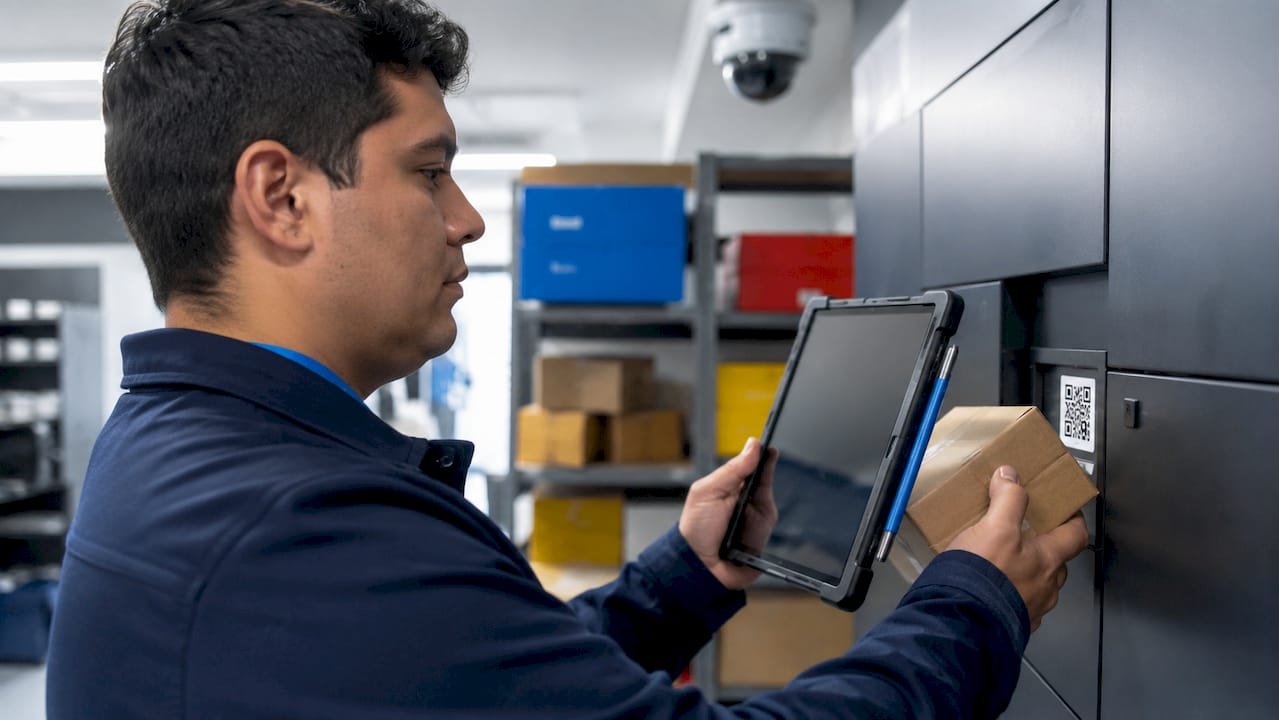
Automation closes the gap between high package volume and limited staff capacity. Computer vision technology automatically logs each delivered package with a timestamp and location, creating an auditable chain of custody without manual data entry. That record matters when a resident claims a package was never received. The log proves exactly when and where it arrived.
Automated resident notifications
Notification systems send residents an alert the moment a package is logged. Automated reminders at 48 and 96 hours after delivery reduce package accumulation and cut the number of “where is my package?” calls to the leasing office. Fewer inquiries means staff spend less time at the front desk and more time on higher-value tasks.
Access control and security
Access-controlled package rooms admit only authorized couriers, residents, and staff. This setup reduces the need for on-site supervision during delivery windows. Automated notifications and access control together reduce resident dependency on staff for package retrieval, which directly improves the resident experience. Presence sensors and computer vision also contribute to a defensible chain of custody that reduces liability in dispute situations.
Key automation capabilities to prioritize:
- Computer vision parcel logging with timestamp and unit-level location data
- Automated text and email alerts at delivery, 48 hours, and 96 hours post-delivery
- Access control integration for couriers, residents, and authorized staff
- Package volume tracking to identify peak delivery days and plan staffing accordingly
- Weekly audit reporting to catch discrepancies before they become complaints
Pro Tip: Track package turnover rates weekly. If average pickup time exceeds three days, your notification cadence or pickup policy needs adjustment before the backlog compounds.
What operational best practices ensure effective package handling?
A three-to-five-day collection window is the industry standard for multifamily package rooms. Set this policy in the lease and enforce it with automated reminders. Without a defined window, packages accumulate until the room becomes unusable, which frustrates residents and creates a security risk.
Effective package room operations follow a clear sequence:
- Log every package on arrival. Use computer vision or manual entry to record carrier, unit number, and timestamp. This creates the chain of custody record you need if a dispute arises.
- Send an immediate delivery notification. Text or email the resident as soon as the package is logged. Do not wait until the end of the day.
- Send a 48-hour reminder. Residents miss notifications. A follow-up reminder at two days significantly increases pickup rates before packages pile up.
- Send a 96-hour final notice. Flag packages that have not been retrieved after four days. Escalate to a phone call or leasing office visit if needed.
- Document chain of custody for disputed packages. Keep a written or digital record of every handoff, including the resident signature at pickup. This record resolves most disputes without escalation.
- Conduct weekly audits. Cross-reference logged packages against current inventory. Discrepancies caught early are far easier to resolve than those discovered weeks later.
Pro Tip: Include your package pickup policy in the lease agreement and in the move-in welcome packet. Residents who understand the policy upfront generate fewer complaints and retrieve packages faster.
Mailroom security requires access control at the room level, not just the building level. Only authorized couriers, residents picking up their own packages, and designated staff should enter the package room. This boundary reduces theft and eliminates the need for staff to supervise every delivery. For managed mailroom operations, the access log also provides a complete record of who entered the room and when.
How to plan and implement a mail management solution for your property
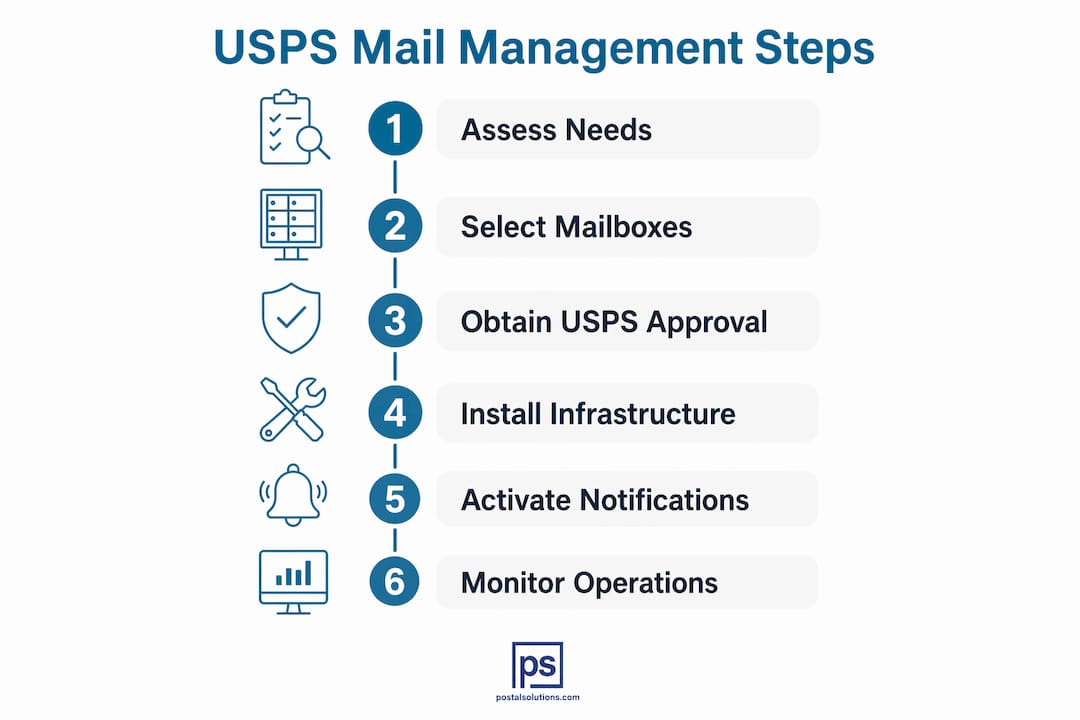
Planning starts with a conversation with your local USPS postmaster. STD-4C installation requires postmaster coordination to confirm delivery type and district-specific approval steps before you order any equipment. Skip this step and you risk purchasing hardware that USPS will not approve for your location.
After postmaster coordination, evaluate your property’s specific needs:
- Unit count and package volume. A 100-unit property and a 400-unit property have fundamentally different infrastructure needs. Calculate your expected annual package volume before selecting mailbox and locker configurations.
- Indoor vs. outdoor installation. Wall-mounted 4C units work for lobbies and mail rooms. CBUs serve outdoor or covered walkway locations. Your building layout determines which format is viable.
- Parcel locker count. Apply the STD-4C ratio of one locker per five compartments as your baseline. Properties with high e-commerce usage may need to exceed this minimum.
- Integration with existing software. If your property already uses package room management software, confirm that any new hardware or locker system connects to it. Gaps in integration create manual workarounds that defeat the purpose of automation.
- Resident communication setup. Define your notification channels (text, email, or both) and configure automated reminders before the system goes live. Residents should receive their first notification on day one of operation.
A phased rollout reduces disruption. Install and test the mailbox infrastructure first. Then activate the notification system and access control. Finally, run a 30-day audit period to identify gaps in volume handling or resident communication before declaring the system fully operational. For properties managing high-volume package deliveries, a phased approach also gives staff time to build consistent habits before volume peaks.
What common challenges arise in USPS mail management?
Package pile-up is the most frequent problem in multifamily mailrooms. It happens when pickup policies are unclear, reminders are absent, or the package room lacks enough locker capacity. The fix is a combination of policy enforcement and automated follow-up. Properties that implement the 48-hour and 96-hour reminder sequence see measurably faster package turnover.
Resident complaints about missing packages almost always trace back to a gap in chain of custody documentation. Noncompliance with mailbox regulations and poor documentation practices both create liability. A complete log from delivery to pickup resolves most disputes without escalation. Without that log, the property has no defense.
USPS delivery variances create a different category of challenge. Carriers sometimes leave packages in non-standard locations, especially during peak seasons. Coordinate with your local postmaster to establish clear delivery protocols for your property. Put those protocols in writing and share them with your building’s USPS carrier contact.
Property renovations that involve mailbox replacement require full STD-4C compliance. You cannot simply swap old 4B units for similar hardware. The renovation triggers a full upgrade requirement, including the mandatory parcel locker ratio. Plan the compliance upgrade into your renovation budget from the start, not as an afterthought.
Technology prevents many of these bottlenecks before they develop. Volume tracking data shows you which days generate the most deliveries, so you can schedule package room organization visits accordingly. Weekly audit reports catch discrepancies early. Access logs document every entry and exit. Together, these tools shift mailroom management from reactive to predictable. For a detailed look at apartment mailroom workflows, the operational principles apply across all multifamily property types.
Key Takeaways
Effective USPS mail management in multifamily housing requires STD-4C compliant infrastructure, automated package tracking, clear pickup policies, and consistent resident communication to prevent backlogs and maintain compliance.
| Point | Details |
|---|---|
| STD-4C compliance is mandatory | All new and replacement mailbox installations must meet USPS STD-4C standards, including one parcel locker per five compartments. |
| Automation reduces staff workload | Computer vision logging and automated reminders at 48 and 96 hours cut resident inquiries and prevent package accumulation. |
| Collection window policy matters | A three-to-five-day pickup window enforced by automated notifications is the most effective way to control package room capacity. |
| Postmaster coordination comes first | Confirm delivery type and district approval requirements with your local USPS postmaster before ordering any mailbox equipment. |
| Documentation prevents disputes | A complete chain of custody record from delivery to pickup resolves resident complaints without escalation. |
What I have learned after years of managing multifamily mail operations
Property managers consistently underestimate package volume growth. A building that processed 10,000 packages three years ago may be handling 20,000 today, and that number keeps climbing as e-commerce grows. The operators who avoid crisis are the ones who built infrastructure and policies for tomorrow’s volume, not today’s.
The second lesson is that USPS engagement is not a one-time event. Your postmaster contact, your delivery protocols, and your equipment approvals all need periodic review. Carriers change. Delivery patterns shift. A protocol that worked in 2023 may create friction in 2026 if no one has revisited it.
Automation’s biggest benefit is not labor savings. It is transparency. When residents can see that their package was logged at 2:14 PM on a Tuesday, they trust the system. That trust reduces complaints, reduces confrontations at the leasing office, and improves overall resident satisfaction scores. The technology pays for itself in staff time recovered and resident goodwill preserved.
Balancing security and convenience is the hardest part of mailroom design. Lock the room down too tightly and residents stop picking up packages promptly. Make it too accessible and theft becomes a problem. The right answer is access control tied to individual resident credentials, combined with a pickup policy that creates urgency without creating friction.
— Postal Solutions
How Postal Solutions supports multifamily mail and package management
Postal Solutions manages daily package room organization for conventional multifamily, student housing, and senior housing communities across the country. The service includes daily visits to organize the package room, mark unit numbers on packages, and complete weekly audits using your property’s existing package room software. For properties that need a full infrastructure solution, Postal Solutions is the largest Luxer One sales agency in the country, with over 1,200 Luxer One locker systems sold and installed across more than 40% of U.S. states. Properties that want both hardware and ongoing management can combine a Luxer One installation with six-day-per-week managed package room visits. Contact Postal Solutions to discuss the right package room management approach for your property’s size and volume.
FAQ
What is USPS STD-4C and who does it apply to?
USPS STD-4C is the federal standard for centralized mailbox installations in multifamily and commercial properties, effective since october 2006. It applies to all new construction and any property replacing existing mailbox equipment.
How many parcel lockers does my property need?
USPS STD-4C requires one parcel locker for every five tenant mail compartments. Parcel lockers have been mandatory in new installations since July 2020.
What happens if my mailboxes are not USPS-compliant?
Noncompliance results in failed USPS inspections, possible suspension of mail delivery, and resident dissatisfaction. Strict adherence to size, mounting height, and parcel locker ratios is required for uninterrupted service.
How do automated reminders reduce package accumulation?
Automated alerts sent at delivery, 48 hours, and 96 hours after delivery prompt residents to retrieve packages before they pile up. This reduces the need for staff follow-up and keeps the package room functional during peak delivery periods.
Do I need USPS approval before installing new mailboxes?
Yes. Recessed 4C mailboxes are pre-approved, but surface-mounted and freestanding units require local postmaster approval before installation. Coordinate with your district postmaster before ordering any equipment.